Exercise 9.21
At what angle should a ray of light be incident on the face of a prism of refracting angle ° so that it just suffers total internal reflection at the other face? The refractive index of the material of the prism is 1.524.
NCERT’s answer
If the refracted ray in the prism is incident on the second face at the critical angle \(\displaystyle i_{c}\), the angle of refraction r at the first face is ($\displaystyle 60$°-\(\displaystyle i_{c}\)). Now, \(\displaystyle i_{c}\)= \(\displaystyle sin^{-1}\) ($\displaystyle 1$/$\displaystyle 1.524$) ~ $\displaystyle 41$° Therefore, r = $\displaystyle 19$° sin i = $\displaystyle 0.4962$; i ~ $\displaystyle 30$°
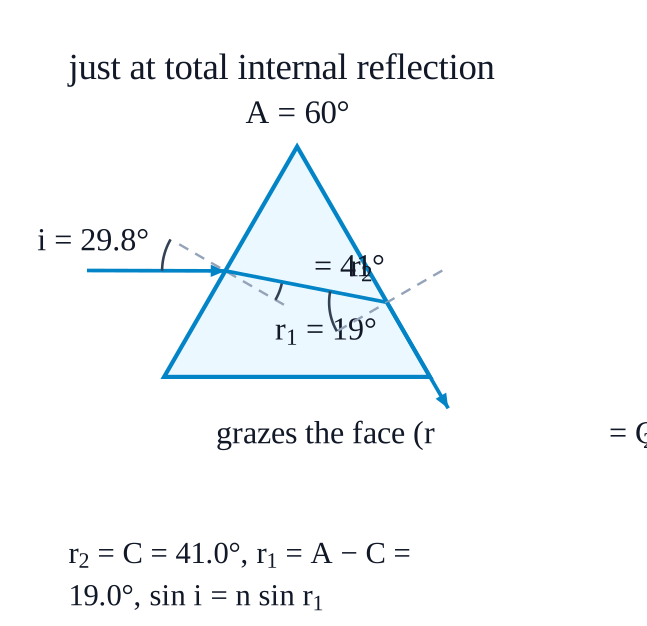 For the ray to just suffer total internal reflection at the second face, the angle of refraction there equals the critical angle: \(\displaystyle r_2=C\), where
\[\sin C=\frac{1}{n}=\frac{1}{1.524}=0.6562\ \Rightarrow\ C=41.0^\circ\]
For a prism of refracting angle \(\displaystyle A=60^\circ\): \(\displaystyle r_1+r_2=A\), so
\[r_1=A-C=60^\circ-41.0^\circ=19.0^\circ\]
Applying Snell's law at the first face (air to glass), \(\displaystyle \sin i=n\sin r_1\):
\[\sin i=1.524\times\sin(19.0^\circ)=1.524\times0.3256=0.4962\]
\[i=\arcsin(0.4962)\approx\mathbf{29.8^\circ}\]
The ray must be incident at about \(\displaystyle 29.8^\circ\) to the normal on the first face.
For the ray to just suffer total internal reflection at the second face, the angle of refraction there equals the critical angle: \(\displaystyle r_2=C\), where
\[\sin C=\frac{1}{n}=\frac{1}{1.524}=0.6562\ \Rightarrow\ C=41.0^\circ\]
For a prism of refracting angle \(\displaystyle A=60^\circ\): \(\displaystyle r_1+r_2=A\), so
\[r_1=A-C=60^\circ-41.0^\circ=19.0^\circ\]
Applying Snell's law at the first face (air to glass), \(\displaystyle \sin i=n\sin r_1\):
\[\sin i=1.524\times\sin(19.0^\circ)=1.524\times0.3256=0.4962\]
\[i=\arcsin(0.4962)\approx\mathbf{29.8^\circ}\]
The ray must be incident at about \(\displaystyle 29.8^\circ\) to the normal on the first face.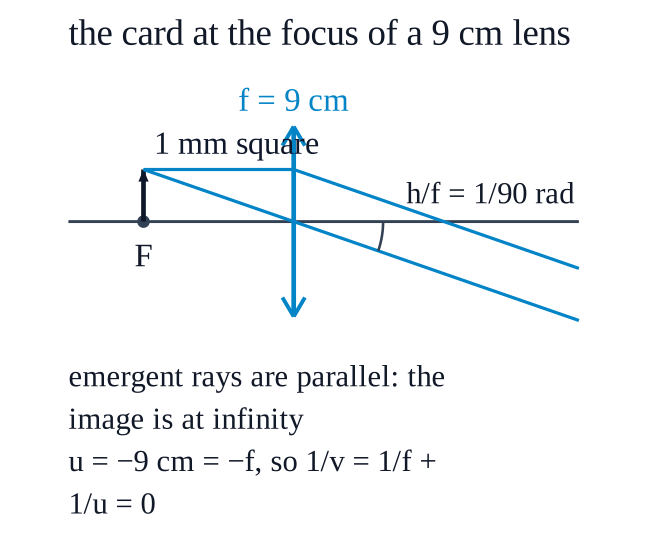 Principle: thin-lens formula \(\displaystyle \dfrac{1}{v}-\dfrac{1}{u}=\dfrac{1}{f}\), with the lens held close to the eye so the object distance equals the stated viewing distance.Here \(\displaystyle u=-9\ \mathrm{cm}\) (object $\displaystyle 9$ cm from the lens) and \(\displaystyle f=+9\ \mathrm{cm}\) (converging lens).\[\frac{1}{v}=\frac{1}{f}+\frac{1}{u}=\frac{1}{9}+\frac{1}{-9}=0 \;\Rightarrow\; v\to\infty\](a) Because the card is exactly at the focal point, the rays emerging from the lens are parallel and the (virtual) image is thrown to infinity. The linear magnification \(\displaystyle m=v/u\) therefore has no finite value — it grows without bound as \(\displaystyle u\to f\). Consequently no finite area can be quoted for the image of a square in this configuration; the image is angularly, not linearly, well defined.(b) With the image at infinity this is the "normal adjustment" of a simple magnifier, for which
\[\text{MP}=\frac{D}{f}=\frac{25\ \mathrm{cm}}{9\ \mathrm{cm}}\approx\mathbf{2.8}\]
(taking the least distance of distinct vision \(\displaystyle D=25\ \mathrm{cm}\)).(c) No. The linear magnification in (a) is undefined/unbounded, while the magnifying power in (b) is a finite number (≈$\displaystyle 2.8$). This is the sharpest possible illustration that magnification (ratio of image size to object size) and magnifying power (ratio of the angle the image subtends to the angle the object would subtend at the near point) are different quantities — they need not even be comparable, let alone equal, unless the image happens to form exactly at the near point \(\displaystyle D\).
Principle: thin-lens formula \(\displaystyle \dfrac{1}{v}-\dfrac{1}{u}=\dfrac{1}{f}\), with the lens held close to the eye so the object distance equals the stated viewing distance.Here \(\displaystyle u=-9\ \mathrm{cm}\) (object $\displaystyle 9$ cm from the lens) and \(\displaystyle f=+9\ \mathrm{cm}\) (converging lens).\[\frac{1}{v}=\frac{1}{f}+\frac{1}{u}=\frac{1}{9}+\frac{1}{-9}=0 \;\Rightarrow\; v\to\infty\](a) Because the card is exactly at the focal point, the rays emerging from the lens are parallel and the (virtual) image is thrown to infinity. The linear magnification \(\displaystyle m=v/u\) therefore has no finite value — it grows without bound as \(\displaystyle u\to f\). Consequently no finite area can be quoted for the image of a square in this configuration; the image is angularly, not linearly, well defined.(b) With the image at infinity this is the "normal adjustment" of a simple magnifier, for which
\[\text{MP}=\frac{D}{f}=\frac{25\ \mathrm{cm}}{9\ \mathrm{cm}}\approx\mathbf{2.8}\]
(taking the least distance of distinct vision \(\displaystyle D=25\ \mathrm{cm}\)).(c) No. The linear magnification in (a) is undefined/unbounded, while the magnifying power in (b) is a finite number (≈$\displaystyle 2.8$). This is the sharpest possible illustration that magnification (ratio of image size to object size) and magnifying power (ratio of the angle the image subtends to the angle the object would subtend at the near point) are different quantities — they need not even be comparable, let alone equal, unless the image happens to form exactly at the near point \(\displaystyle D\).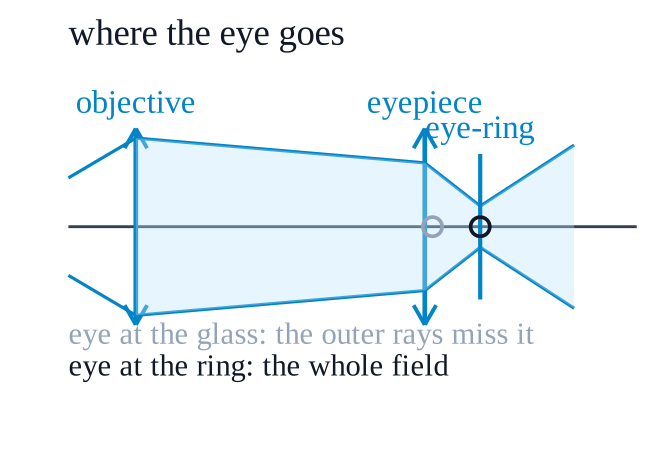 (a) The angle at the eye is unchanged, but the magnifying glass lets that angle be produced by an object held much closer than the near point \(\displaystyle D\) — closer than the eye alone could ever focus on. Without the lens the object cannot be brought nearer than \(\displaystyle D=25\ \mathrm{cm}\) and still be seen sharply; with the lens it can be held near the focal point (a few cm away) while the eye still sees a sharp virtual image. The "angular magnification" is the gain in subtended angle relative to viewing the same object unaided at the near point — the lens is what makes it legal to bring the object in that close in the first place.(b) Yes, it changes, though only slightly for a small shift. With the object and lens fixed, the image position is fixed; moving the eye back by a distance \(\displaystyle x\) increases the eye-to-image distance to \(\displaystyle |v|+x\), so the angle subtended by the image, \(\displaystyle h'/(|v|+x)\), decreases, and hence \(\displaystyle \text{MP}=m\,D/(|v|+x)\) decreases as the eye is moved away from the lens.(c) Because \(\displaystyle \text{MP}=D/f\) demands an ever smaller, more strongly curved lens as \(\displaystyle f\) shrinks. Such lenses suffer severe spherical and chromatic aberration, and become mechanically hard to grind and hold close to the eye, so image quality collapses well before the formula's magnification could be realised — in practice a simple magnifier is limited to roughly $\displaystyle 8$–10X.(d) The overall magnifying power of a compound microscope is (magnitude) \(\displaystyle M\approx \dfrac{L}{f_o}\left(1+\dfrac{D}{f_e}\right)\), inversely proportional to both focal lengths. A short \(\displaystyle f_o\) lets the objective form a strongly magnified real image close to the eyepiece, and a short \(\displaystyle f_e\) lets the eyepiece then apply a large further angular magnification to that image; both are needed together to reach useful overall magnification.(e) All the light rays collected by the objective and passed on by the eyepiece cross through a small circular region just outside the eyepiece called the eye-ring (exit pupil) — this is where the image-forming beam is narrowest. Placing the eye elsewhere (e.g. right against the eyepiece lens) misses part of this beam and loses field of view/brightness. The eye should be positioned exactly at the eye-ring, a short distance behind the eyepiece — of the order of the eyepiece's own focal length (typically a few mm to about \(\displaystyle f_e\)) — for the widest, brightest view.
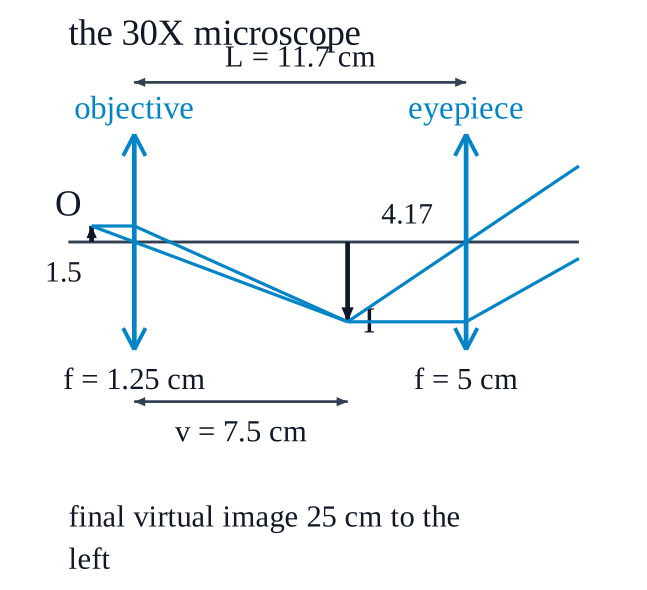 Principle: total magnifying power of a compound microscope \(\displaystyle =\) (linear magnification of objective) \(\displaystyle \times\) (angular magnification of eyepiece, image at near point).Eyepiece (\(\displaystyle f_e=5\ \mathrm{cm}\)) at maximum magnifying power (image at \(\displaystyle D=25\ \mathrm{cm}\)):
\[\text{MP}_e=1+\frac{D}{f_e}=1+\frac{25}{5}=6\]Required objective magnification:
\[m_o=\frac{\text{MP}_{\text{total}}}{\text{MP}_e}=\frac{30}{6}=5\]Objective (\(\displaystyle f_o=1.25\ \mathrm{cm}\)), real inverted image so \(\displaystyle v_o=-5u_o\):
\[\frac{1}{-5u_o}-\frac{1}{u_o}=\frac{1}{1.25}\;\Rightarrow\;\frac{-6/5}{u_o}=0.8\;\Rightarrow\;u_o=-1.5\ \mathrm{cm},\quad v_o=7.5\ \mathrm{cm}\]Eyepiece, virtual image at \(\displaystyle v_e=-25\ \mathrm{cm}\):
\[\frac{1}{u_e}=\frac{1}{v_e}-\frac{1}{f_e}=-\frac{1}{25}-\frac{1}{5}=-\frac{6}{25}\;\Rightarrow\;u_e=-\frac{25}{6}\approx-4.17\ \mathrm{cm}\]Set-up: place the object \(\displaystyle \mathbf{1.5\ cm}\) in front of the objective; the objective forms a real, $\displaystyle 5$\(\displaystyle \times\)-magnified image \(\displaystyle 7.5\ \mathrm{cm}\) behind itself, which must fall \(\displaystyle \approx\mathbf{4.17\ cm}\) in front of the eyepiece. So the two lenses should be separated by
\[L=v_o+|u_e|=7.5+\frac{25}{6}=\frac{35}{3}\approx\mathbf{11.7\ cm}\]
Principle: total magnifying power of a compound microscope \(\displaystyle =\) (linear magnification of objective) \(\displaystyle \times\) (angular magnification of eyepiece, image at near point).Eyepiece (\(\displaystyle f_e=5\ \mathrm{cm}\)) at maximum magnifying power (image at \(\displaystyle D=25\ \mathrm{cm}\)):
\[\text{MP}_e=1+\frac{D}{f_e}=1+\frac{25}{5}=6\]Required objective magnification:
\[m_o=\frac{\text{MP}_{\text{total}}}{\text{MP}_e}=\frac{30}{6}=5\]Objective (\(\displaystyle f_o=1.25\ \mathrm{cm}\)), real inverted image so \(\displaystyle v_o=-5u_o\):
\[\frac{1}{-5u_o}-\frac{1}{u_o}=\frac{1}{1.25}\;\Rightarrow\;\frac{-6/5}{u_o}=0.8\;\Rightarrow\;u_o=-1.5\ \mathrm{cm},\quad v_o=7.5\ \mathrm{cm}\]Eyepiece, virtual image at \(\displaystyle v_e=-25\ \mathrm{cm}\):
\[\frac{1}{u_e}=\frac{1}{v_e}-\frac{1}{f_e}=-\frac{1}{25}-\frac{1}{5}=-\frac{6}{25}\;\Rightarrow\;u_e=-\frac{25}{6}\approx-4.17\ \mathrm{cm}\]Set-up: place the object \(\displaystyle \mathbf{1.5\ cm}\) in front of the objective; the objective forms a real, $\displaystyle 5$\(\displaystyle \times\)-magnified image \(\displaystyle 7.5\ \mathrm{cm}\) behind itself, which must fall \(\displaystyle \approx\mathbf{4.17\ cm}\) in front of the eyepiece. So the two lenses should be separated by
\[L=v_o+|u_e|=7.5+\frac{25}{6}=\frac{35}{3}\approx\mathbf{11.7\ cm}\]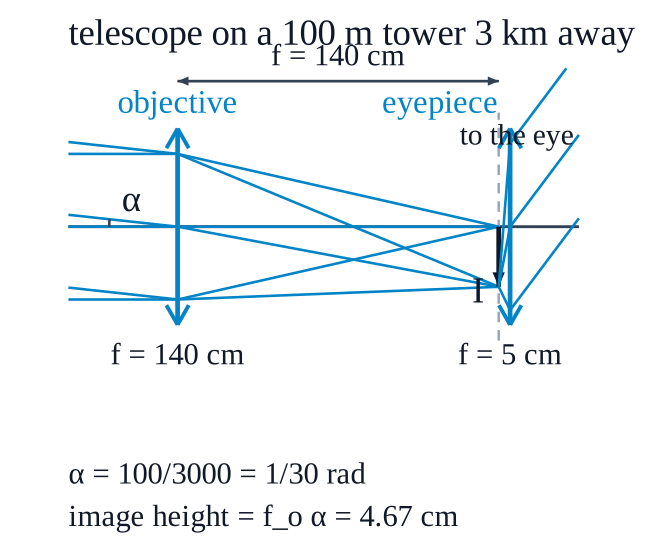 (a) In normal adjustment the objective's image lies at its own focus, which must also be the eyepiece's focus (so the final image is at infinity):
\[L=f_o+f_e=140+5.0=\mathbf{145\ cm}\](b) Tower height $\displaystyle 100$ m at distance $\displaystyle 3$ km subtends a small angle \(\displaystyle \theta=\dfrac{100}{3000}=\dfrac{1}{30}\ \mathrm{rad}\) at the objective. The real image formed by the objective has height
\[h'=f_o\,\theta=140\ \mathrm{cm}\times\frac{1}{30}=\frac{14}{3}\approx\mathbf{4.67\ cm}\]
(inverted).(c) With the final image pulled in to \(\displaystyle D=25\ \mathrm{cm}\), the eyepiece applies its maximum linear magnification, \(\displaystyle 1+D/f_e=1+25/5=6\), to that objective image:
\[h_{\text{final}}=h'\times 6=\frac{14}{3}\times6=\mathbf{28\ cm}\]
(a) In normal adjustment the objective's image lies at its own focus, which must also be the eyepiece's focus (so the final image is at infinity):
\[L=f_o+f_e=140+5.0=\mathbf{145\ cm}\](b) Tower height $\displaystyle 100$ m at distance $\displaystyle 3$ km subtends a small angle \(\displaystyle \theta=\dfrac{100}{3000}=\dfrac{1}{30}\ \mathrm{rad}\) at the objective. The real image formed by the objective has height
\[h'=f_o\,\theta=140\ \mathrm{cm}\times\frac{1}{30}=\frac{14}{3}\approx\mathbf{4.67\ cm}\]
(inverted).(c) With the final image pulled in to \(\displaystyle D=25\ \mathrm{cm}\), the eyepiece applies its maximum linear magnification, \(\displaystyle 1+D/f_e=1+25/5=6\), to that objective image:
\[h_{\text{final}}=h'\times 6=\frac{14}{3}\times6=\mathbf{28\ cm}\] A Cassegrain telescope uses two mirrors as shown in Fig. 9.26. Such a telescope is built with the mirrors 20mm apart. If the radius of curvature of the large mirror is 220mm and the small mirror is 140mm, where will the final image of an object at infinity be?
 Light incident normally on a plane mirror attached to a galvanometer coil retraces backwards as shown in Fig. 9.29. A current in the coil produces a deflection of 3.
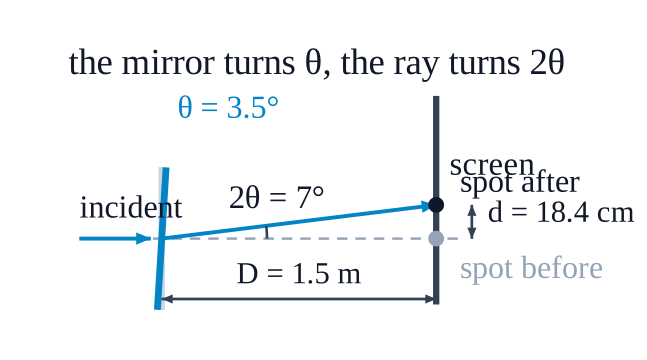 Principle: when a plane mirror rotates through angle \(\displaystyle \theta\), the reflected ray turns through \(\displaystyle 2\theta\) (the incident ray is fixed).Mirror deflection \(\displaystyle \theta=3.5^\circ\), so the reflected ray sweeps \(\displaystyle 2\theta=7^\circ\). On a screen at \(\displaystyle D=1.5\ \mathrm{m}\):
\[d=D\tan(2\theta)=1.5\ \mathrm{m}\times\tan(7^\circ)=1.5\times0.1228\]
\[\boxed{d\approx 0.184\ \mathrm{m}=\mathbf{18.4\ cm}}\]
displaced along the sense of the mirror's rotation.
Principle: when a plane mirror rotates through angle \(\displaystyle \theta\), the reflected ray turns through \(\displaystyle 2\theta\) (the incident ray is fixed).Mirror deflection \(\displaystyle \theta=3.5^\circ\), so the reflected ray sweeps \(\displaystyle 2\theta=7^\circ\). On a screen at \(\displaystyle D=1.5\ \mathrm{m}\):
\[d=D\tan(2\theta)=1.5\ \mathrm{m}\times\tan(7^\circ)=1.5\times0.1228\]
\[\boxed{d\approx 0.184\ \mathrm{m}=\mathbf{18.4\ cm}}\]
displaced along the sense of the mirror's rotation. Figure
 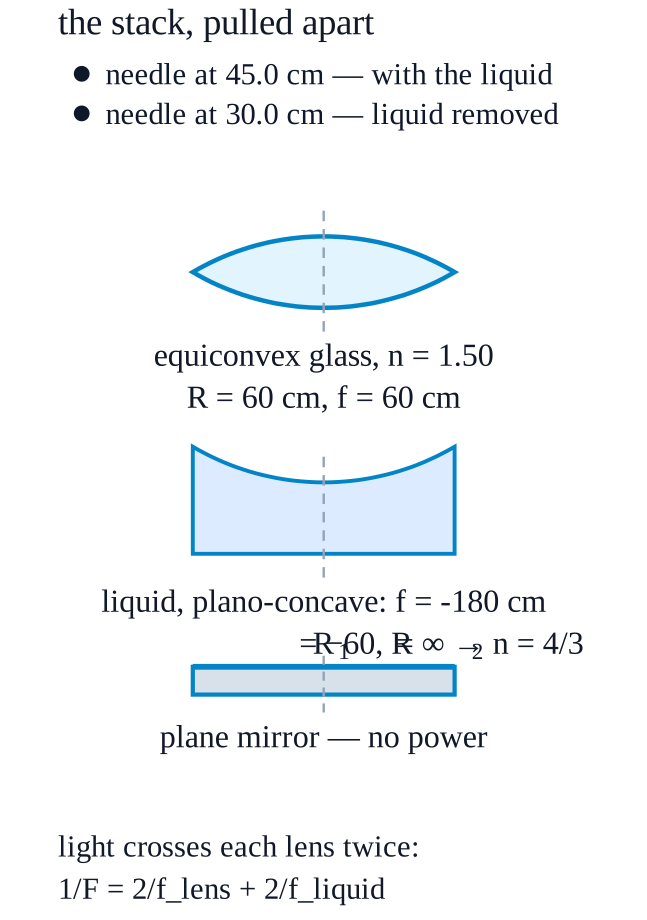 Principle: an equiconvex lens sitting on a liquid layer over a plane mirror forms an auto-collimating (lens+liquid+mirror) system; the needle's image coincides with the needle when the needle sits at the focus of this combined mirror system, so the measured distance directly gives the equivalent focal length \(\displaystyle F\) each time. For two thin elements of focal length \(\displaystyle f_1,f_2\) in contact with a mirror, light crosses each lens twice, so \(\displaystyle \dfrac{1}{F}=\dfrac{2}{f_1}+\dfrac{2}{f_2}\) (a plane mirror contributes zero power).Liquid removed (glass lens + plane mirror only), \(\displaystyle F=30.0\ \mathrm{cm}\):
\[\frac{1}{30}=\frac{2}{f_{\text{lens}}}\;\Rightarrow\;f_{\text{lens}}=60\ \mathrm{cm}\]Radius of curvature of the equiconvex lens (\(\displaystyle n_{\text{glass}}=1.50\), \(\displaystyle R_1=+R,\,R_2=-R\)):
\[\frac{1}{60}=(1.50-1)\left(\frac{1}{R}-\frac{-1}{R}\right)=\frac{0.50\times2}{R}\;\Rightarrow\;R=60\ \mathrm{cm}\]With liquid, \(\displaystyle F=45.0\ \mathrm{cm}\):
\[\frac{1}{45}=2\left(\frac{1}{60}+\frac{1}{f_{\text{liquid}}}\right)\;\Rightarrow\;\frac{1}{f_{\text{liquid}}}=\frac{1}{90}-\frac{1}{60}=-\frac{1}{180}\]
\[f_{\text{liquid}}=-180\ \mathrm{cm}\]The liquid forms a plano-concave lens: its upper surface matches the lens's lower surface (\(\displaystyle R_1=-60\ \mathrm{cm}\)), and its lower surface is flat against the mirror (\(\displaystyle R_2=\infty\)):
\[\frac{1}{-180}=(n_{\text{liq}}-1)\left(\frac{1}{-60}-0\right)\;\Rightarrow\;n_{\text{liq}}-1=\frac{60}{180}=\frac13\]
\[\boxed{n_{\text{liq}}=\frac{4}{3}\approx\mathbf{1.33}}\]
Principle: an equiconvex lens sitting on a liquid layer over a plane mirror forms an auto-collimating (lens+liquid+mirror) system; the needle's image coincides with the needle when the needle sits at the focus of this combined mirror system, so the measured distance directly gives the equivalent focal length \(\displaystyle F\) each time. For two thin elements of focal length \(\displaystyle f_1,f_2\) in contact with a mirror, light crosses each lens twice, so \(\displaystyle \dfrac{1}{F}=\dfrac{2}{f_1}+\dfrac{2}{f_2}\) (a plane mirror contributes zero power).Liquid removed (glass lens + plane mirror only), \(\displaystyle F=30.0\ \mathrm{cm}\):
\[\frac{1}{30}=\frac{2}{f_{\text{lens}}}\;\Rightarrow\;f_{\text{lens}}=60\ \mathrm{cm}\]Radius of curvature of the equiconvex lens (\(\displaystyle n_{\text{glass}}=1.50\), \(\displaystyle R_1=+R,\,R_2=-R\)):
\[\frac{1}{60}=(1.50-1)\left(\frac{1}{R}-\frac{-1}{R}\right)=\frac{0.50\times2}{R}\;\Rightarrow\;R=60\ \mathrm{cm}\]With liquid, \(\displaystyle F=45.0\ \mathrm{cm}\):
\[\frac{1}{45}=2\left(\frac{1}{60}+\frac{1}{f_{\text{liquid}}}\right)\;\Rightarrow\;\frac{1}{f_{\text{liquid}}}=\frac{1}{90}-\frac{1}{60}=-\frac{1}{180}\]
\[f_{\text{liquid}}=-180\ \mathrm{cm}\]The liquid forms a plano-concave lens: its upper surface matches the lens's lower surface (\(\displaystyle R_1=-60\ \mathrm{cm}\)), and its lower surface is flat against the mirror (\(\displaystyle R_2=\infty\)):
\[\frac{1}{-180}=(n_{\text{liq}}-1)\left(\frac{1}{-60}-0\right)\;\Rightarrow\;n_{\text{liq}}-1=\frac{60}{180}=\frac13\]
\[\boxed{n_{\text{liq}}=\frac{4}{3}\approx\mathbf{1.33}}\]