Exercise 9.11
A compound microscope consists of an objective lens of focal length cm and an eyepiece of focal length cm separated by a distance of 15cm. How far from the objective should an object be placed in order to obtain the final image at
(a)
the least distance of distinct vision (25cm), and
(b)
at infinity? What is the magnifying power of the microscope in each case?
NCERT’s answer
(a)
\(\displaystyle v_{e}\) = -$\displaystyle 25$ cm and \(\displaystyle f_{e}\) = $\displaystyle 6.25$ cm give \(\displaystyle u_{e}\) = -$\displaystyle 5$ cm; \(\displaystyle v_{O}\)= ($\displaystyle 15$ - $\displaystyle 5$) cm = $\displaystyle 10$ cm, \(\displaystyle f_{O}\) = \(\displaystyle u_{O}\) = - $\displaystyle 2.5$ cm; Magnifying power = $\displaystyle 20$ (b) \(\displaystyle u_{O}\)= - $\displaystyle 2.59$ cm. Magnifying power = 13.5.
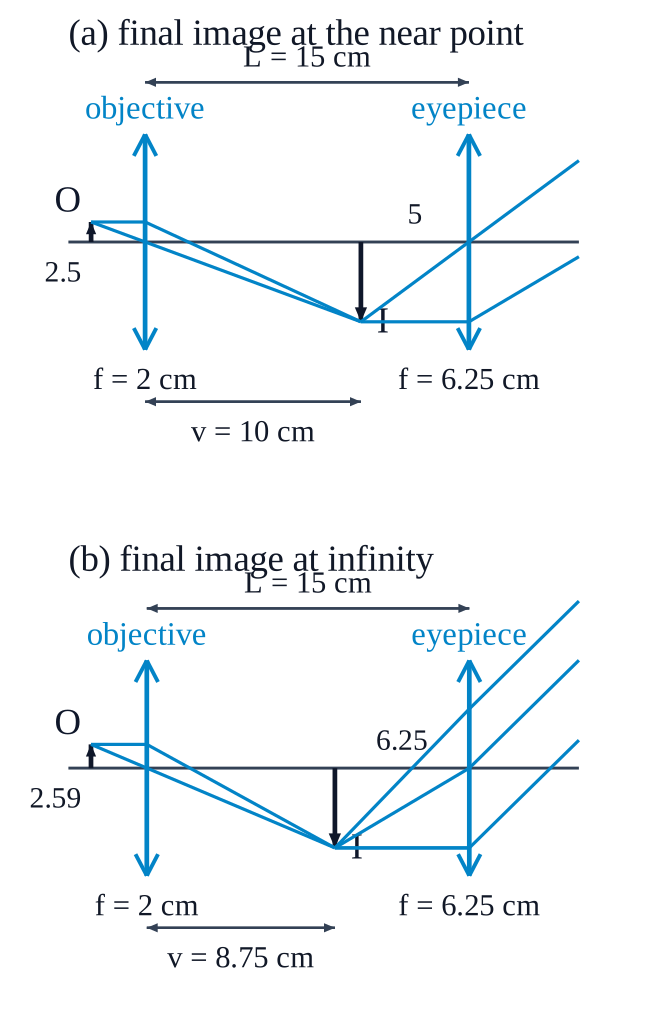 Objective \(\displaystyle f_o=2.0\ \mathrm{cm}\), eyepiece \(\displaystyle f_e=6.25\ \mathrm{cm}\), separation \(\displaystyle L=15\ \mathrm{cm}\).(a) Final image at \(\displaystyle D=25\ \mathrm{cm}\) (near point):For the eyepiece, the object (the objective's image) must form so the eyepiece gives a virtual image at \(\displaystyle v_e=-25\ \mathrm{cm}\):\[\frac{1}{v_e}-\frac{1}{u_e}=\frac{1}{f_e}\ \Rightarrow\ \frac{1}{u_e}=\frac{1}{v_e}-\frac{1}{f_e}=-\frac{1}{25}-\frac{1}{6.25}=-0.04-0.16=-0.20\]\(\displaystyle u_e=-5\ \mathrm{cm}\) — so the objective's real image must form $\displaystyle 5$ cm in front of the eyepiece, i.e. at \(\displaystyle v_o=L-5=15-5=10\ \mathrm{cm}\) from the objective.For the objective:\[\frac{1}{v_o}-\frac{1}{u_o}=\frac{1}{f_o}\ \Rightarrow\ \frac{1}{u_o}=\frac{1}{v_o}-\frac{1}{f_o}=\frac{1}{10}-\frac{1}{2}=-\frac{4}{10}=-0.4\]\(\displaystyle u_o=-2.5\ \mathrm{cm}\).The object must be placed $\displaystyle 2.5$ cm from the objective.Magnifying power \(\displaystyle M=m_o\times m_e\), with \(\displaystyle m_o=\dfrac{v_o}{u_o}=\dfrac{10}{-2.5}=-4\) and \(\displaystyle m_e=1+\dfrac{D}{f_e}=1+\dfrac{25}{6.25}=1+4=5\):\[M=(-4)(5)=-20\]Magnifying power \(\displaystyle =20\) (magnitude), image inverted.(b) Final image at infinity:Now the objective's image must fall exactly at the eyepiece's focus: \(\displaystyle u_e=-f_e=-6.25\ \mathrm{cm}\Rightarrow v_o=L-f_e=15-6.25=8.75\ \mathrm{cm}\).For the objective:\[\frac{1}{u_o}=\frac{1}{v_o}-\frac{1}{f_o}=\frac{1}{8.75}-\frac{1}{2}=0.1143-0.5=-0.3857\]\(\displaystyle u_o=-2.59\ \mathrm{cm}\).The object must be placed \(\displaystyle \approx2.59\ \mathrm{cm}\) from the objective.\(\displaystyle m_o=\dfrac{v_o}{u_o}=\dfrac{8.75}{-2.59}=-3.375\); for image at infinity, \(\displaystyle m_e=\dfrac{D}{f_e}=\dfrac{25}{6.25}=4\):\[M=(-3.375)(4)=-13.5\]Magnifying power \(\displaystyle =13.5\) (magnitude), image inverted.
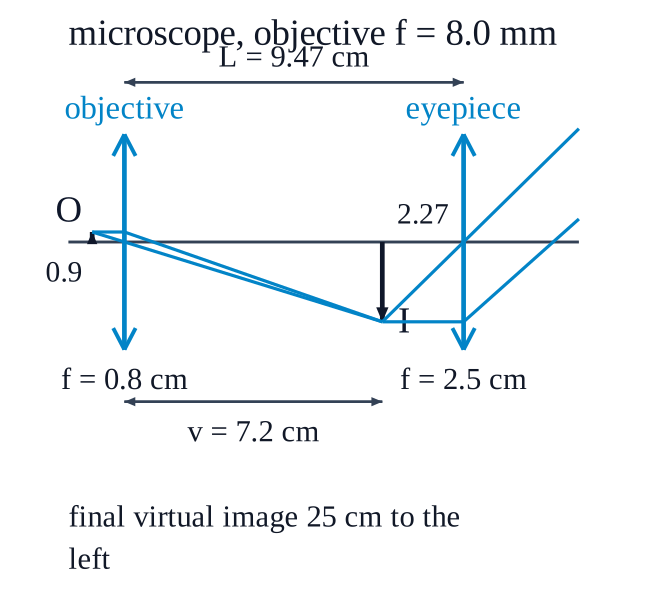 Objective: With \(\displaystyle f_o=8.0\,\mathrm{mm}=0.80\,\mathrm{cm}\) and object distance \(\displaystyle u_o=-0.90\,\mathrm{cm}\) (object is beyond \(\displaystyle f_o\), so a real image forms), the lens formula \(\displaystyle \frac{1}{v}-\frac{1}{u}=\frac{1}{f}\) gives
\[\frac{1}{v_o}=\frac{1}{f_o}+\frac{1}{u_o}=\frac{1}{0.80}-\frac{1}{0.90}=1.25-1.1111=0.1389\,\mathrm{cm^{-1}}\]
\[v_o=7.2\,\mathrm{cm}\]
Objective magnification: \(\displaystyle m_o=\dfrac{v_o}{u_o}=\dfrac{7.2}{-0.90}=-8\) (magnitude $\displaystyle 8$).Eyepiece: it must throw a virtual image at the near point, so \(\displaystyle v_e=-D=-25\,\mathrm{cm}\):
\[\frac{1}{v_e}-\frac{1}{u_e}=\frac{1}{f_e}\ \Rightarrow\ \frac{1}{-25}-\frac{1}{u_e}=\frac{1}{2.5}\]
\[\frac{1}{u_e}=-\frac{1}{25}-\frac{1}{2.5}=-0.44\ \Rightarrow\ u_e=-2.27\,\mathrm{cm}\]
The intermediate image (objective's real image) must therefore sit \(\displaystyle 2.27\,\mathrm{cm}\) in front of the eyepiece.Separation \(\displaystyle L=v_o+|u_e|=7.2+2.27=\mathbf{9.47\,cm}\)Magnifying power \(\displaystyle m_e=1+\dfrac{D}{f_e}=1+\dfrac{25}{2.5}=11\)
\[M=m_o\times m_e=8\times11=\mathbf{88}\]
Objective: With \(\displaystyle f_o=8.0\,\mathrm{mm}=0.80\,\mathrm{cm}\) and object distance \(\displaystyle u_o=-0.90\,\mathrm{cm}\) (object is beyond \(\displaystyle f_o\), so a real image forms), the lens formula \(\displaystyle \frac{1}{v}-\frac{1}{u}=\frac{1}{f}\) gives
\[\frac{1}{v_o}=\frac{1}{f_o}+\frac{1}{u_o}=\frac{1}{0.80}-\frac{1}{0.90}=1.25-1.1111=0.1389\,\mathrm{cm^{-1}}\]
\[v_o=7.2\,\mathrm{cm}\]
Objective magnification: \(\displaystyle m_o=\dfrac{v_o}{u_o}=\dfrac{7.2}{-0.90}=-8\) (magnitude $\displaystyle 8$).Eyepiece: it must throw a virtual image at the near point, so \(\displaystyle v_e=-D=-25\,\mathrm{cm}\):
\[\frac{1}{v_e}-\frac{1}{u_e}=\frac{1}{f_e}\ \Rightarrow\ \frac{1}{-25}-\frac{1}{u_e}=\frac{1}{2.5}\]
\[\frac{1}{u_e}=-\frac{1}{25}-\frac{1}{2.5}=-0.44\ \Rightarrow\ u_e=-2.27\,\mathrm{cm}\]
The intermediate image (objective's real image) must therefore sit \(\displaystyle 2.27\,\mathrm{cm}\) in front of the eyepiece.Separation \(\displaystyle L=v_o+|u_e|=7.2+2.27=\mathbf{9.47\,cm}\)Magnifying power \(\displaystyle m_e=1+\dfrac{D}{f_e}=1+\dfrac{25}{2.5}=11\)
\[M=m_o\times m_e=8\times11=\mathbf{88}\]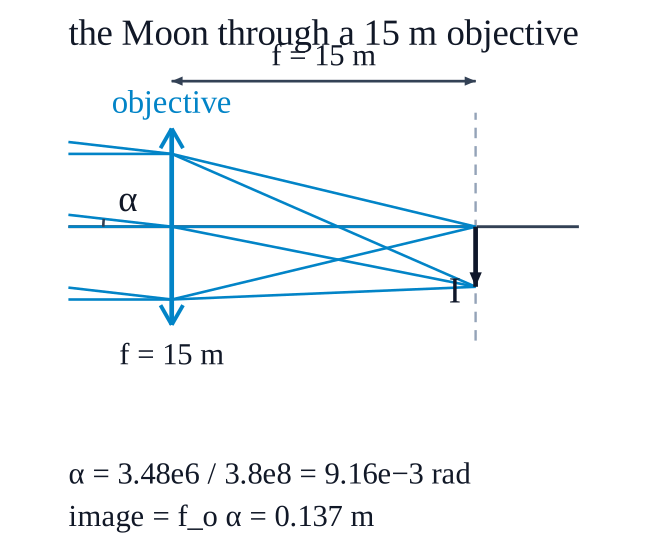 \[\alpha=\frac{d_{\text{moon}}}{r_{\text{orbit}}}=\frac{3.48\times10^{6}\,\mathrm{m}}{3.8\times10^{8}\,\mathrm{m}}=9.16\times10^{-3}\,\mathrm{rad}\]
The objective forms its real image at (near) its focus, so the image size is
\[d_{\text{image}}=f_o\,\alpha=15\,\mathrm{m}\times9.16\times10^{-3}=0.1374\,\mathrm{m}\]
\[\boxed{d_{\text{image}}\approx\mathbf{13.7\,cm}}\]
\[\alpha=\frac{d_{\text{moon}}}{r_{\text{orbit}}}=\frac{3.48\times10^{6}\,\mathrm{m}}{3.8\times10^{8}\,\mathrm{m}}=9.16\times10^{-3}\,\mathrm{rad}\]
The objective forms its real image at (near) its focus, so the image size is
\[d_{\text{image}}=f_o\,\alpha=15\,\mathrm{m}\times9.16\times10^{-3}=0.1374\,\mathrm{m}\]
\[\boxed{d_{\text{image}}\approx\mathbf{13.7\,cm}}\]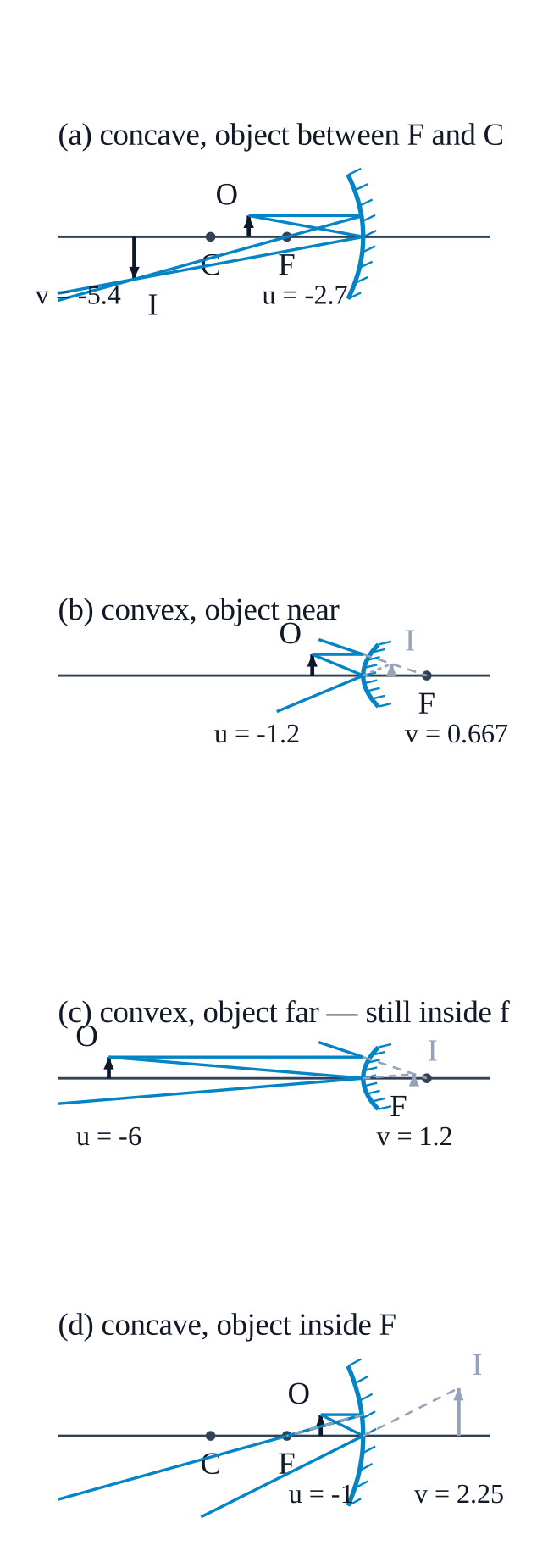 Use the mirror formula \(\displaystyle \dfrac{1}{v}+\dfrac{1}{u}=\dfrac{1}{f}\) with the Cartesian sign convention: distances measured from the pole; distances of real objects/images (in front of the mirror) are negative, and the focus of a concave mirror is negative while that of a convex mirror is positive. Write \(\displaystyle f=-f_0\) for a concave mirror and \(\displaystyle f=+f_0\) for a convex mirror \(\displaystyle (f_0>0)\), and \(\displaystyle u=-x\) for a real object \(\displaystyle (x>0)\).(a) Concave mirror, object between \(\displaystyle f\) and \(\displaystyle 2f\): here \(\displaystyle f_0<x<2f_0\).
\[\frac{1}{v}=\frac{1}{f}-\frac{1}{u}=-\frac{1}{f_0}+\frac{1}{x}=\frac{f_0-x}{f_0x}\]
Since \(\displaystyle x>f_0\), \(\displaystyle f_0-x<0\), so \(\displaystyle v<0\): the image is real (in front of the mirror). Its magnitude is
\[|v|=\frac{f_0x}{x-f_0}\]
Compare with \(\displaystyle 2f_0\): \(\displaystyle |v|>2f_0 \iff \dfrac{x}{x-f_0}>2 \iff x<2f_0\), which holds by assumption. Hence the real image lies beyond \(\displaystyle 2f\).(b) Convex mirror, any object position: \(\displaystyle f=+f_0\), \(\displaystyle u=-x\), \(\displaystyle x>0\).
\[\frac{1}{v}=\frac{1}{f_0}+\frac{1}{x}>0\ \Rightarrow\ v>0\ \text{for every }x>0\]
A positive \(\displaystyle v\) (behind the mirror) means the image is always virtual, independent of \(\displaystyle u\).(c) Convex mirror, size and location of that virtual image:
\[v=\frac{f_0x}{f_0+x}\ \Rightarrow\ \frac{1}{v}=\frac{1}{f_0}+\frac{1}{x}>\frac{1}{f_0}\ \Rightarrow\ 0<v<f_0\]
so the image always lies between the pole and the focus. Magnification
\[m=-\frac{v}{u}=\frac{v}{x}=\frac{f_0}{f_0+x}<1\]
so it is always diminished, for every object distance \(\displaystyle x\).(d) Concave mirror, object between pole and focus: \(\displaystyle f=-f_0\), \(\displaystyle u=-x\), \(\displaystyle 0<x<f_0\).
\[\frac{1}{v}=-\frac{1}{f_0}+\frac{1}{x}=\frac{f_0-x}{f_0x}>0\ \text{(since }x<f_0\text{)}\]
So \(\displaystyle v>0\): the image is virtual (behind the mirror). Magnification
\[m=-\frac{v}{u}=\frac{v}{x}=\frac{f_0}{f_0-x}>1\ \text{(since }f_0-x<f_0\text{)}\]
so the virtual image is enlarged, as required.
Use the mirror formula \(\displaystyle \dfrac{1}{v}+\dfrac{1}{u}=\dfrac{1}{f}\) with the Cartesian sign convention: distances measured from the pole; distances of real objects/images (in front of the mirror) are negative, and the focus of a concave mirror is negative while that of a convex mirror is positive. Write \(\displaystyle f=-f_0\) for a concave mirror and \(\displaystyle f=+f_0\) for a convex mirror \(\displaystyle (f_0>0)\), and \(\displaystyle u=-x\) for a real object \(\displaystyle (x>0)\).(a) Concave mirror, object between \(\displaystyle f\) and \(\displaystyle 2f\): here \(\displaystyle f_0<x<2f_0\).
\[\frac{1}{v}=\frac{1}{f}-\frac{1}{u}=-\frac{1}{f_0}+\frac{1}{x}=\frac{f_0-x}{f_0x}\]
Since \(\displaystyle x>f_0\), \(\displaystyle f_0-x<0\), so \(\displaystyle v<0\): the image is real (in front of the mirror). Its magnitude is
\[|v|=\frac{f_0x}{x-f_0}\]
Compare with \(\displaystyle 2f_0\): \(\displaystyle |v|>2f_0 \iff \dfrac{x}{x-f_0}>2 \iff x<2f_0\), which holds by assumption. Hence the real image lies beyond \(\displaystyle 2f\).(b) Convex mirror, any object position: \(\displaystyle f=+f_0\), \(\displaystyle u=-x\), \(\displaystyle x>0\).
\[\frac{1}{v}=\frac{1}{f_0}+\frac{1}{x}>0\ \Rightarrow\ v>0\ \text{for every }x>0\]
A positive \(\displaystyle v\) (behind the mirror) means the image is always virtual, independent of \(\displaystyle u\).(c) Convex mirror, size and location of that virtual image:
\[v=\frac{f_0x}{f_0+x}\ \Rightarrow\ \frac{1}{v}=\frac{1}{f_0}+\frac{1}{x}>\frac{1}{f_0}\ \Rightarrow\ 0<v<f_0\]
so the image always lies between the pole and the focus. Magnification
\[m=-\frac{v}{u}=\frac{v}{x}=\frac{f_0}{f_0+x}<1\]
so it is always diminished, for every object distance \(\displaystyle x\).(d) Concave mirror, object between pole and focus: \(\displaystyle f=-f_0\), \(\displaystyle u=-x\), \(\displaystyle 0<x<f_0\).
\[\frac{1}{v}=-\frac{1}{f_0}+\frac{1}{x}=\frac{f_0-x}{f_0x}>0\ \text{(since }x<f_0\text{)}\]
So \(\displaystyle v>0\): the image is virtual (behind the mirror). Magnification
\[m=-\frac{v}{u}=\frac{v}{x}=\frac{f_0}{f_0-x}>1\ \text{(since }f_0-x<f_0\text{)}\]
so the virtual image is enlarged, as required.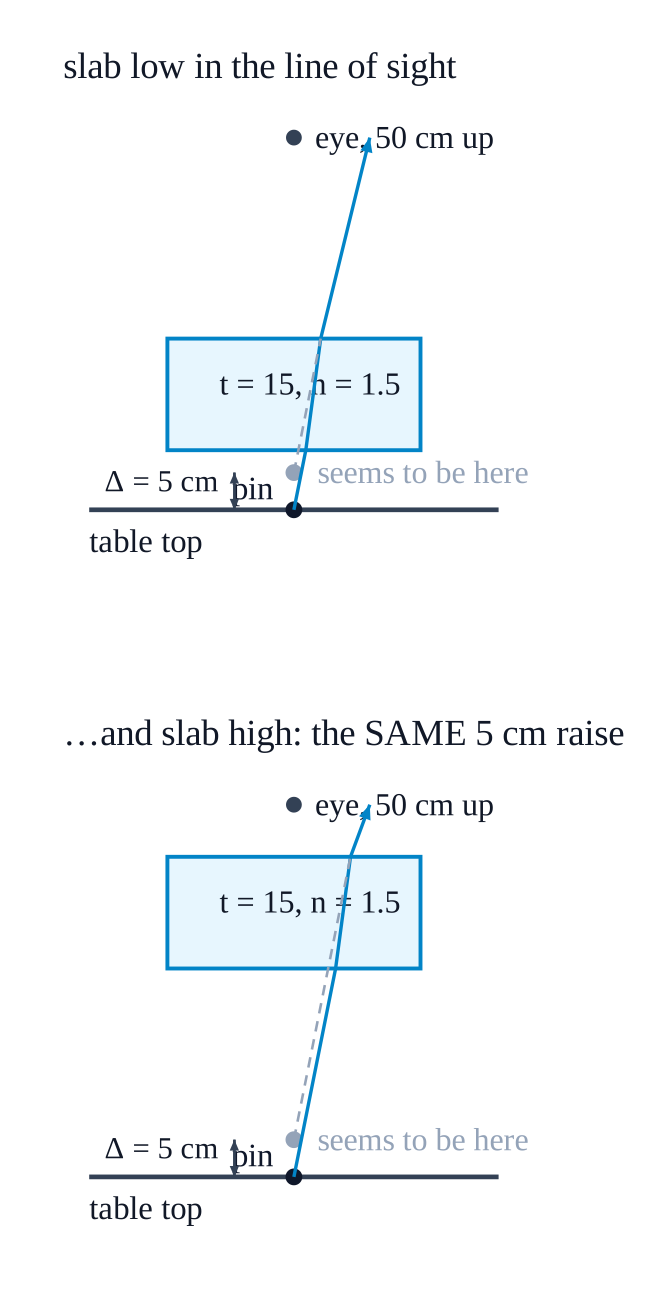 A slab of thickness \(\displaystyle t\) and refractive index \(\displaystyle n\), viewed along the normal, makes objects behind it appear shifted toward the viewer by
\[\Delta=t\left(1-\frac{1}{n}\right)\]
With \(\displaystyle t=15\,\mathrm{cm}\), \(\displaystyle n=1.5\):
\[\Delta=15\left(1-\frac{1}{1.5}\right)=15\times\frac{1}{3}=\mathbf{5\,cm}\]
The pin appears raised by $\displaystyle 5$ cm. The formula for \(\displaystyle \Delta\) depends only on \(\displaystyle t\) and \(\displaystyle n\), not on where along the $\displaystyle 50$ cm line of sight the slab sits — so no, the answer does not depend on the location of the slab (as long as it stays parallel to the table, between pin and eye).
A slab of thickness \(\displaystyle t\) and refractive index \(\displaystyle n\), viewed along the normal, makes objects behind it appear shifted toward the viewer by
\[\Delta=t\left(1-\frac{1}{n}\right)\]
With \(\displaystyle t=15\,\mathrm{cm}\), \(\displaystyle n=1.5\):
\[\Delta=15\left(1-\frac{1}{1.5}\right)=15\times\frac{1}{3}=\mathbf{5\,cm}\]
The pin appears raised by $\displaystyle 5$ cm. The formula for \(\displaystyle \Delta\) depends only on \(\displaystyle t\) and \(\displaystyle n\), not on where along the $\displaystyle 50$ cm line of sight the slab sits — so no, the answer does not depend on the location of the slab (as long as it stays parallel to the table, between pin and eye).
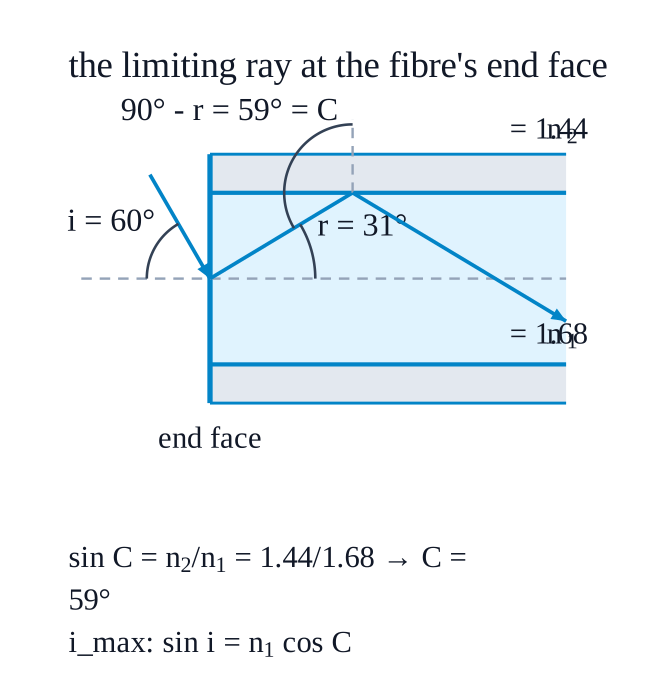 \[\sin C=\frac{n_2}{n_1}=\frac{1.44}{1.68}=\frac{6}{7}\ \Rightarrow\ \cos C=\frac{\sqrt{13}}{7}=0.5151\]
A ray entering the flat end at angle \(\displaystyle i\) refracts to angle \(\displaystyle r\) (measured from the pipe's axis, i.e. the normal to the end face); it then strikes the side wall at angle \(\displaystyle (90^\circ-r)\) from the wall's normal. TIR requires
\[90^\circ-r\ge C \ \Rightarrow\ r\le 90^\circ-C \ \Rightarrow\ \sin r\le\cos C\]
Applying Snell's law at the entrance face (air, \(\displaystyle n=1\), to core \(\displaystyle n_1=1.68\)):
\[\sin i=n_1\sin r\le n_1\cos C=1.68\times0.5151=0.8653\]
\[i\le\arcsin(0.8653)\approx\mathbf{60^\circ}\]
So all rays incident on the end face within \(\displaystyle 0^\circ\) to about \(\displaystyle 60^\circ\) of the axis undergo total internal reflection inside the pipe.(b) Without the cladding, the core interfaces directly with air, \(\displaystyle n_2'=1\):
\[\sin C'=\frac{1}{1.68}=0.5952\ \Rightarrow\ \cos C'=\sqrt{1-0.5952^2}=0.8035\]
\[\sin i_{\max}=n_1\cos C'=1.68\times0.8035=1.35>1\]
Since this exceeds unity, the condition \(\displaystyle \sin i\le1.35\) is satisfied by every physically possible angle of incidence. So without the outer covering, all rays entering the flat face (any angle from \(\displaystyle 0^\circ\) to \(\displaystyle 90^\circ\)) undergo total internal reflection — there is no restriction on \(\displaystyle i\).
\[\sin C=\frac{n_2}{n_1}=\frac{1.44}{1.68}=\frac{6}{7}\ \Rightarrow\ \cos C=\frac{\sqrt{13}}{7}=0.5151\]
A ray entering the flat end at angle \(\displaystyle i\) refracts to angle \(\displaystyle r\) (measured from the pipe's axis, i.e. the normal to the end face); it then strikes the side wall at angle \(\displaystyle (90^\circ-r)\) from the wall's normal. TIR requires
\[90^\circ-r\ge C \ \Rightarrow\ r\le 90^\circ-C \ \Rightarrow\ \sin r\le\cos C\]
Applying Snell's law at the entrance face (air, \(\displaystyle n=1\), to core \(\displaystyle n_1=1.68\)):
\[\sin i=n_1\sin r\le n_1\cos C=1.68\times0.5151=0.8653\]
\[i\le\arcsin(0.8653)\approx\mathbf{60^\circ}\]
So all rays incident on the end face within \(\displaystyle 0^\circ\) to about \(\displaystyle 60^\circ\) of the axis undergo total internal reflection inside the pipe.(b) Without the cladding, the core interfaces directly with air, \(\displaystyle n_2'=1\):
\[\sin C'=\frac{1}{1.68}=0.5952\ \Rightarrow\ \cos C'=\sqrt{1-0.5952^2}=0.8035\]
\[\sin i_{\max}=n_1\cos C'=1.68\times0.8035=1.35>1\]
Since this exceeds unity, the condition \(\displaystyle \sin i\le1.35\) is satisfied by every physically possible angle of incidence. So without the outer covering, all rays entering the flat face (any angle from \(\displaystyle 0^\circ\) to \(\displaystyle 90^\circ\)) undergo total internal reflection — there is no restriction on \(\displaystyle i\).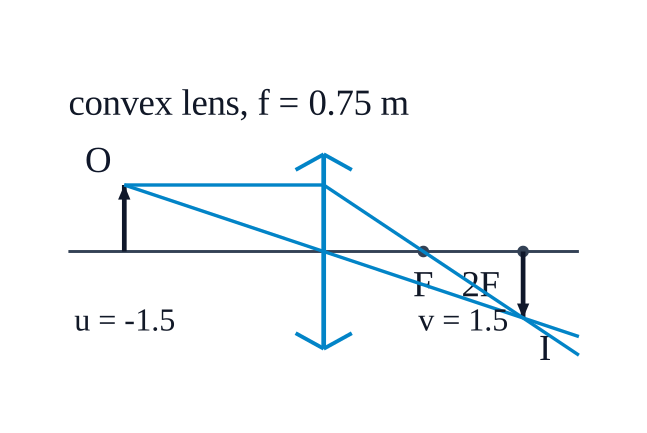 For a real image of a fixed object formed by a convex lens with a fixed object-to-screen distance \(\displaystyle D\), the lens equation restricts \(\displaystyle D\) and \(\displaystyle f\) by \(\displaystyle D\ge4f\); the minimum separation for which a real image is possible at all is \(\displaystyle D_{\min}=4f\), attained when the object and image are symmetric (each at \(\displaystyle 2f\) from the lens). Hence the largest focal length that can still produce a real image over a fixed \(\displaystyle D\) is
\[f_{\max}=\frac{D}{4}=\frac{3\,\mathrm{m}}{4}=0.75\,\mathrm{m}\]
Maximum possible focal length \(\displaystyle =\mathbf{75\,cm}\).
For a real image of a fixed object formed by a convex lens with a fixed object-to-screen distance \(\displaystyle D\), the lens equation restricts \(\displaystyle D\) and \(\displaystyle f\) by \(\displaystyle D\ge4f\); the minimum separation for which a real image is possible at all is \(\displaystyle D_{\min}=4f\), attained when the object and image are symmetric (each at \(\displaystyle 2f\) from the lens). Hence the largest focal length that can still produce a real image over a fixed \(\displaystyle D\) is
\[f_{\max}=\frac{D}{4}=\frac{3\,\mathrm{m}}{4}=0.75\,\mathrm{m}\]
Maximum possible focal length \(\displaystyle =\mathbf{75\,cm}\).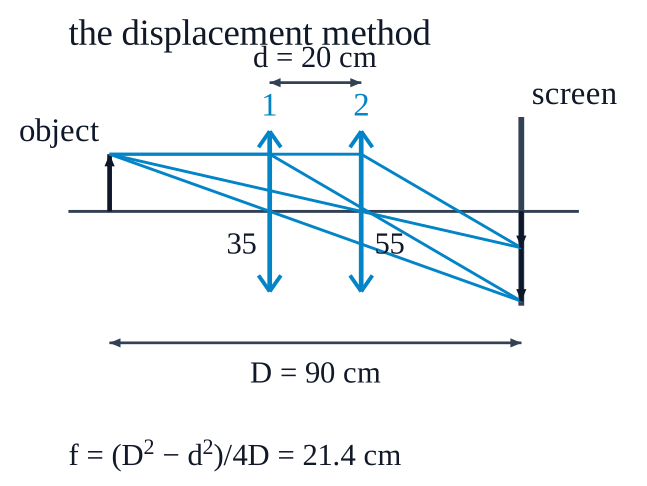 This is the displacement (conjugate foci) method. If the lens in one position has object distance \(\displaystyle u\) and image distance \(\displaystyle v\) with \(\displaystyle u+v=D=90\,\mathrm{cm}\), by reversibility the second sharp-image position swaps \(\displaystyle u\) and \(\displaystyle v\); the lens shift between the two positions is
\[d=v-u=20\,\mathrm{cm}\]
Solving \(\displaystyle u+v=90\), \(\displaystyle v-u=20\) gives \(\displaystyle v=55\,\mathrm{cm}\), \(\displaystyle u=35\,\mathrm{cm}\) (taking \(\displaystyle u=-35\,\mathrm{cm}\) with sign convention). Substituting in the lens formula, or equivalently using the standard result of this method,
\[f=\frac{D^2-d^2}{4D}=\frac{90^2-20^2}{4\times90}=\frac{8100-400}{360}=\frac{7700}{360}\]
\[\boxed{f\approx\mathbf{21.4\,cm}}\]
This is the displacement (conjugate foci) method. If the lens in one position has object distance \(\displaystyle u\) and image distance \(\displaystyle v\) with \(\displaystyle u+v=D=90\,\mathrm{cm}\), by reversibility the second sharp-image position swaps \(\displaystyle u\) and \(\displaystyle v\); the lens shift between the two positions is
\[d=v-u=20\,\mathrm{cm}\]
Solving \(\displaystyle u+v=90\), \(\displaystyle v-u=20\) gives \(\displaystyle v=55\,\mathrm{cm}\), \(\displaystyle u=35\,\mathrm{cm}\) (taking \(\displaystyle u=-35\,\mathrm{cm}\) with sign convention). Substituting in the lens formula, or equivalently using the standard result of this method,
\[f=\frac{D^2-d^2}{4D}=\frac{90^2-20^2}{4\times90}=\frac{8100-400}{360}=\frac{7700}{360}\]
\[\boxed{f\approx\mathbf{21.4\,cm}}\]