Exercise 8.1

Figure shows a capacitor made of two circular plates each of radius cm, and separated by cm. The capacitor is being charged by an external source (not shown in the figure). The charging current is constant and equal to 0.15A.
(a)
Calculate the capacitance and the rate of change of potential difference between the plates.
(b)
Obtain the displacement current across the plates.
(c)
Is Kirchhoff’s first rule (junction rule) valid at each plate of the capacitor? Explain.
Disagrees with the book
This working does not reach the answer printed in NCERT. One of the two is wrong and it has not yet been settled which — check it before you rely on it.
NCERT’s answer
(a)
$\displaystyle 0$ / C A d ε = = $\displaystyle 8.00$ pF d d d d Q V C t t = -$\displaystyle 12$ $\displaystyle 0.15$ $\displaystyle 8$ × $\displaystyle 10$ dV dt = $\displaystyle 10$ -$\displaystyle 1$ $\displaystyle 1.87$ $\displaystyle 10$ V s = × (b) $\displaystyle 0$ . d d di t ε \(\displaystyle Φ_{Ε}\) = . Now across the capacitor \(\displaystyle Φ_{E}\) = EA, ignoring end corrections. Therefore, $\displaystyle 0$ dE d di A t ε = Now, $\displaystyle 0$ Q E A ε = . Therefore, $\displaystyle 0$ d d E i t A ε = , which implies \(\displaystyle i_{d}\) = i = $\displaystyle 0.15$ A. (c) Yes, provided by ‘current’ we mean the sum of conduction and displacement currents.
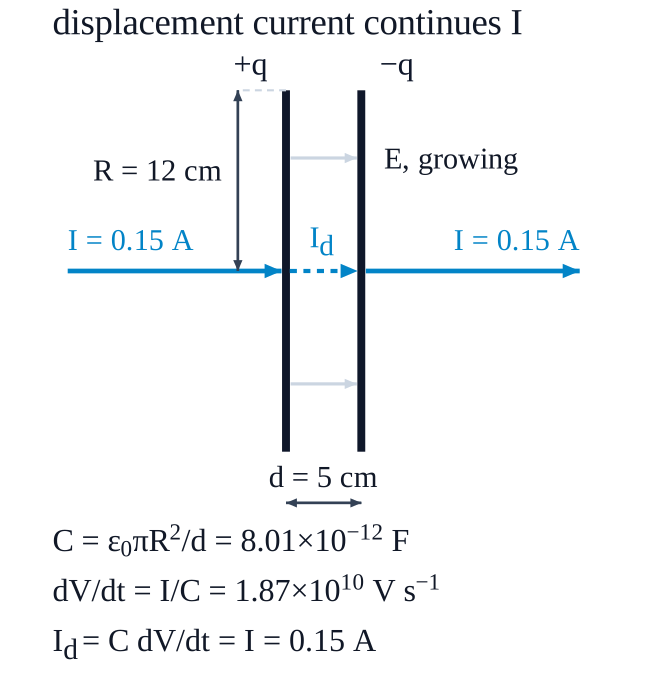 (a) Capacitance of a parallel-plate capacitor: \[C=\frac{\epsilon_0 A}{d}=\frac{\epsilon_0 \pi R^2}{d}\] With \(\displaystyle R=0.12\,\mathrm{m}\), \(\displaystyle d=0.05\,\mathrm{m}\): \(\displaystyle A=\pi(0.12)^2=0.04524\,\mathrm{m^2}\) \[C=\frac{(8.854\times10^{-12})(0.04524)}{0.05}=8.01\times10^{-12}\,\mathrm{F}\] Since \(\displaystyle I=C\dfrac{dV}{dt}\) (constant charging current), \[\frac{dV}{dt}=\frac{I}{C}=\frac{0.15}{8.01\times10^{-12}}=1.87\times10^{10}\,\mathrm{V/s}\] C \(\displaystyle \approx\) $\displaystyle 8.01$ pF, dV/dt \(\displaystyle \approx\) $\displaystyle 1.87$\(\displaystyle \times10^{10}\) V/s(b) The displacement current is \(\displaystyle I_d=\epsilon_0 A\dfrac{dE}{dt}=\epsilon_0\dfrac{A}{d}\dfrac{dV}{dt}=C\dfrac{dV}{dt}=I\). So \(\displaystyle I_d = 0.15\,\mathrm{A}\), exactly equal to the conduction current in the wires.(c) Kirchhoff's junction rule, as stated for conduction current alone, fails at a capacitor plate — current flows in through the wire but no conduction current crosses the gap between the plates. However, once the displacement current \(\displaystyle I_d\) between the plates is included (Maxwell's correction to Ampère's law), \(\displaystyle I_d=I\) at every instant, so the sum of conduction current and displacement current is continuous across the plate. The junction rule is valid at each plate only when displacement current is counted along with conduction current.
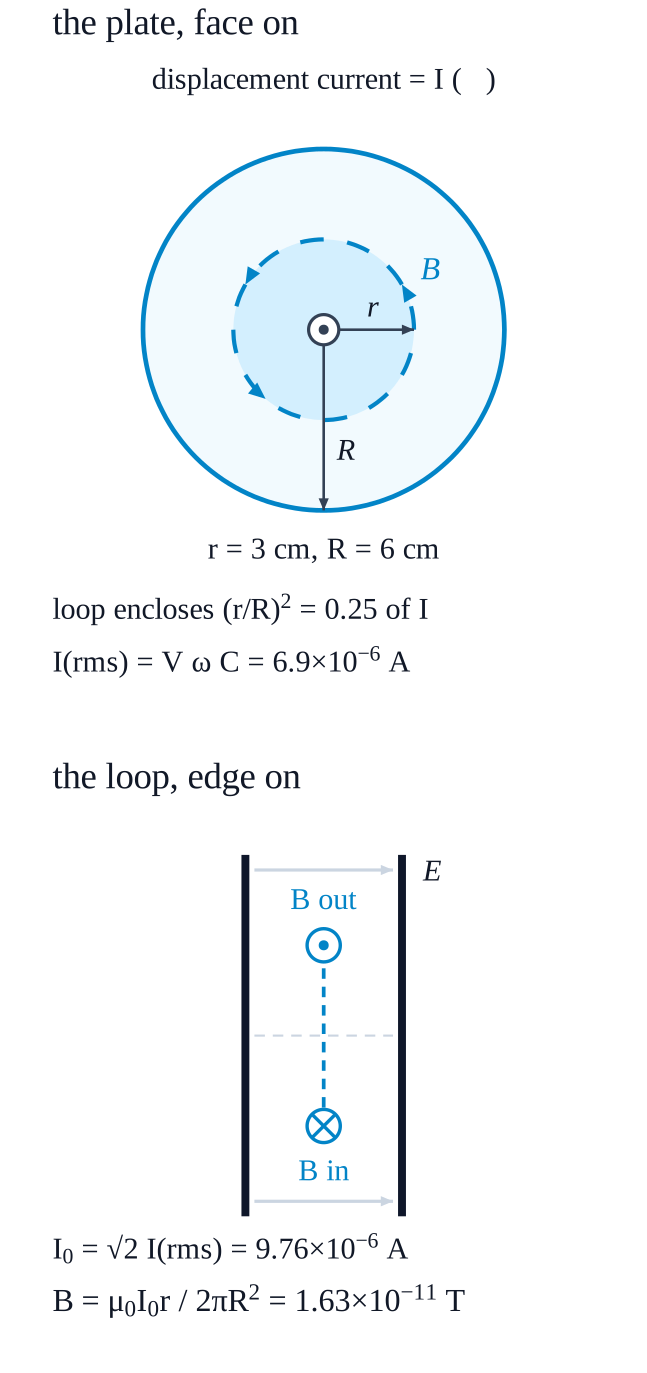 (a) Capacitive reactance: \(\displaystyle X_C=\dfrac{1}{\omega C}=\dfrac{1}{(300)(100\times10^{-12})}=3.33\times10^{7}\,\Omega\) \[I_{rms}=\frac{V_{rms}}{X_C}=\frac{230}{3.33\times10^{7}}=6.9\times10^{-6}\,\mathrm{A}\] \(\displaystyle I_{rms}\approx 6.9\,\mu\mathrm{A}\)(b) Yes. By charge conservation (Maxwell's equations), the displacement current between the plates equals the conduction current supplying the plates at every instant: \(\displaystyle I_d=I_{conduction}\).(c) Peak current \(\displaystyle I_0=\sqrt2\,I_{rms}=1.414\times6.9\times10^{-6}=9.76\times10^{-6}\,\mathrm{A}\). Inside the plates (\(\displaystyle r<R\)), the Ampère–Maxwell law gives, by symmetry, \[B=\frac{\mu_0 I_0\,r}{2\pi R^2}\] With \(\displaystyle r=0.03\,\mathrm{m}\), \(\displaystyle R=0.06\,\mathrm{m}\): \[B=\frac{(4\pi\times10^{-7})(9.76\times10^{-6})(0.03)}{2\pi(0.06)^2}=1.63\times10^{-11}\,\mathrm{T}\] B \(\displaystyle \approx\) $\displaystyle 1.63$\(\displaystyle \times10^{-11}\) T ($\displaystyle 16.3$ pT)
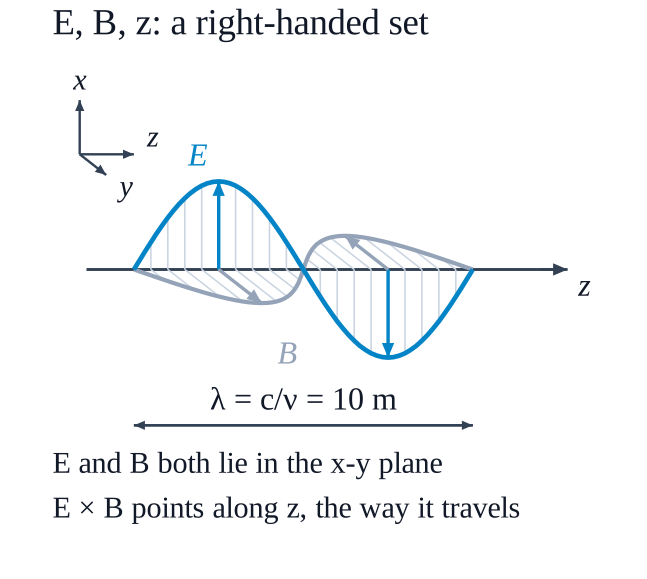 For a plane electromagnetic wave in vacuum, \(\displaystyle \vec E\), \(\displaystyle \vec B\), and the direction of propagation form a mutually perpendicular right-handed set (\(\displaystyle \vec E\times\vec B\) points along the propagation direction). Since the wave travels along \(\displaystyle z\), \(\displaystyle \vec E\) and \(\displaystyle \vec B\) both lie in the \(\displaystyle xy\)-plane, perpendicular to \(\displaystyle z\) and perpendicular to each other — e.g. \(\displaystyle E\) along \(\displaystyle x\), \(\displaystyle B\) along \(\displaystyle y\) (or any such perpendicular pair rotated about \(\displaystyle z\)).Wavelength from \(\displaystyle c=\nu\lambda\): \[\lambda=\frac{c}{\nu}=\frac{3\times10^{8}}{30\times10^{6}}=10\,\mathrm{m}\] \(\displaystyle \lambda = 10\,\mathrm{m}\)
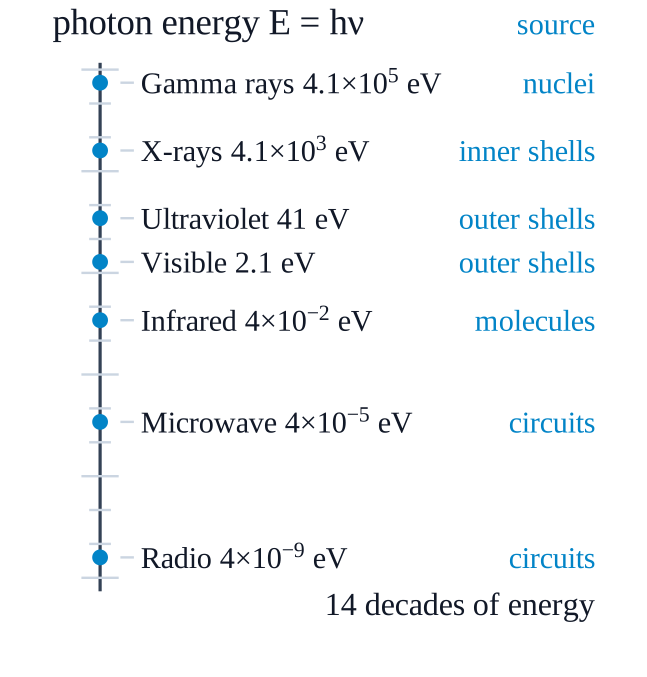 Using \(\displaystyle E=h\nu\) with \(\displaystyle h=6.63\times10^{-34}\,\mathrm{J\,s}\) and converting to eV (\(\displaystyle 1\,\mathrm{eV}=1.6\times10^{-19}\,\mathrm{J}\)), taking one representative frequency from each band of the spectrum: