Exercise 12.1
Choose the correct alternative from the clues given at the end of the each statement:
(a)
The size of the atom in Thomson’s model is .......... the atomic size in Rutherford’s model. (much greater than/no different from/much less than.)
(b)
In the ground state of .......... electrons are in stable equilibrium, while in .......... electrons always experience a net force. (Thomson’s model/ Rutherford’s model.)
(c)
A classical atom based on .......... is doomed to collapse. (Thomson’s model/ Rutherford’s model.)
(d)
An atom has a nearly continuous mass distribution in a .......... but has a highly non-uniform mass distribution in .......... (Thomson’s model/ Rutherford’s model.)
(e)
The positively charged part of the atom possesses most of the mass in .......... (Rutherford’s model/both the models.)
Not cross-checked
NCERT prints no numerical answer for this exercise, so this working has not been cross-checked against the book.
NCERT’s answer
(a)
No different from (b) Thomson’s model; Rutherford’s model (c) Rutherford’s model (d) Thomson’s model; Rutherford’s model (e) Both the models
Compare the two models directly.
(a)
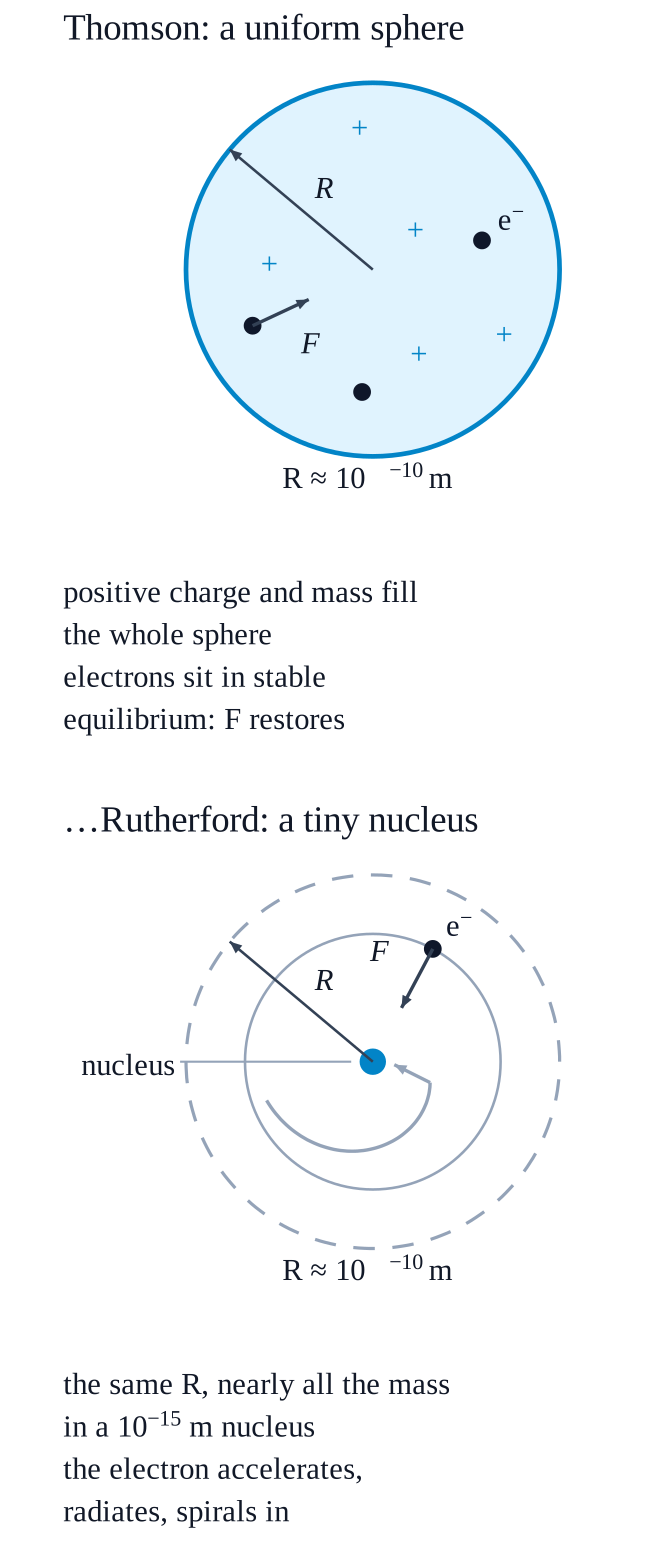
The size of the atom in Thomson's model is no different from the atomic size in Rutherford's model — Thomson's model too gives an atom of radius \(\displaystyle \sim 10^{-10}\,\mathrm{m}\); what differs is the mass/charge distribution inside that volume, not the volume itself.
(b)
In the ground state of Thomson's model, electrons sit in stable equilibrium (embedded in the uniform positive sphere, restoring force present). In Rutherford's model, electrons orbiting a point nucleus always experience a net (centripetal) force — there is no static equilibrium position.
(c)
A classical atom based on Rutherford's model is doomed to collapse: an orbiting (hence accelerating) electron must radiate energy continuously by classical electromagnetism, spiralling into the nucleus.
(d)
An atom has a nearly continuous mass distribution in Thomson's model (positive charge/mass spread over the whole sphere), but a highly non-uniform mass distribution in Rutherford's model (almost all mass concentrated in the tiny central nucleus).
(e)
The positively charged part of the atom possesses most of the mass in both the models — in Thomson's model the massive positive sphere carries the charge, and in Rutherford's model the massive nucleus carries the positive charge; in each case the light electrons contribute negligible mass.
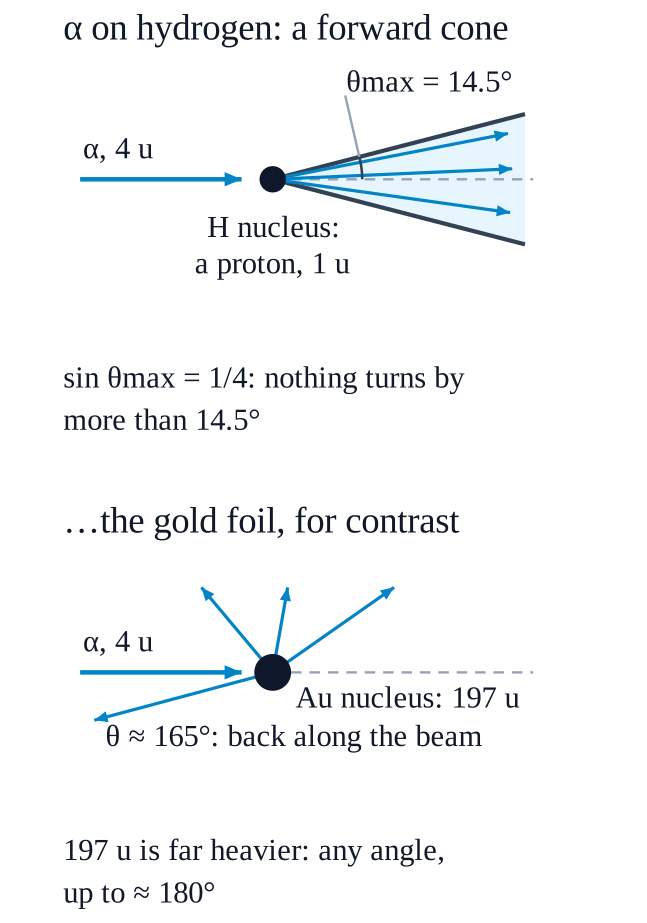 In Rutherford scattering, the projectile (\(\displaystyle \alpha\)-particle, mass \(\displaystyle \approx 4\,\mathrm{u}\)) is being fired at a target nucleus. For a fixed target that is lighter than the projectile, conservation of momentum caps the maximum possible deflection angle \(\displaystyle \theta_{\max}\), given by
\[\sin\theta_{\max}=\frac{m_{\text{target}}}{m_{\text{projectile}}}
\]For a hydrogen target, \(\displaystyle m_{\text{target}}\approx 1\,\mathrm{u}\) and \(\displaystyle m_{\text{projectile}}\approx 4\,\mathrm{u}\) (an \(\displaystyle \alpha\)-particle), so
\[\sin\theta_{\max}=\frac{1}{4}=0.25 \;\Rightarrow\; \theta_{\max}\approx 14.5^{\circ}
\]So, unlike gold (mass \(\displaystyle \approx 197\,\mathrm{u}\), much heavier than the \(\displaystyle \alpha\)-particle), which can send an \(\displaystyle \alpha\)-particle back at large angles including near \(\displaystyle 180^{\circ}\), a solid-hydrogen target — being lighter than the \(\displaystyle \alpha\)-particle — cannot produce any large-angle or back-scattering at all. The alpha particles would pass through the hydrogen sheet with only small deflections (at most \(\displaystyle \sim 14.5^{\circ}\)); no large-angle scattering would be seen, and this experiment could not be used to establish the existence of a small, massive nucleus in hydrogen the way the gold-foil experiment did.
In Rutherford scattering, the projectile (\(\displaystyle \alpha\)-particle, mass \(\displaystyle \approx 4\,\mathrm{u}\)) is being fired at a target nucleus. For a fixed target that is lighter than the projectile, conservation of momentum caps the maximum possible deflection angle \(\displaystyle \theta_{\max}\), given by
\[\sin\theta_{\max}=\frac{m_{\text{target}}}{m_{\text{projectile}}}
\]For a hydrogen target, \(\displaystyle m_{\text{target}}\approx 1\,\mathrm{u}\) and \(\displaystyle m_{\text{projectile}}\approx 4\,\mathrm{u}\) (an \(\displaystyle \alpha\)-particle), so
\[\sin\theta_{\max}=\frac{1}{4}=0.25 \;\Rightarrow\; \theta_{\max}\approx 14.5^{\circ}
\]So, unlike gold (mass \(\displaystyle \approx 197\,\mathrm{u}\), much heavier than the \(\displaystyle \alpha\)-particle), which can send an \(\displaystyle \alpha\)-particle back at large angles including near \(\displaystyle 180^{\circ}\), a solid-hydrogen target — being lighter than the \(\displaystyle \alpha\)-particle — cannot produce any large-angle or back-scattering at all. The alpha particles would pass through the hydrogen sheet with only small deflections (at most \(\displaystyle \sim 14.5^{\circ}\)); no large-angle scattering would be seen, and this experiment could not be used to establish the existence of a small, massive nucleus in hydrogen the way the gold-foil experiment did.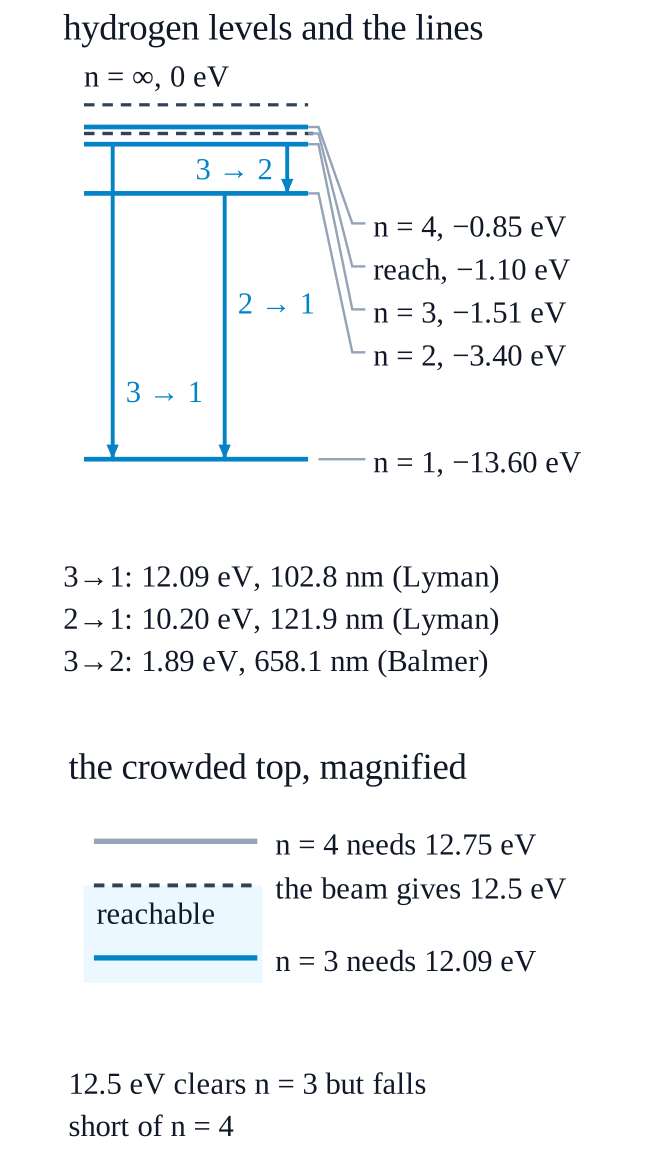 Ground-state hydrogen has \(\displaystyle E_1=-13.6\,\mathrm{eV}\). In an inelastic collision the bombarding electron (energy \(\displaystyle 12.5\,\mathrm{eV}\)) can transfer at most \(\displaystyle 12.5\,\mathrm{eV}\) to the atom. Check which excited levels \(\displaystyle E_n=-13.6/n^2\,\mathrm{eV}\) are reachable, i.e. for which \(\displaystyle E_n-E_1\le 12.5\,\mathrm{eV}\):\[E_2-E_1 = -3.4-(-13.6)=10.2\,\mathrm{eV}\ \ (\text{reachable})
\]
\[E_3-E_1 = -1.51-(-13.6)=12.09\,\mathrm{eV}\ \ (\text{reachable, }\le12.5\,\mathrm{eV})
\]
\[E_4-E_1 = -0.85-(-13.6)=12.75\,\mathrm{eV}\ \ (\text{NOT reachable, exceeds }12.5\,\mathrm{eV})
\]So the electron beam can excite the atom up to \(\displaystyle n=3\) only. On de-excitation, the atom can emit the three transitions \(\displaystyle 3\to1\), \(\displaystyle 3\to2\), and \(\displaystyle 2\to1\), using \(\displaystyle \lambda = hc/\Delta E\) with \(\displaystyle hc\approx1243\,\mathrm{eV\,nm}\):\[\lambda_{3\to1}=\frac{1243}{12.09}\approx102.8\,\mathrm{nm}\ (\text{Lyman})
\]
\[\lambda_{2\to1}=\frac{1243}{10.2}\approx121.9\,\mathrm{nm}\ (\text{Lyman})
\]
\[\lambda_{3\to2}=\frac{1243}{1.89}\approx658\,\mathrm{nm}\ (\text{Balmer})
\]Two Lyman-series lines (\(\displaystyle \lambda\approx102.8\,\mathrm{nm}\) and \(\displaystyle 121.9\,\mathrm{nm}\), from \(\displaystyle 3\to1\) and \(\displaystyle 2\to1\)) and one Balmer-series line (\(\displaystyle \lambda\approx658\,\mathrm{nm}\), from \(\displaystyle 3\to2\)) are emitted; transitions to \(\displaystyle n=4\) or beyond do not occur since that would require more than \(\displaystyle 12.5\,\mathrm{eV}\).
Ground-state hydrogen has \(\displaystyle E_1=-13.6\,\mathrm{eV}\). In an inelastic collision the bombarding electron (energy \(\displaystyle 12.5\,\mathrm{eV}\)) can transfer at most \(\displaystyle 12.5\,\mathrm{eV}\) to the atom. Check which excited levels \(\displaystyle E_n=-13.6/n^2\,\mathrm{eV}\) are reachable, i.e. for which \(\displaystyle E_n-E_1\le 12.5\,\mathrm{eV}\):\[E_2-E_1 = -3.4-(-13.6)=10.2\,\mathrm{eV}\ \ (\text{reachable})
\]
\[E_3-E_1 = -1.51-(-13.6)=12.09\,\mathrm{eV}\ \ (\text{reachable, }\le12.5\,\mathrm{eV})
\]
\[E_4-E_1 = -0.85-(-13.6)=12.75\,\mathrm{eV}\ \ (\text{NOT reachable, exceeds }12.5\,\mathrm{eV})
\]So the electron beam can excite the atom up to \(\displaystyle n=3\) only. On de-excitation, the atom can emit the three transitions \(\displaystyle 3\to1\), \(\displaystyle 3\to2\), and \(\displaystyle 2\to1\), using \(\displaystyle \lambda = hc/\Delta E\) with \(\displaystyle hc\approx1243\,\mathrm{eV\,nm}\):\[\lambda_{3\to1}=\frac{1243}{12.09}\approx102.8\,\mathrm{nm}\ (\text{Lyman})
\]
\[\lambda_{2\to1}=\frac{1243}{10.2}\approx121.9\,\mathrm{nm}\ (\text{Lyman})
\]
\[\lambda_{3\to2}=\frac{1243}{1.89}\approx658\,\mathrm{nm}\ (\text{Balmer})
\]Two Lyman-series lines (\(\displaystyle \lambda\approx102.8\,\mathrm{nm}\) and \(\displaystyle 121.9\,\mathrm{nm}\), from \(\displaystyle 3\to1\) and \(\displaystyle 2\to1\)) and one Balmer-series line (\(\displaystyle \lambda\approx658\,\mathrm{nm}\), from \(\displaystyle 3\to2\)) are emitted; transitions to \(\displaystyle n=4\) or beyond do not occur since that would require more than \(\displaystyle 12.5\,\mathrm{eV}\).