SolveItNCERT · CBSE Boards

NCERT Solutions · Class 12 Physics Magnetism and Matter

7 exercises · 2 still being checked

Exercises 5.1–5.7

  1. Exercise 5.1

    A short bar magnet placed with its axis at $\displaystyle 30$° with a uniform external magnetic field of $\displaystyle 0.25$ T experiences a torque of magnitude equal to $\displaystyle 4.5$ × \(\displaystyle 10^{-2}\) J. What is the magnitude of magnetic moment of the magnet?
    NCERT’s answer
    0.$\displaystyle 36$ \(\displaystyle JT^{-1}\)
    Torque on a magnetic dipole: \[\tau = mB\sin\theta \] Given \(\displaystyle \theta = 30^\circ\), \(\displaystyle B = 0.25\ \mathrm{T}\), \(\displaystyle \tau = 4.5\times10^{-2}\ \mathrm{J}\). \[m = \frac{\tau}{B\sin\theta} = \frac{4.5\times10^{-2}}{0.25\times\sin 30^\circ} = \frac{4.5\times10^{-2}}{0.25\times0.5} \] \[m = \frac{4.5\times10^{-2}}{0.125} = 0.36\ \mathrm{J\,T^{-1}} \] Magnetic moment \(\displaystyle m = 0.36\ \mathrm{J\,T^{-1}}\).
  2. Exercise 5.2

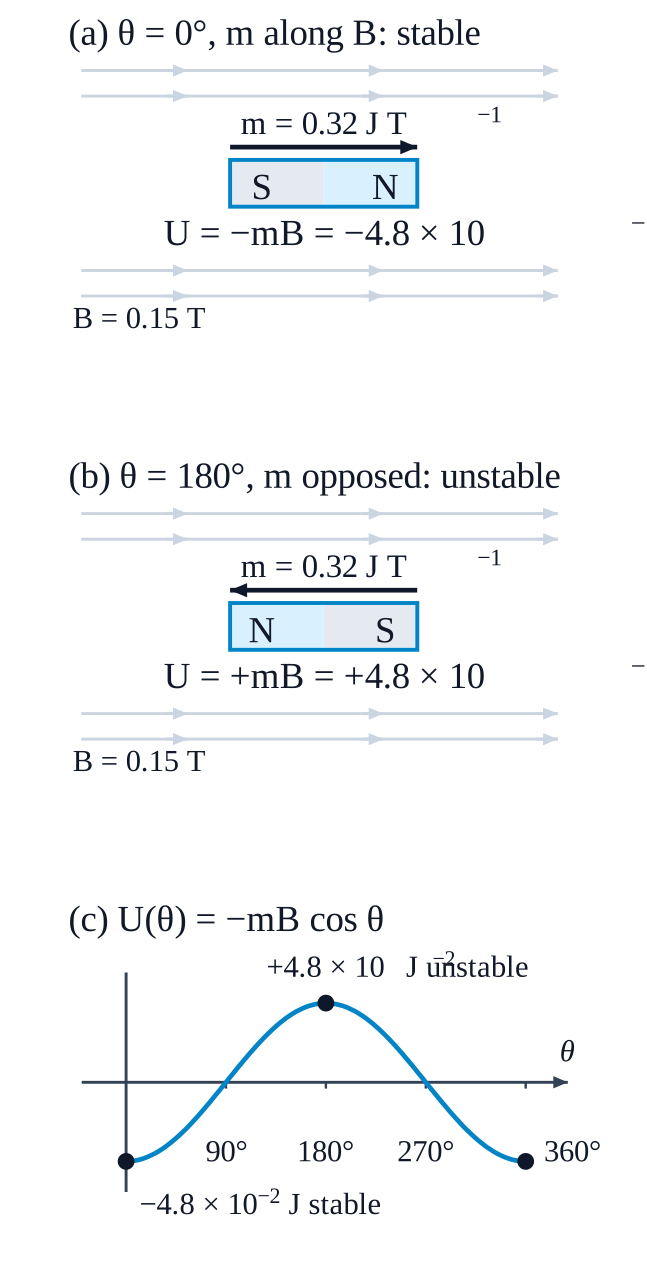
    A short bar magnet of magnetic moment m = $\displaystyle 0.32$ JT -$\displaystyle 1$ is placed in a uniform magnetic field of $\displaystyle 0.15$ T. If the bar is free to rotate in the plane of the field, which orientation would correspond to its
    (a)
    stable, and
    (b)
    unstable equilibrium? What is the potential energy of the magnet in each case?
    NCERT’s answer
    (a)
    m parallel to B; U = -mB = -$\displaystyle 4.8$ × \(\displaystyle 10^{-2}\) J: stable. (b) m anti-parallel to B; U = +mB = +$\displaystyle 4.8$ × \(\displaystyle 10^{-2}\) J; unstable.
    NCERT_Solution_Class12_Physics_Ch5_Q5-2
    Potential energy of a dipole in a field: \[U(\theta) = -mB\cos\theta \]
    Stable equilibrium is the orientation of minimum energy, unstable is the orientation of maximum energy.
    (a)
    Stable equilibrium: moment \(\displaystyle \vec{m}\) parallel to \(\displaystyle \vec{B}\), i.e. \(\displaystyle \theta = 0^\circ\).
    \[U = -mB\cos 0^\circ = -mB = -(0.32)(0.15) = -4.8\times10^{-2}\ \mathrm{J} \]
    (b)
    Unstable equilibrium: moment \(\displaystyle \vec{m}\) antiparallel to \(\displaystyle \vec{B}\), i.e. \(\displaystyle \theta = 180^\circ\).
    \[U = -mB\cos 180^\circ = +mB = 4.8\times10^{-2}\ \mathrm{J} \]
    Stable: \(\displaystyle \theta=0^\circ\), \(\displaystyle U=-4.8\times10^{-2}\ \mathrm{J}\); Unstable: \(\displaystyle \theta=180^\circ\), \(\displaystyle U=+4.8\times10^{-2}\ \mathrm{J}\).
  3. Exercise 5.3

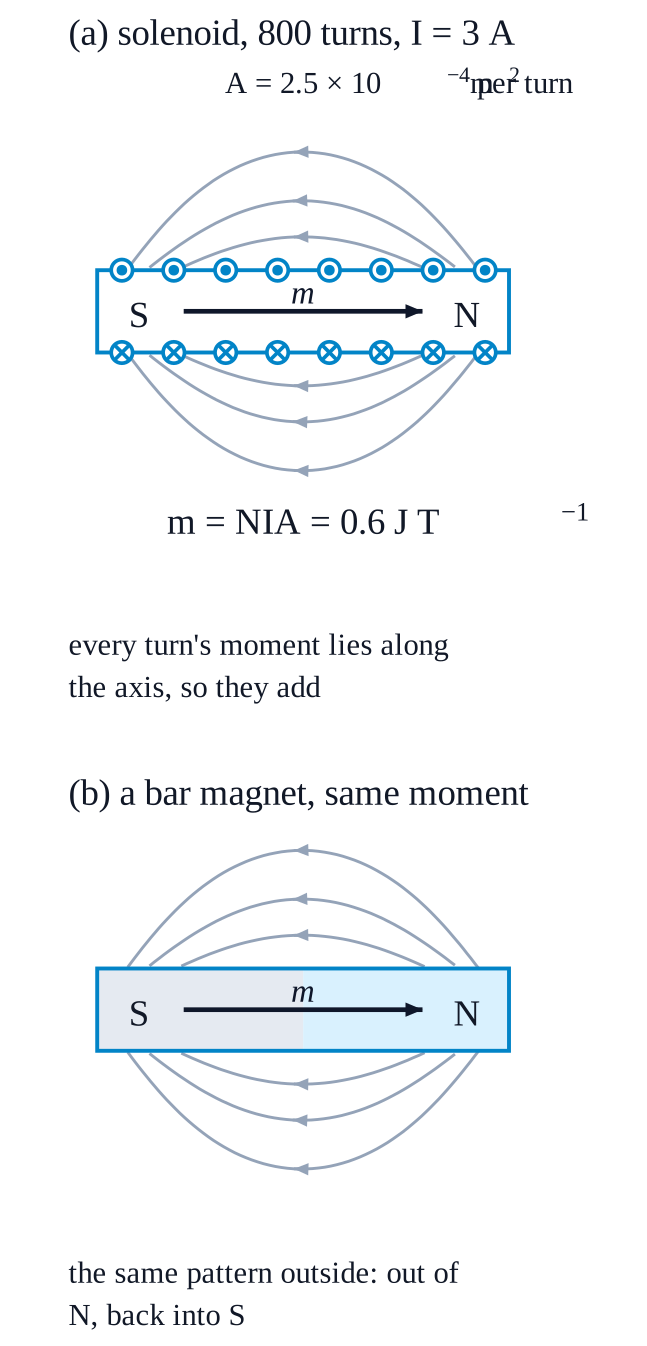
    A closely wound solenoid of $\displaystyle 800$ turns and area of cross section $\displaystyle 2.5$ × \(\displaystyle 10^{-4}\) \(\displaystyle m^{2}\) carries a current of $\displaystyle 3.0$ A. Explain the sense in which the solenoid acts like a bar magnet. What is its associated magnetic moment?

    Disagrees with the book

    This working does not reach the answer printed in NCERT. One of the two is wrong and it has not yet been settled which — check it before you rely on it.

    NCERT’s answer
    0.$\displaystyle 60$ \(\displaystyle JT^{-1}\) along the axis of the solenoid determined by the sense of flow of the current. $\displaystyle 5.4$ $\displaystyle 7.5$ ×\(\displaystyle 10^{-2}\)J
    NCERT_Solution_Class12_Physics_Ch5_Q5-3A current-carrying solenoid behaves like a bar magnet because each turn is a current loop with its own magnetic dipole moment along the solenoid's axis; these add up, so the whole solenoid produces a dipole-like field with one end acting as a N-pole and the other as a S-pole (by the right-hand rule), just as field lines emerge from a bar magnet's N-pole and curve back into its S-pole.Magnetic moment of a solenoid: \[m = NIA \] Given \(\displaystyle N = 800\), \(\displaystyle I = 3.0\ \mathrm{A}\), \(\displaystyle A = 2.5\times10^{-4}\ \mathrm{m^2}\). \[m = 800\times3.0\times2.5\times10^{-4} = 0.6\ \mathrm{J\,T^{-1}} \] Associated magnetic moment \(\displaystyle m = 0.6\ \mathrm{J\,T^{-1}}\) (i.e. \(\displaystyle 0.6\ \mathrm{A\,m^2}\)), directed along the solenoid's axis.
  4. Exercise 5.4

    If the solenoid in Exercise $\displaystyle 5.5$ is free to turn about the vertical direction and a uniform horizontal magnetic field of $\displaystyle 0.25$ T is applied, what is the magnitude of torque on the solenoid when its axis makes an angle of $\displaystyle 30$° with the direction of applied field?

    Not cross-checked

    NCERT prints no numerical answer for this exercise, so this working has not been cross-checked against the book.

    The referenced solenoid ($\displaystyle 800$ turns, area \(\displaystyle 2.5\times10^{-4}\ \mathrm{m^2}\), current $\displaystyle 3.0$ A) has magnetic moment \(\displaystyle m = NIA = 0.6\ \mathrm{J\,T^{-1}}\).Torque on the dipole: \[\tau = mB\sin\theta \] With \(\displaystyle B = 0.25\ \mathrm{T}\), \(\displaystyle \theta = 30^\circ\): \[\tau = 0.6\times0.25\times\sin 30^\circ = 0.6\times0.25\times0.5 \] \[\tau = 7.5\times10^{-2}\ \mathrm{N\,m} \] Torque on the solenoid \(\displaystyle \tau = 7.5\times10^{-2}\ \mathrm{N\,m}\).
  5. Exercise 5.5

    A bar magnet of magnetic moment $\displaystyle 1.5$ J T -$\displaystyle 1$ lies aligned with the direction of a uniform magnetic field of $\displaystyle 0.22$ T.
    (a)
    What is the amount of work required by an external torque to turn the magnet so as to align its magnetic moment:
    (i)
    normal to the field direction,
    (ii)
    opposite to the field direction?
    (b)
    What is the torque on the magnet in cases (i) and (ii)?
    NCERT’s answer
    (i)
    0.$\displaystyle 33$ J (ii) $\displaystyle 0.66$ J (b) (i) Torque of magnitude $\displaystyle 0.33$ J in a direction that tends to align the magnitude moment vector along B. (ii) Zero.
    Work done to rotate a dipole from \(\displaystyle \theta_i\) to \(\displaystyle \theta_f\) equals the change in potential energy: \[W = U(\theta_f) - U(\theta_i) = -mB\cos\theta_f - (-mB\cos\theta_i) \]
    Initially the magnet is aligned with the field, \(\displaystyle \theta_i = 0^\circ\), so \(\displaystyle U(\theta_i) = -mB\).
    Given \(\displaystyle m = 1.5\ \mathrm{J\,T^{-1}}\), \(\displaystyle B = 0.22\ \mathrm{T}\), so \(\displaystyle mB = 1.5\times0.22 = 0.33\ \mathrm{J}\).
    (a) (i) Normal to the field, \(\displaystyle \theta_f = 90^\circ\):
    \[W = -mB\cos 90^\circ - (-mB) = 0 + mB = 0.33\ \mathrm{J} \]
    (ii)
    Opposite to the field, \(\displaystyle \theta_f = 180^\circ\):
    \[W = -mB\cos 180^\circ - (-mB) = mB + mB = 2mB = 0.66\ \mathrm{J} \]
    (b) Torque \(\displaystyle \tau = mB\sin\theta_f\):
    (i)
    \(\displaystyle \theta_f = 90^\circ\): \(\displaystyle \tau = mB\sin 90^\circ = 0.33\ \mathrm{N\,m}\)
    (ii)
    \(\displaystyle \theta_f = 180^\circ\): \(\displaystyle \tau = mB\sin 180^\circ = 0\ \mathrm{N\,m}\)
    Work: (i) \(\displaystyle 0.33\ \mathrm{J}\), (ii) \(\displaystyle 0.66\ \mathrm{J}\). Torque: (i) \(\displaystyle 0.33\ \mathrm{N\,m}\), (ii) \(\displaystyle 0\).
  6. Exercise 5.6

    A closely wound solenoid of $\displaystyle 2000$ turns and area of cross-section $\displaystyle 1.6$ × $\displaystyle 10$ -$\displaystyle 4$ \(\displaystyle m^{2}\), carrying a current of $\displaystyle 4.0$ A, is suspended through its centre allowing it to turn in a horizontal plane.
    (a)
    What is the magnetic moment associated with the solenoid?
    (b)
    What is the force and torque on the solenoid if a uniform horizontal magnetic field of $\displaystyle 7.5$ × \(\displaystyle 10^{-2}\) T is set up at an angle of $\displaystyle 30$° with the axis of the solenoid?
    NCERT’s answer
    (a)
    1.$\displaystyle 28$ A \(\displaystyle m^{2}\) along the axis in the direction related to the sense of current via the right-handed screw rule. (b) Force is zero in uniform field; torque = $\displaystyle 0.048$ Nm in a direction that tends to align the axis of the solenoid (i.e., its magnetic moment vector) along B.
    (a) Magnetic moment of the solenoid: \[m = NIA \] Given \(\displaystyle N = 2000\), \(\displaystyle I = 4.0\ \mathrm{A}\), \(\displaystyle A = 1.6\times10^{-4}\ \mathrm{m^2}\). \[m = 2000\times4.0\times1.6\times10^{-4} = 1.28\ \mathrm{J\,T^{-1}} \](b) In a uniform magnetic field the net force on any current loop (and hence on the solenoid, a stack of loops) is zero — the forces on opposite sides cancel — so: \[F = 0 \] The torque, with \(\displaystyle B = 7.5\times10^{-2}\ \mathrm{T}\) and \(\displaystyle \theta = 30^\circ\): \[\tau = mB\sin\theta = 1.28\times7.5\times10^{-2}\times\sin 30^\circ = 1.28\times0.075\times0.5 \] \[\tau = 4.8\times10^{-2}\ \mathrm{N\,m} \] \(\displaystyle m = 1.28\ \mathrm{J\,T^{-1}}\); Force \(\displaystyle =0\); Torque \(\displaystyle =4.8\times10^{-2}\ \mathrm{N\,m}\), tending to align the solenoid's axis with \(\displaystyle \vec{B}\).
  7. Exercise 5.7

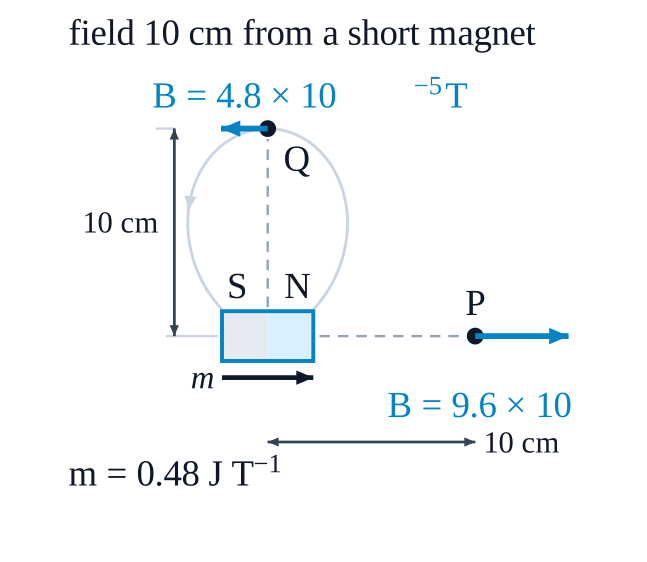
    A short bar magnet has a magnetic moment of $\displaystyle 0.48$ J T -1. Give the direction and magnitude of the magnetic field produced by the magnet at a distance of $\displaystyle 10$ cm from the centre of the magnet on
    (a)
    the axis,
    (b)
    the equatorial lines (normal bisector) of the magnet.
    NCERT’s answer
    (a)
    0.$\displaystyle 96$ g along S-N direction. (b) $\displaystyle 0.48$ G along N-S direction.
    NCERT_Solution_Class12_Physics_Ch5_Q5-7Field of a short bar magnet, magnetic moment \(\displaystyle m = 0.48\ \mathrm{J\,T^{-1}}\), at distance \(\displaystyle r = 10\ \mathrm{cm} = 0.10\ \mathrm{m}\).(a) On the axis: \[B_{\text{axial}} = \frac{\mu_0}{4\pi}\frac{2m}{r^3} \] \[B_{\text{axial}} = 10^{-7}\times\frac{2\times0.48}{(0.10)^3} = 10^{-7}\times\frac{0.96}{1.0\times10^{-3}} \] \[B_{\text{axial}} = 10^{-7}\times 960 = 9.6\times10^{-5}\ \mathrm{T} \] directed along the axis, parallel to \(\displaystyle \vec{m}\) (from S to N pole, i.e. pointing away from the magnet on the N-pole side).(b) On the equatorial line (normal bisector): \[B_{\text{eq}} = \frac{\mu_0}{4\pi}\frac{m}{r^3} \] \[B_{\text{eq}} = 10^{-7}\times\frac{0.48}{1.0\times10^{-3}} = 10^{-7}\times 480 = 4.8\times10^{-5}\ \mathrm{T} \] directed antiparallel to \(\displaystyle \vec{m}\) (i.e. from N to S, opposite to the magnet's moment).\(\displaystyle B_{\text{axial}} = 9.6\times10^{-5}\ \mathrm{T}\) (parallel to \(\displaystyle \vec{m}\)); \(\displaystyle B_{\text{eq}} = 4.8\times10^{-5}\ \mathrm{T}\) (antiparallel to \(\displaystyle \vec{m}\)), i.e. exactly half the axial value.