SolveItNCERT · CBSE Boards

NCERT Solutions · Class 12 Physics Electrostatic Potential and Capacitance

11 exercises · 2 still being checked

Exercises 2.1–2.11

  1. Exercise 2.1

    Two charges $\displaystyle 5$ × \(\displaystyle 10^{-8}\)C and -$\displaystyle 3$ × \(\displaystyle 10^{-8}\)C are located $\displaystyle 16$ cm apart. At what point(s) on the line joining the two charges is the electric potential zero? Take the potential at infinity to be zero.
    NCERT’s answer
    $\displaystyle 10$ cm, $\displaystyle 40$ cm away from the positive charge on the side of the negative charge.
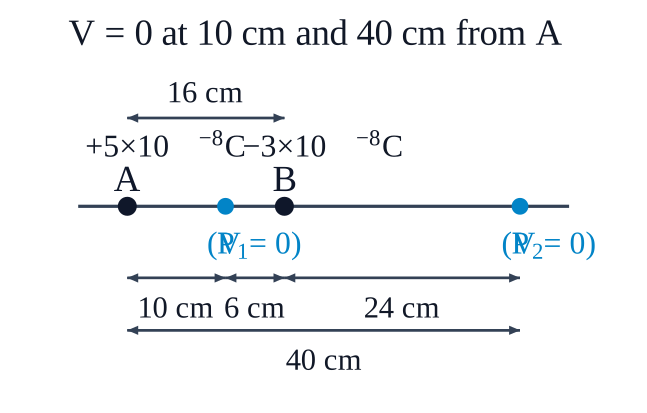
    NCERT_Solution_Class12_Physics_Ch2_Q2-1By the superposition principle, the net potential at a point on the line joining the charges is the algebraic sum \(\displaystyle V=\dfrac{1}{4\pi\epsilon_0}\left(\dfrac{q_1}{r_1}+\dfrac{q_2}{r_2}\right)\), with \(\displaystyle q_1=5\times10^{-8}\,\mathrm{C}\), \(\displaystyle q_2=-3\times10^{-8}\,\mathrm{C}\), separation \(\displaystyle 16\,\mathrm{cm}\), using \(\displaystyle k=9\times10^{9}\,\mathrm{N\,m^2/C^2}\).Case $\displaystyle 1$ — between the charges. Let the null point be at distance \(\displaystyle x\) from the \(\displaystyle 5\times10^{-8}\,\mathrm{C}\) charge (so \(\displaystyle 16-x\) from the other). Setting \(\displaystyle V=0\): \[\frac{5\times10^{-8}}{x}=\frac{3\times10^{-8}}{16-x}\ \Rightarrow\ 5(16-x)=3x\ \Rightarrow\ 80=8x\ \Rightarrow\ x=10\,\mathrm{cm}\]Case $\displaystyle 2$ — outside the charges, beyond the smaller (negative) charge. No null point exists beyond the larger charge; on the far side of the \(\displaystyle -3\times10^{-8}\,\mathrm{C}\) charge, let \(\displaystyle x\) be measured from the \(\displaystyle 5\times10^{-8}\,\mathrm{C}\) charge: \[\frac{5\times10^{-8}}{x}=\frac{3\times10^{-8}}{x-16}\ \Rightarrow\ 5(x-16)=3x\ \Rightarrow\ 2x=80\ \Rightarrow\ x=40\,\mathrm{cm}\]The potential is zero at $\displaystyle 10$ cm from the \(\displaystyle 5\times10^{-8}\,\mathrm{C}\) charge (between the two charges), and at $\displaystyle 40$ cm from the \(\displaystyle 5\times10^{-8}\,\mathrm{C}\) charge, i.e. $\displaystyle 24$ cm beyond the \(\displaystyle -3\times10^{-8}\,\mathrm{C}\) charge (outside, on the far side of the negative charge).
  2. Exercise 2.2

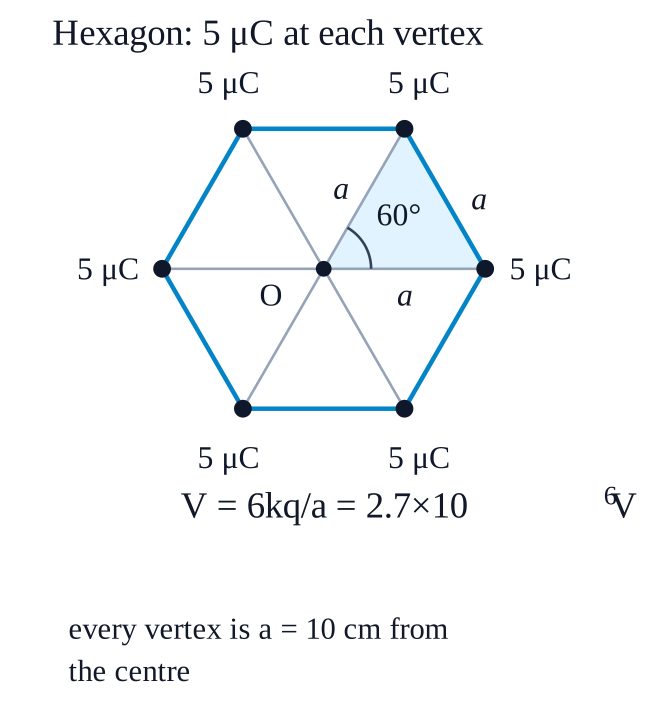
    A regular hexagon of side $\displaystyle 10$ cm has a charge $\displaystyle 5$ μC at each of its vertices. Calculate the potential at the centre of the hexagon.
    NCERT’s answer
    2.$\displaystyle 7$ × \(\displaystyle 10^{6}\) V
    NCERT_Solution_Class12_Physics_Ch2_Q2-2For a regular hexagon of side \(\displaystyle a\), the distance from the centre to every vertex equals \(\displaystyle a\) itself (the vertices lie on a circle of radius \(\displaystyle a\)). Here \(\displaystyle a=10\,\mathrm{cm}=0.1\,\mathrm{m}\), and each vertex carries \(\displaystyle q=5\,\mu\mathrm{C}=5\times10^{-6}\,\mathrm{C}\).Potential is a scalar, so the potential at the centre is just the sum of the six individual contributions, each at the same distance \(\displaystyle a\): \[V=6\times\frac{kq}{a}=6\times\frac{(9\times10^{9})(5\times10^{-6})}{0.1}\] \[V=6\times4.5\times10^{5}=2.7\times10^{6}\,\mathrm{V}\]\(\displaystyle V = 2.7\times10^{6}\,\mathrm{V}\)
  3. Exercise 2.3

    Two charges $\displaystyle 2$ μC and -$\displaystyle 2$ μC are placed at points A and B $\displaystyle 6$ cm apart.
    (a)
    Identify an equipotential surface of the system.
    (b)
    What is the direction of the electric field at every point on this surface?
    NCERT’s answer
    (a)
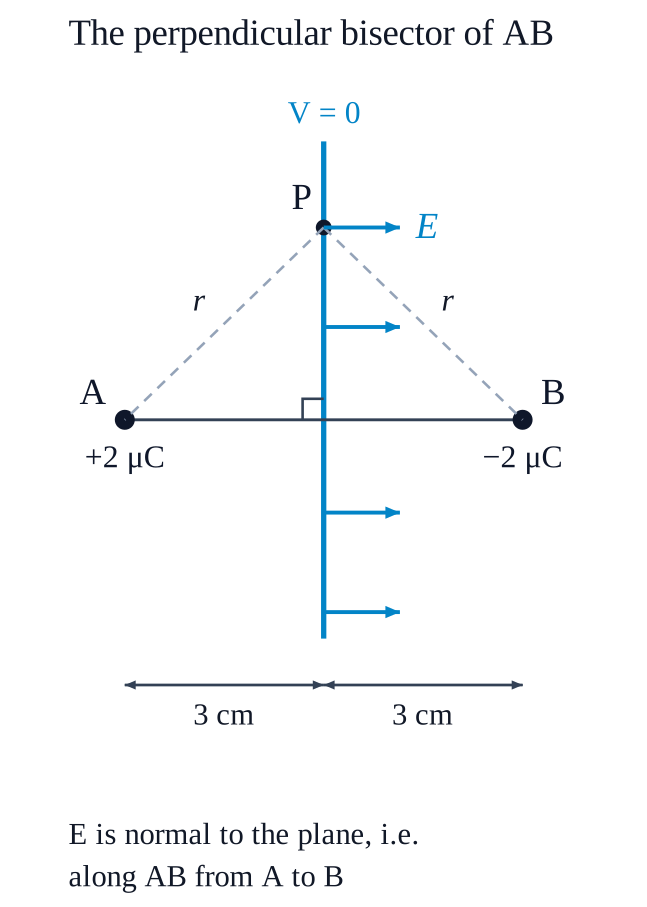
    The plane normal to AB and passing through its mid-point has zero potential everywhere. (b) Normal to the plane in the direction AB.
    NCERT_Solution_Class12_Physics_Ch2_Q2-3(a) For two equal and opposite charges, the plane that perpendicularly bisects the line AB (i.e. passes through the midpoint of AB, at right angles to AB) is an equipotential surface — every point on it is equidistant from \(\displaystyle +2\,\mu\mathrm{C}\) and \(\displaystyle -2\,\mu\mathrm{C}\), so the two contributions to \(\displaystyle V\) cancel and \(\displaystyle V=0\) everywhere on this plane.(b) The electric field is always perpendicular to an equipotential surface. Since this equipotential plane is perpendicular to AB, the field at every point on it is directed along AB, from A (the \(\displaystyle +2\,\mu\mathrm{C}\) charge) toward B (the \(\displaystyle -2\,\mu\mathrm{C}\) charge), i.e. normal to the plane.
  4. Exercise 2.4

    A spherical conductor of radius $\displaystyle 12$ cm has a charge of $\displaystyle 1.6$ × \(\displaystyle 10^{-7}\)C distributed uniformly on its surface. What is the electric field
    (a)
    inside the sphere
    (b)
    just outside the sphere
    (c)
    at a point $\displaystyle 18$ cm from the centre of the sphere?
    NCERT’s answer
    (a)
    Zero (b) \(\displaystyle 10^{5}\) N \(\displaystyle C^{-1}\) (c) $\displaystyle 4.4$ × \(\displaystyle 10^{4}\) N \(\displaystyle C^{-1}\)
    By Gauss's law, treating the uniformly charged conducting sphere's field (outside) as that of a point charge \(\displaystyle q\) at the centre, with \(\displaystyle R=12\,\mathrm{cm}=0.12\,\mathrm{m}\) and \(\displaystyle q=1.6\times10^{-7}\,\mathrm{C}\):(a) Inside the sphere: all the charge resides on the (conducting) surface, so the enclosed charge for any Gaussian surface inside is zero. \[E_{\text{inside}}=0\](b) Just outside the sphere (\(\displaystyle r=R=0.12\,\mathrm{m}\)): \[E=\frac{kq}{R^2}=\frac{(9\times10^{9})(1.6\times10^{-7})}{(0.12)^2}=\frac{1440}{0.0144}=1.0\times10^{5}\,\mathrm{N/C}\] (directed radially outward)(c) At \(\displaystyle r=18\,\mathrm{cm}=0.18\,\mathrm{m}\): \[E=\frac{kq}{r^2}=\frac{(9\times10^{9})(1.6\times10^{-7})}{(0.18)^2}=\frac{1440}{0.0324}\approx4.44\times10^{4}\,\mathrm{N/C}\] (directed radially outward)
  5. Exercise 2.5

    A parallel plate capacitor with air between the plates has a capacitance of $\displaystyle 8$ pF (1pF = \(\displaystyle 10^{-12}\) F). What will be the capacitance if the distance between the plates is reduced by half, and the space between them is filled with a substance of dielectric constant $\displaystyle 6$?
    NCERT’s answer
    $\displaystyle 96$ pF
    For a parallel-plate capacitor, \(\displaystyle C=\dfrac{K\epsilon_0 A}{d}\), so \(\displaystyle C\) is directly proportional to \(\displaystyle K\) and inversely proportional to \(\displaystyle d\). Originally (air, \(\displaystyle K=1\)): \(\displaystyle C_0=\dfrac{\epsilon_0 A}{d_0}=8\,\mathrm{pF}\).Now \(\displaystyle d_{\text{new}}=d_0/2\) and \(\displaystyle K=6\): \[C=\frac{K\epsilon_0 A}{d_0/2}=2K\cdot\frac{\epsilon_0 A}{d_0}=2K\,C_0=2\times6\times8\,\mathrm{pF}\]\(\displaystyle C=96\,\mathrm{pF}\)
  6. Exercise 2.6

    Three capacitors each of capacitance $\displaystyle 9$ pF are connected in series.
    (a)
    What is the total capacitance of the combination?
    (b)
    What is the potential difference across each capacitor if the combination is connected to a $\displaystyle 120$ V supply?
    NCERT’s answer
    (a)
    $\displaystyle 3$ pF (b) $\displaystyle 40$ V
    (a) For capacitors in series, reciprocals add. With each \(\displaystyle C=9\,\mathrm{pF}\): \[\frac{1}{C_{\text{eq}}}=\frac{1}{9}+\frac{1}{9}+\frac{1}{9}=\frac{3}{9}=\frac{1}{3}\ \Rightarrow\ C_{\text{eq}}=3\,\mathrm{pF}\](b) In a series combination, the same charge \(\displaystyle Q\) flows onto every capacitor: \[Q=C_{\text{eq}}V=(3\,\mathrm{pF})(120\,\mathrm{V})=360\,\mathrm{pC}\] Since all three capacitors are equal, the $\displaystyle 120$ V supply divides equally among them: \[V_{\text{each}}=\frac{Q}{9\,\mathrm{pF}}=\frac{360\,\mathrm{pC}}{9\,\mathrm{pF}}=40\,\mathrm{V}\]Each capacitor has a potential difference of $\displaystyle 40$ V across it.
  7. Exercise 2.7

    Three capacitors of capacitances $\displaystyle 2$ pF, $\displaystyle 3$ pF and $\displaystyle 4$ pF are connected in parallel.
    (a)
    What is the total capacitance of the combination?
    (b)
    Determine the charge on each capacitor if the combination is connected to a $\displaystyle 100$ V supply.
    NCERT’s answer
    (a)
    $\displaystyle 9$ pF (b) $\displaystyle 2$ × \(\displaystyle 10^{-10}\) C, $\displaystyle 3$ × \(\displaystyle 10^{-10}\) C, $\displaystyle 4$ × \(\displaystyle 10^{-10}\) C
    (a) For capacitors in parallel, capacitances simply add: \[C_{\text{eq}}=2+3+4=9\,\mathrm{pF}\](b) In a parallel combination, each capacitor has the full supply voltage \(\displaystyle V=100\,\mathrm{V}\) across it, so \(\displaystyle Q=CV\) for each individually: \[Q_1=(2\,\mathrm{pF})(100\,\mathrm{V})=200\,\mathrm{pC}=2\times10^{-10}\,\mathrm{C}\] \[Q_2=(3\,\mathrm{pF})(100\,\mathrm{V})=300\,\mathrm{pC}=3\times10^{-10}\,\mathrm{C}\] \[Q_3=(4\,\mathrm{pF})(100\,\mathrm{V})=400\,\mathrm{pC}=4\times10^{-10}\,\mathrm{C}\]
  8. Exercise 2.8

    In a parallel plate capacitor with air between the plates, each plate has an area of $\displaystyle 6$ × \(\displaystyle 10^{-3}\) \(\displaystyle m^{2}\) and the distance between the plates is $\displaystyle 3$ mm. Calculate the capacitance of the capacitor. If this capacitor is connected to a $\displaystyle 100$ V supply, what is the charge on each plate of the capacitor?
    NCERT’s answer
    $\displaystyle 18$ pF, $\displaystyle 1.8$ × \(\displaystyle 10^{-9}\) C
    For a parallel-plate capacitor with air between the plates, \(\displaystyle C=\dfrac{\epsilon_0 A}{d}\), with \(\displaystyle A=6\times10^{-3}\,\mathrm{m}^2\), \(\displaystyle d=3\,\mathrm{mm}=3\times10^{-3}\,\mathrm{m}\), \(\displaystyle \epsilon_0=8.854\times10^{-12}\,\mathrm{C^2/N\,m^2}\): \[C=\frac{(8.854\times10^{-12})(6\times10^{-3})}{3\times10^{-3}}=1.77\times10^{-11}\,\mathrm{F}\approx17.7\,\mathrm{pF}\]With \(\displaystyle V=100\,\mathrm{V}\): \[Q=CV=(1.77\times10^{-11}\,\mathrm{F})(100\,\mathrm{V})=1.77\times10^{-9}\,\mathrm{C}\]\(\displaystyle C\approx17.7\,\mathrm{pF}\); charge on each plate \(\displaystyle \approx1.77\times10^{-9}\,\mathrm{C}\) (equal and opposite).
  9. Exercise 2.9

    Explain what would happen if in the capacitor given in Exercise $\displaystyle 2.8$, a $\displaystyle 3$ mm thick mica sheet (of dielectric constant = $\displaystyle 6$) were inserted between the plates,
    (a)
    while the voltage supply remained connected.
    (b)
    after the supply was disconnected.

    Disagrees with the book

    This working does not reach the answer printed in NCERT. One of the two is wrong and it has not yet been settled which — check it before you rely on it.

    NCERT’s answer
    (a)
    V = $\displaystyle 100$ V, C = $\displaystyle 108$ pF, Q = $\displaystyle 1.08$ × \(\displaystyle 10^{-8}\) C (b) Q = $\displaystyle 1.8$ × \(\displaystyle 10^{-9}\) C, C = $\displaystyle 108$ pF, V = $\displaystyle 16.6$ V
    The mica sheet (\(\displaystyle K=6\)) is exactly as thick as the original $\displaystyle 3$ mm gap, so it fills the whole gap and the new capacitance is \(\displaystyle C'=KC_0=6\times17.7\,\mathrm{pF}\approx106\,\mathrm{pF}\) (using \(\displaystyle C_0\approx17.7\,\mathrm{pF}\) from Q2.8).(a) Voltage supply still connected — \(\displaystyle V\) is held fixed at $\displaystyle 100$ V by the battery, so \[Q'=C'V=(1.06\times10^{-10}\,\mathrm{F})(100\,\mathrm{V})\approx1.06\times10^{-8}\,\mathrm{C}\] The charge increases (from \(\displaystyle 1.77\times10^{-9}\,\mathrm{C}\) to \(\displaystyle \approx1.06\times10^{-8}\,\mathrm{C}\)) as the battery supplies more charge; since \(\displaystyle U=\tfrac12 CV^2\) with \(\displaystyle V\) fixed, the stored energy also increases by the same factor of 6.(b) Supply disconnected first — the charge \(\displaystyle Q_0\approx1.77\times10^{-9}\,\mathrm{C}\) is now isolated and stays constant. As \(\displaystyle C\) rises to \(\displaystyle C'=6C_0\), the voltage falls: \[V'=\frac{Q_0}{C'}=\frac{V_0}{K}=\frac{100\,\mathrm{V}}{6}\approx16.7\,\mathrm{V}\] Since \(\displaystyle U=\dfrac{Q_0^2}{2C}\) with \(\displaystyle Q_0\) fixed and \(\displaystyle C\) increased $\displaystyle 6$-fold, the stored energy decreases to \(\displaystyle 1/6\) of its original value.
  10. Exercise 2.10

    A 12pF capacitor is connected to a 50V battery. How much electrostatic energy is stored in the capacitor?
    NCERT’s answer
    1.$\displaystyle 5$ × \(\displaystyle 10^{-8}\) J
    Energy stored in a charged capacitor: \(\displaystyle U=\dfrac12 CV^2\), with \(\displaystyle C=12\,\mathrm{pF}=12\times10^{-12}\,\mathrm{F}\), \(\displaystyle V=50\,\mathrm{V}\). \[U=\frac12(12\times10^{-12})(50)^2=\frac12(12\times10^{-12})(2500)\] \[U=1.5\times10^{-8}\,\mathrm{J}\]\(\displaystyle U=1.5\times10^{-8}\,\mathrm{J}\)
  11. Exercise 2.11

    A 600pF capacitor is charged by a 200V supply. It is then disconnected from the supply and is connected to another uncharged $\displaystyle 600$ pF capacitor. How much electrostatic energy is lost in the process?

    Disagrees with the book

    This working does not reach the answer printed in NCERT. One of the two is wrong and it has not yet been settled which — check it before you rely on it.

    NCERT’s answer
    $\displaystyle 6$ × \(\displaystyle 10^{-6}\) J
    Before connection, \(\displaystyle C_1=600\,\mathrm{pF}\) is charged to \(\displaystyle V_0=200\,\mathrm{V}\): \[Q_0=C_1V_0=(600\times10^{-12})(200)=1.2\times10^{-7}\,\mathrm{C}\] \[U_i=\tfrac12 C_1V_0^2=\tfrac12(600\times10^{-12})(200)^2=1.2\times10^{-8}\,\mathrm{J}\]After connection to the uncharged \(\displaystyle C_2=600\,\mathrm{pF}\), charge redistributes (charge is conserved) until both share a common potential \(\displaystyle V'\), by conservation of charge \(\displaystyle Q_0=(C_1+C_2)V'\): \[V'=\frac{Q_0}{C_1+C_2}=\frac{1.2\times10^{-7}}{1200\times10^{-12}}=100\,\mathrm{V}\] \[U_f=\tfrac12(C_1+C_2)V'^2=\tfrac12(1200\times10^{-12})(100)^2=6\times10^{-9}\,\mathrm{J}\]Energy lost (dissipated as heat/radiation during the redistribution, since this is not a reversible process): \[\Delta U=U_i-U_f=1.2\times10^{-8}-6\times10^{-9}=6\times10^{-9}\,\mathrm{J}\]\(\displaystyle \Delta U=6\times10^{-9}\,\mathrm{J}\) is lost.