SolveItNCERT · CBSE Boards

NCERT Solutions · Class 12 Physics Wave Optics

6 exercises · 3 still being checked

Exercises 10.1–10.6

  1. Exercise 10.1

    Monochromatic light of wavelength $\displaystyle 589$ nm is incident from air on a water surface. What are the wavelength, frequency and speed of
    (a)
    reflected, and
    (b)
    refracted light? Refractive index of water is 1.33.
    NCERT’s answer
    (a)
    Reflected light: (wavelength, frequency, speed same as incident light) λ = $\displaystyle 589$ nm, ν = $\displaystyle 5.09$ × \(\displaystyle 10^{14}\) Hz, c = $\displaystyle 3.00$ × \(\displaystyle 10^{8}\) m \(\displaystyle s^{-1}\) (b) Refracted light: (frequency same as the incident frequency) ν = $\displaystyle 5.09$ × \(\displaystyle 10^{14}\)Hz v = (c/n) = $\displaystyle 2.26$ × \(\displaystyle 10^{8}\) m \(\displaystyle s^{-1}\), λ = (v/ν) = $\displaystyle 444$ nm
    Speed of light in air \(\displaystyle c = 3\times10^{8}\ \mathrm{m/s}\), incident wavelength \(\displaystyle \lambda = 589\ \mathrm{nm}\), refractive index of water \(\displaystyle n = 1.33\).Frequency of the incident light (fixed by the source, unaffected by reflection or refraction): \[\nu = \frac{c}{\lambda} = \frac{3\times10^{8}}{589\times10^{-9}} = 5.09\times10^{14}\ \mathrm{Hz} \](a) Reflected light stays in the same medium (air), so its wavelength, frequency, and speed are all unchanged from the incident ray: \[\boxed{\lambda_{\text{refl}} = 589\ \mathrm{nm},\quad \nu_{\text{refl}} = 5.09\times10^{14}\ \mathrm{Hz},\quad v_{\text{refl}} = 3\times10^{8}\ \mathrm{m/s}} \](b) Refracted light: on entering water the frequency stays fixed (it is set by the source), but the speed changes to \(\displaystyle v = c/n\), and correspondingly the wavelength changes to \(\displaystyle \lambda' = \lambda/n\): \[v' = \frac{c}{n} = \frac{3\times10^{8}}{1.33} = 2.26\times10^{8}\ \mathrm{m/s} \] \[\lambda' = \frac{\lambda}{n} = \frac{589\ \mathrm{nm}}{1.33} = 442.9\ \mathrm{nm} \] Refracted light: \(\displaystyle \lambda' \approx 443\ \mathrm{nm}\), \(\displaystyle \nu' = 5.09\times10^{14}\ \mathrm{Hz}\) (unchanged), \(\displaystyle v' = 2.26\times10^{8}\ \mathrm{m/s}\).
  2. Exercise 10.2

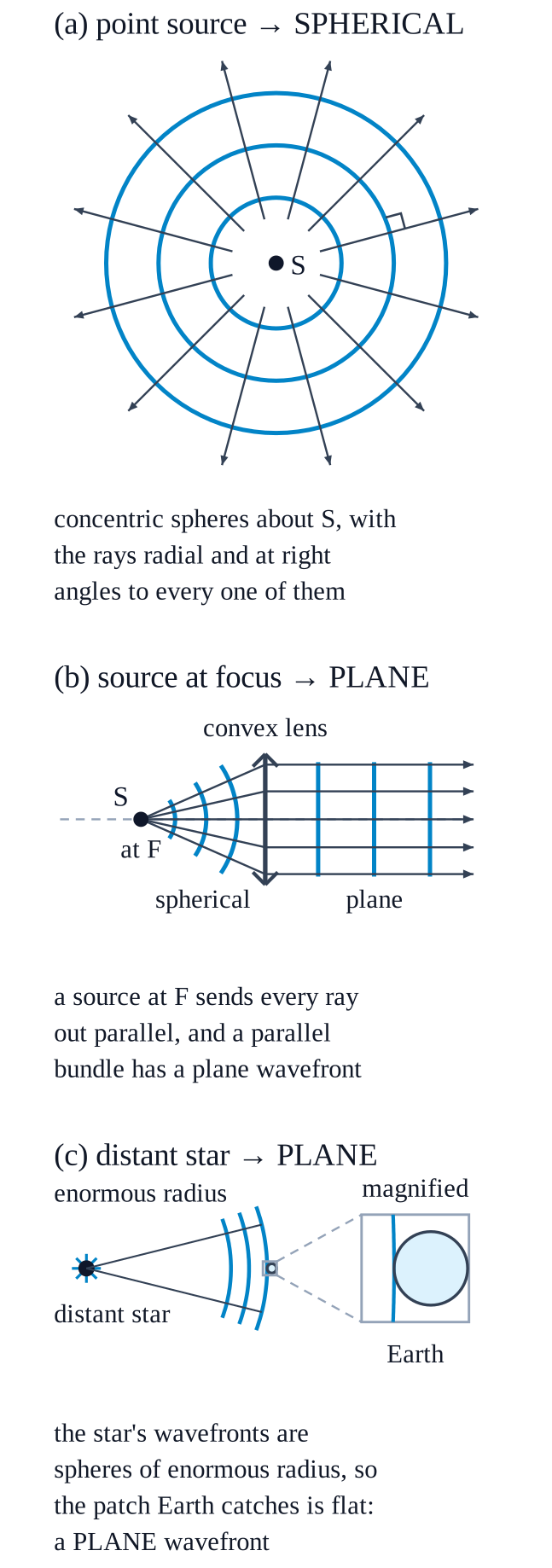
    What is the shape of the wavefront in each of the following cases:
    (a)
    Light diverging from a point source.
    (b)
    Light emerging out of a convex lens when a point source is placed at its focus.
    (c)
    The portion of the wavefront of light from a distant star intercepted by the Earth.

    Not cross-checked

    NCERT prints no numerical answer for this exercise, so this working has not been cross-checked against the book.

    NCERT’s answer
    (a)
    Spherical (b) Plane (c) Plane (a small area on the surface of a large sphere is nearly planar).
    NCERT_Solution_Class12_Physics_Ch10_Q10-2A wavefront is the locus of points that a source's disturbance reaches simultaneously (a surface of constant phase), and by Huygens' construction its shape follows directly from the geometry of the source.(a) Light diverging from a point source: the disturbance spreads out equally in all directions at the same speed, so surfaces of constant phase are concentric spheres centred on the source — the wavefront is spherical.(b) Light emerging from a convex lens with a point source at its focus: a source at the focus produces rays that emerge parallel to the axis after refraction through the lens, and a bundle of parallel rays corresponds to wavefronts perpendicular to them everywhere — the emergent wavefront is plane.(c) The portion of a distant star's wavefront intercepted by Earth: the star's light forms spherical wavefronts of enormous radius (the star–Earth distance is astronomically large); the small patch of that sphere spanning the Earth's size is, to excellent approximation, flat — the intercepted wavefront is plane.
  3. Exercise 10.3

    (a)
    The refractive index of glass is 1.5. What is the speed of light in glass? (Speed of light in vacuum is $\displaystyle 3.0$ × \(\displaystyle 10^{8}\)m \(\displaystyle s^{-1}\))
    (b)
    Is the speed of light in glass independent of the colour of light? If not, which of the two colours red and violet travels slower in a glass prism?
    NCERT’s answer
    (a)
    2.$\displaystyle 0$ × \(\displaystyle 10^{8}\)m \(\displaystyle s^{-1}\) (b) No. The refractive index, and hence the speed of light in a medium, depends on wavelength. [When no particular wavelength or colour of light is specified, we may take the given refractive index to refer to yellow colour.] Now we know violet colour deviates more than red in a glass prism, i.e. \(\displaystyle n_{v}\) > \(\displaystyle n_{r}\). Therefore, the violet component of white light travels slower than the red component.
    (a) Refractive index relates the speed of light in vacuum to the speed in the medium: \(\displaystyle n = c/v\), so \[v = \frac{c}{n} = \frac{3.0\times10^{8}\ \mathrm{m\,s^{-1}}}{1.5} = 2.0\times10^{8}\ \mathrm{m\,s^{-1}} \] Speed of light in glass \(\displaystyle = 2.0\times10^{8}\ \mathrm{m\,s^{-1}}\).(b) No — the refractive index of a medium is not the same for all wavelengths (this is dispersion); \(\displaystyle n\) increases as wavelength decreases, so violet light (shorter wavelength) has a higher refractive index than red light (longer wavelength) in glass. Since \(\displaystyle v = c/n\), a larger \(\displaystyle n\) means a smaller speed. Violet light travels slower than red light in a glass prism.
  4. Exercise 10.4

    In a Young’s double-slit experiment, the slits are separated by $\displaystyle 0.28$ mm and the screen is placed $\displaystyle 1.4$ m away. The distance between the central bright fringe and the fourth bright fringe is measured to be $\displaystyle 1.2$ cm. Determine the wavelength of light used in the experiment.

    Disagrees with the book

    This working does not reach the answer printed in NCERT. One of the two is wrong and it has not yet been settled which — check it before you rely on it.

    NCERT’s answer
    λ= × × × × $\displaystyle 1$ $\displaystyle 2$ $\displaystyle 10$ $\displaystyle 0$ $\displaystyle 28$ $\displaystyle 10$ $\displaystyle 4$ $\displaystyle 14$ . . . - $\displaystyle 2$ - $\displaystyle 3$ m = $\displaystyle 600$ nm
    Young's double-slit fringe formula: the position of the \(\displaystyle n\)-th bright fringe from the central maximum is \[y_n = \frac{n\lambda D}{d} \] Given slit separation \(\displaystyle d = 0.28\ \mathrm{mm} = 0.28\times10^{-3}\ \mathrm{m}\), screen distance \(\displaystyle D = 1.4\ \mathrm{m}\), and the 4th bright fringe at \(\displaystyle y_4 = 1.2\ \mathrm{cm} = 1.2\times10^{-2}\ \mathrm{m}\) from the centre, solve for \(\displaystyle \lambda\): \[\lambda = \frac{y_4\, d}{nD} = \frac{(1.2\times10^{-2})(0.28\times10^{-3})}{4\times1.4} \] \[\lambda = \frac{3.36\times10^{-6}}{5.6} = 6.0\times10^{-7}\ \mathrm{m} \] \(\displaystyle \lambda = 600\ \mathrm{nm}\).
  5. Exercise 10.5

    In Young’s double-slit experiment using monochromatic light of wavelength λ, the intensity of light at a point on the screen where path difference is λ, is K units. What is the intensity of light at a point where path difference is λ/$\displaystyle 3$?
    NCERT’s answer
    K/$\displaystyle 4$
    In Young's double-slit experiment the resultant intensity at a point where the path difference is \(\displaystyle \Delta\) (phase difference \(\displaystyle \phi = \frac{2\pi}{\lambda}\Delta\)) is \[I = I_{\max}\cos^{2}\!\left(\frac{\phi}{2}\right) \]At path difference \(\displaystyle \Delta = \lambda\): \(\displaystyle \phi = 2\pi\), so \(\displaystyle I = I_{\max}\cos^{2}(\pi) = I_{\max}\). This point is given to have intensity \(\displaystyle K\), so \(\displaystyle I_{\max} = K\).At path difference \(\displaystyle \Delta = \lambda/3\): \(\displaystyle \phi = \frac{2\pi}{\lambda}\cdot\frac{\lambda}{3} = \frac{2\pi}{3}\), so \[I = K\cos^{2}\!\left(\frac{\pi}{3}\right) = K\left(\frac{1}{2}\right)^{2} = \frac{K}{4} \] Intensity at path difference \(\displaystyle \lambda/3\) is \(\displaystyle K/4\).
  6. Exercise 10.6

    A beam of light consisting of two wavelengths, $\displaystyle 650$ nm and $\displaystyle 520$ nm, is used to obtain interference fringes in a Young’s double-slit experiment.
    (a)
    Find the distance of the third bright fringe on the screen from the central maximum for wavelength $\displaystyle 650$ nm.
    (b)
    What is the least distance from the central maximum where the bright fringes due to both the wavelengths coincide?
    NCERT’s answer
    (a)
    1.$\displaystyle 17$ mm (b) $\displaystyle 1.56$ mm

    Working being prepared