SolveItNCERT · CBSE Boards

NCERT Solutions · Class 12 Physics Current Electricity

9 exercises · 1 still being checked

Exercises 3.1–3.9

  1. Exercise 3.1

    The storage battery of a car has an emf of $\displaystyle 12$ V. If the internal resistance of the battery is $\displaystyle 0.4$ Ω, what is the maximum current that can be drawn from the battery?
    NCERT’s answer
    $\displaystyle 30$ A
    Maximum current is drawn when the external resistance is zero (short-circuit), so the entire emf drives current only against the internal resistance: \(\displaystyle I_{max} = \dfrac{\varepsilon}{r}\).\[I_{max} = \frac{12\ \mathrm{V}}{0.4\ \Omega} \]\(\displaystyle I_{max} = 30\ \mathrm{A}\)
  2. Exercise 3.2

    A battery of emf $\displaystyle 10$ V and internal resistance $\displaystyle 3$ Ω is connected to a resistor. If the current in the circuit is $\displaystyle 0.5$ A, what is the resistance of the resistor? What is the terminal voltage of the battery when the circuit is closed?
    NCERT’s answer
    $\displaystyle 17$ Ω, $\displaystyle 8.5$ V
    For a battery of emf \(\displaystyle \varepsilon\) and internal resistance \(\displaystyle r\) driving current \(\displaystyle I\) through external resistance \(\displaystyle R\): \(\displaystyle \varepsilon = I(R+r)\).\[10\ \mathrm{V} = 0.5\ \mathrm{A}\,(R + 3\ \Omega) \] \[R + 3\ \Omega = 20\ \Omega \]\(\displaystyle R = 17\ \Omega\)Terminal voltage is the potential drop across the external resistance (equivalently \(\displaystyle \varepsilon - Ir\)):\[V = IR = 0.5\ \mathrm{A} \times 17\ \Omega \]\(\displaystyle V = 8.5\ \mathrm{V}\)
  3. Exercise 3.3

    At room temperature ($\displaystyle 27.0$ °C) the resistance of a heating element is $\displaystyle 100$ Ω. What is the temperature of the element if the resistance is found to be $\displaystyle 117$ Ω, given that the temperature coefficient of the material of the resistor is $\displaystyle 1.70$ × \(\displaystyle 10^{-4}\) °\(\displaystyle C^{-1}\).
    NCERT’s answer
    $\displaystyle 1027$ °C
    Resistance varies with temperature as \(\displaystyle R = R_0\,[1 + \alpha (T - T_0)]\), with \(\displaystyle R_0 = 100\ \Omega\) at \(\displaystyle T_0 = 27.0\ ^\circ\mathrm{C}\) and \(\displaystyle \alpha = 1.70\times10^{-4}\ ^\circ\mathrm{C}^{-1}\).\[117\ \Omega = 100\ \Omega\,[1 + 1.70\times10^{-4}(T - 27.0)] \] \[0.17 = 1.70\times10^{-4}(T-27.0) \] \[T - 27.0 = 1000\ ^\circ\mathrm{C} \]\(\displaystyle T = 1027\ ^\circ\mathrm{C}\)
  4. Exercise 3.4

    A negligibly small current is passed through a wire of length $\displaystyle 15$ m and uniform cross-section $\displaystyle 6.0$ × \(\displaystyle 10^{-7}\) \(\displaystyle m^{2}\), and its resistance is measured to be $\displaystyle 5.0$ Ω. What is the resistivity of the material at the temperature of the experiment?
    NCERT’s answer
    2.$\displaystyle 0$ × \(\displaystyle 10^{-7}\) Ωm
    Resistance relates to resistivity by \(\displaystyle R = \rho \dfrac{L}{A}\), so \(\displaystyle \rho = \dfrac{RA}{L}\).\[\rho = \frac{(5.0\ \Omega)(6.0\times10^{-7}\ \mathrm{m^2})}{15\ \mathrm{m}} \]\(\displaystyle \rho = 2.0\times10^{-7}\ \Omega\,\mathrm{m}\)
  5. Exercise 3.5

    A silver wire has a resistance of $\displaystyle 2.1$ Ω at $\displaystyle 27.5$ °C, and a resistance of $\displaystyle 2.7$ Ω at $\displaystyle 100$ °C. Determine the temperature coefficient of resistivity of silver.
    NCERT’s answer
    0.$\displaystyle 0039$ °\(\displaystyle C^{-1}\)
    Using \(\displaystyle R = R_0[1+\alpha(T-T_0)]\) between the two measured states, \(\displaystyle \alpha = \dfrac{R_2 - R_1}{R_1 (T_2 - T_1)}\), with \(\displaystyle R_1 = 2.1\ \Omega\) at \(\displaystyle T_1 = 27.5\ ^\circ\mathrm{C}\) and \(\displaystyle R_2 = 2.7\ \Omega\) at \(\displaystyle T_2 = 100\ ^\circ\mathrm{C}\).\[\alpha = \frac{2.7\ \Omega - 2.1\ \Omega}{(2.1\ \Omega)(100\ ^\circ\mathrm{C} - 27.5\ ^\circ\mathrm{C})} = \frac{0.6}{2.1 \times 72.5} \]\(\displaystyle \alpha \approx 3.94\times10^{-3}\ ^\circ\mathrm{C}^{-1}\)
  6. Exercise 3.6

    A heating element using nichrome connected to a $\displaystyle 230$ V supply draws an initial current of $\displaystyle 3.2$ A which settles after a few seconds to a steady value of $\displaystyle 2.8$ A. What is the steady temperature of the heating element if the room temperature is $\displaystyle 27.0$ °C? Temperature coefficient of resistance of nichrome averaged over the temperature range involved is $\displaystyle 1.70$ × \(\displaystyle 10^{-4}\) °\(\displaystyle C^{-1}\).
    NCERT’s answer
    $\displaystyle 867$ °C
    At each stage, resistance follows Ohm's law \(\displaystyle R = V/I\), with \(\displaystyle V = 230\ \mathrm{V}\) fixed.Initial (room temperature, \(\displaystyle T_0 = 27.0\ ^\circ\mathrm{C}\)): \(\displaystyle R_1 = \dfrac{230}{3.2} = 71.875\ \Omega\).Steady state: \(\displaystyle R_2 = \dfrac{230}{2.8} = 82.143\ \Omega\).Using \(\displaystyle R_2 = R_1[1+\alpha(T-T_0)]\) with \(\displaystyle \alpha = 1.70\times10^{-4}\ ^\circ\mathrm{C}^{-1}\):\[\frac{82.143}{71.875} - 1 = 1.70\times10^{-4}(T-27.0) \] \[0.1429 = 1.70\times10^{-4}(T-27.0) \] \[T - 27.0 \approx 840\ ^\circ\mathrm{C} \]\(\displaystyle T \approx 867\ ^\circ\mathrm{C}\)
  7. Exercise 3.7

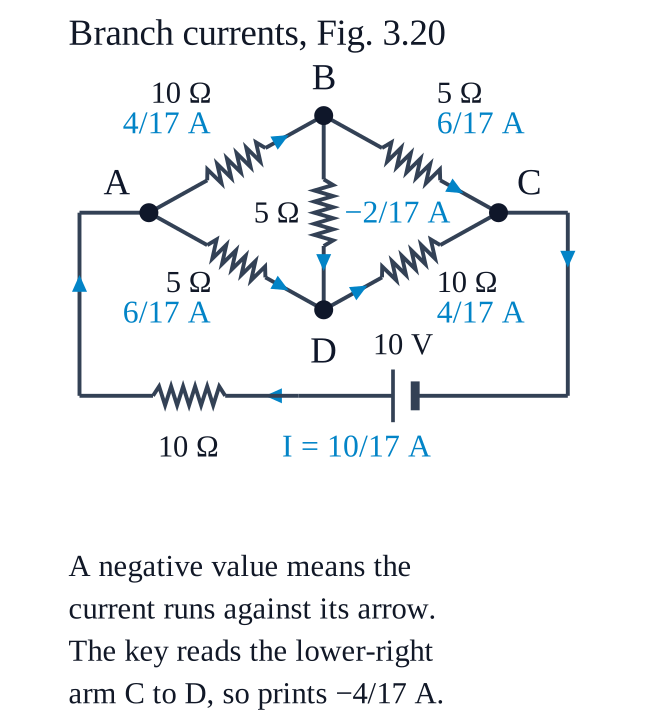
    NCERT_Question_Class12_Physics_Ch3_Q3-7 Determine the current in each branch of the network shown in Fig. $\displaystyle 3.20$:

    Matches the book, not yet reviewed

    This working reaches the answer NCERT prints. It has not yet been read through by hand.

    NCERT’s answer
    Current in branch AB = ($\displaystyle 4$/$\displaystyle 17$) A, in BC = ($\displaystyle 6$/$\displaystyle 17$) A, in CD = (-$\displaystyle 4$/$\displaystyle 17$) A, in AD = ($\displaystyle 6$/$\displaystyle 17$) A, in BD. = (-$\displaystyle 2$/$\displaystyle 17$) A, total current = ($\displaystyle 10$/$\displaystyle 17$) A.
    NCERT_Solution_Class12_Physics_Ch3_Q3-7The bridge is not balanced — \(\displaystyle \frac{AB}{BC}=\frac{10}{5}=2\) while \(\displaystyle \frac{AD}{DC}=\frac{5}{10}=\tfrac12\) — so a current does cross BD and Kirchhoff's rules are needed rather than a series–parallel reduction.Let \(\displaystyle I_1\) flow A→B, \(\displaystyle I_2\) flow A→D and \(\displaystyle I_3\) flow D→B. Applying the junction rule at A, B and D and the loop rule round ABDA, BCDB and the outer circuit through the cell gives\[I_1=\tfrac{4}{17}\ \mathrm{A},\qquad I_2=\tfrac{6}{17}\ \mathrm{A},\qquad I_3=\tfrac{2}{17}\ \mathrm{A}\ (\text{from D to B}) \]so the branch currents are
    AB = $\displaystyle 4$/$\displaystyle 17$ A ≈ $\displaystyle 0.24$ A
    BC = I₁ + I₃ = $\displaystyle 6$/$\displaystyle 17$ A ≈ $\displaystyle 0.35$ A
    AD = $\displaystyle 6$/$\displaystyle 17$ A ≈ $\displaystyle 0.35$ A
    DC = I₂ − I₃ = $\displaystyle 4$/$\displaystyle 17$ A, flowing D→C. The key names this branch CD and so
    prints it as −$\displaystyle 4$/$\displaystyle 17$ A — the same current, read the other way round.
    BD = $\displaystyle 2$/$\displaystyle 17$ A, flowing D→B; printed as −$\displaystyle 2$/$\displaystyle 17$ A for the same reason.
    Total drawn from the cell = $\displaystyle 10$/$\displaystyle 17$ A ≈ $\displaystyle 0.59$ A
    Check. From A to C by ABC: \(\displaystyle \tfrac{4}{17}(10)+\tfrac{6}{17}(5)=\tfrac{70}{17}\ \mathrm{V}\); by ADC: \(\displaystyle \tfrac{6}{17}(5)+\tfrac{4}{17}(10)=\tfrac{70}{17}\ \mathrm{V}\). The two paths agree, as they must. Adding the drop across the $\displaystyle 10$ Ω in series with the cell, \(\displaystyle \tfrac{70}{17}+\tfrac{10}{17}(10)=\tfrac{170}{17}=10\ \mathrm{V}\), the emf.
  8. Exercise 3.8

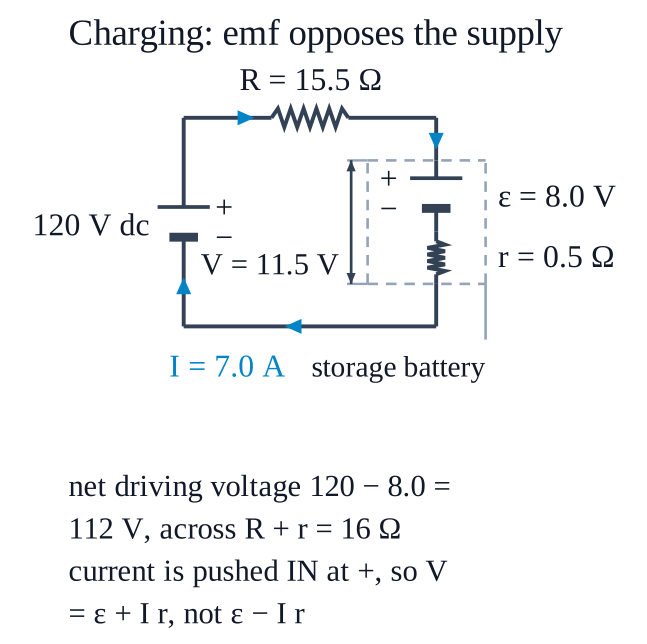
    A storage battery of emf $\displaystyle 8.0$ V and internal resistance $\displaystyle 0.5$ Ω is being charged by a $\displaystyle 120$ V dc supply using a series resistor of $\displaystyle 15.5$ Ω. What is the terminal voltage of the battery during charging? What is the purpose of having a series resistor in the charging circuit?
    NCERT’s answer
    11.$\displaystyle 5$ V; the series resistor limits the current drawn from the external source. In its absence, the current will be dangerously high.
    NCERT_Solution_Class12_Physics_Ch3_Q3-8During charging, the $\displaystyle 120$ V supply drives current against the battery's emf, so the net driving voltage is \(\displaystyle V_{supply} - \varepsilon\), opposed by the series resistor \(\displaystyle R\) and the battery's internal resistance \(\displaystyle r\):\[I = \frac{V_{supply} - \varepsilon}{R + r} = \frac{120\ \mathrm{V} - 8.0\ \mathrm{V}}{15.5\ \Omega + 0.5\ \Omega} = \frac{112\ \mathrm{V}}{16\ \Omega} \]\[I = 7.0\ \mathrm{A} \]During charging, current is forced into the battery against its emf, so the terminal voltage exceeds the emf by the drop across the internal resistance:\[V_{terminal} = \varepsilon + I r = 8.0\ \mathrm{V} + (7.0\ \mathrm{A})(0.5\ \Omega) \]\(\displaystyle V_{terminal} = 11.5\ \mathrm{V}\)The series resistor limits the charging current to a safe value — without it, the small internal resistance alone would let an excessively large current flow (since \(\displaystyle V_{supply}\) far exceeds \(\displaystyle \varepsilon\)), which could damage the battery.
  9. Exercise 3.9

    The number density of free electrons in a copper conductor estimated in Example $\displaystyle 3.1$ is $\displaystyle 8.5$ × \(\displaystyle 10^{28}\) \(\displaystyle m^{-3}\). How long does an electron take to drift from one end of a wire $\displaystyle 3.0$ m long to its other end? The area of cross-section of the wire is $\displaystyle 2.0$ × \(\displaystyle 10^{-6}\) \(\displaystyle m^{2}\) and it is carrying a current of $\displaystyle 3.0$ A.
    NCERT’s answer
    2.$\displaystyle 7$ × \(\displaystyle 10^{4}\) s ($\displaystyle 7.5$ h)
    Current relates to drift velocity by \(\displaystyle I = n e A v_d\), so \(\displaystyle v_d = \dfrac{I}{neA}\), and the drift time across length \(\displaystyle L\) is \(\displaystyle t = \dfrac{L}{v_d} = \dfrac{L n e A}{I}\).\[t = \frac{(3.0\ \mathrm{m})(8.5\times10^{28}\ \mathrm{m^{-3}})(1.6\times10^{-19}\ \mathrm{C})(2.0\times10^{-6}\ \mathrm{m^2})}{3.0\ \mathrm{A}} \]\[t = (8.5\times10^{28})(1.6\times10^{-19})(2.0\times10^{-6}) \]\(\displaystyle t \approx 2.7\times10^{4}\ \mathrm{s} \approx 7.6\ \mathrm{hours}\)