SolveItNCERT · CBSE Boards

NCERT Solutions · Class 12 Physics Alternating Current

8 exercises · 1 still being checked

Exercises 7.1–7.8

  1. Exercise 7.1

    A $\displaystyle 100$ Ω resistor is connected to a $\displaystyle 220$ V, $\displaystyle 50$ Hz ac supply.
    (a)
    What is the rms value of current in the circuit?
    (b)
    What is the net power consumed over a full cycle?
    NCERT’s answer
    (a)
    2.$\displaystyle 20$ A (b) $\displaystyle 484$ W
    For a pure resistor, Ohm's law applies directly to rms values: \(\displaystyle I_{rms} = V_{rms}/R\).
    (a)
    \[I_{rms} = \frac{V_{rms}}{R} = \frac{220\,\mathrm{V}}{100\,\Omega} = 2.2\,\mathrm{A}\]
    (b)
    Average power over a full cycle for a resistor: \(\displaystyle P = I_{rms}^2 R = V_{rms} I_{rms}\).
    \[P = (2.2\,\mathrm{A})^2 (100\,\Omega) = 484\,\mathrm{W}\]
    \(\displaystyle I_{rms} = 2.2\,\mathrm{A}\); \(\displaystyle P = 484\,\mathrm{W}\).
  2. Exercise 7.2

    (a)
    The peak voltage of an ac supply is $\displaystyle 300$ V. What is the rms voltage?
    (b)
    The rms value of current in an ac circuit is $\displaystyle 10$ A. What is the peak current?

    Disagrees with the book

    This working does not reach the answer printed in NCERT. One of the two is wrong and it has not yet been settled which — check it before you rely on it.

    NCERT’s answer
    (a)
    $\displaystyle 300$ $\displaystyle 2$ $\displaystyle 2121$ = . V (b) $\displaystyle 10$ $\displaystyle 2$ $\displaystyle 141$ = . A
    Relation between peak and rms values of a sinusoid: \(\displaystyle V_{rms} = V_0/\sqrt{2}\), \(\displaystyle I_0 = \sqrt{2}\,I_{rms}\).
    (a)
    \[V_{rms} = \frac{300\,\mathrm{V}}{\sqrt{2}} = 212.1\,\mathrm{V}\]
    (b)
    \[I_0 = \sqrt{2}\,(10\,\mathrm{A}) = 14.14\,\mathrm{A}\]
    \(\displaystyle V_{rms} = 212.1\,\mathrm{V}\); \(\displaystyle I_0 = 14.14\,\mathrm{A}\).
  3. Exercise 7.3

    A $\displaystyle 44$ mH inductor is connected to $\displaystyle 220$ V, $\displaystyle 50$ Hz ac supply. Determine the rms value of the current in the circuit.
    NCERT’s answer
    15.$\displaystyle 9$ A
    For a pure inductor, the opposition to ac is the inductive reactance \(\displaystyle X_L = \omega L = 2\pi f L\), and \(\displaystyle I_{rms} = V_{rms}/X_L\).\[X_L = 2\pi (50\,\mathrm{Hz})(44\times10^{-3}\,\mathrm{H}) = 13.82\,\Omega\]\[I_{rms} = \frac{220\,\mathrm{V}}{13.82\,\Omega} = 15.92\,\mathrm{A}\]\(\displaystyle I_{rms} \approx 15.9\,\mathrm{A}\).
  4. Exercise 7.4

    A $\displaystyle 60$ μF capacitor is connected to a $\displaystyle 110$ V, $\displaystyle 60$ Hz ac supply. Determine the rms value of the current in the circuit.
    NCERT’s answer
    2.$\displaystyle 49$ A
    For a pure capacitor, the opposition to ac is the capacitive reactance \(\displaystyle X_C = 1/(\omega C) = 1/(2\pi f C)\), and \(\displaystyle I_{rms} = V_{rms}/X_C\).\[X_C = \frac{1}{2\pi (60\,\mathrm{Hz})(60\times10^{-6}\,\mathrm{F})} = 44.2\,\Omega\]\[I_{rms} = \frac{110\,\mathrm{V}}{44.2\,\Omega} = 2.49\,\mathrm{A}\]\(\displaystyle I_{rms} \approx 2.49\,\mathrm{A}\).
  5. Exercise 7.5

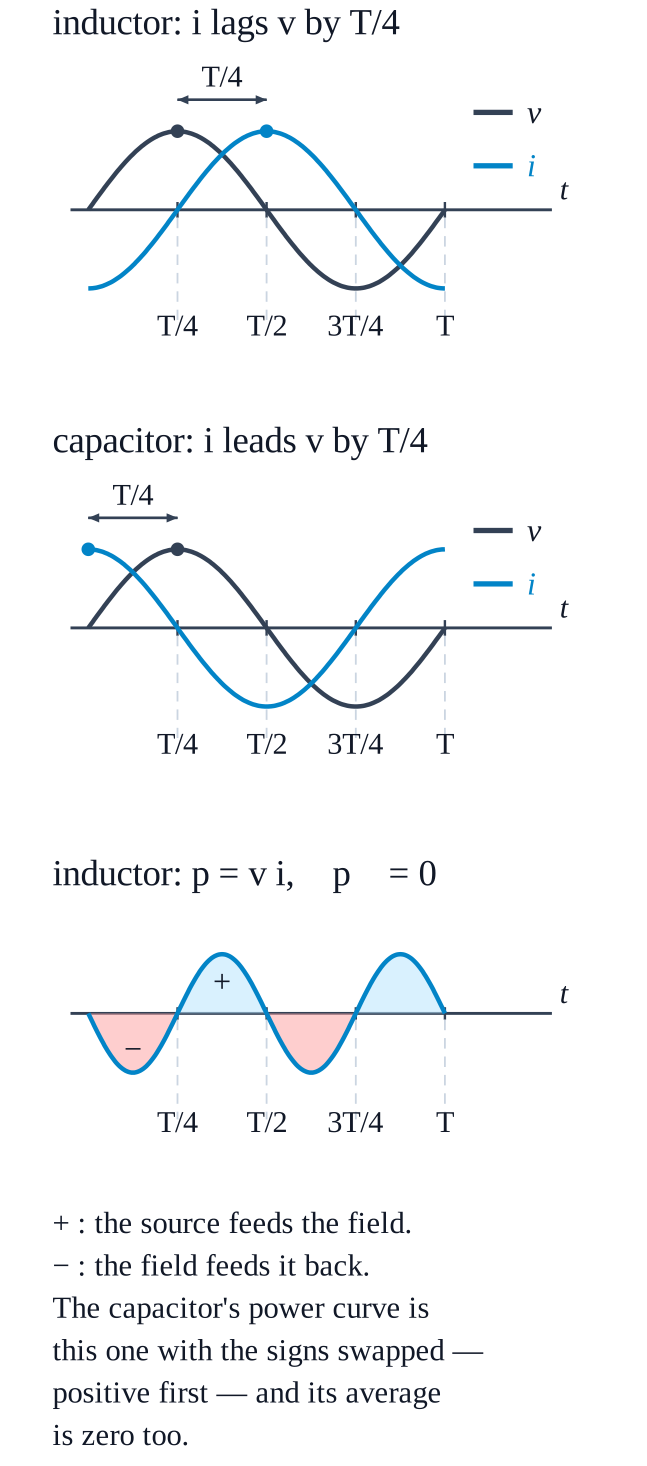
    In Exercises $\displaystyle 7.3$ and $\displaystyle 7.4$, what is the net power absorbed by each circuit over a complete cycle. Explain your answer.
    NCERT’s answer
    Zero in each case.
    NCERT_Solution_Class12_Physics_Ch7_Q7-5In a purely inductive or purely capacitive ac circuit the current and voltage are \(\displaystyle 90^\circ\) out of phase (current lags voltage by \(\displaystyle \pi/2\) in the inductor; current leads voltage by \(\displaystyle \pi/2\) in the capacitor). Instantaneous power is \(\displaystyle p = v i = V_0 I_0 \sin(\omega t)\sin(\omega t \pm \pi/2) = \pm V_0 I_0 \sin(\omega t)\cos(\omega t)\), whose average over a full cycle is zero because \(\displaystyle \langle \sin\omega t \cos\omega t\rangle = 0\).So for both the inductor circuit of $\displaystyle 7.3$ and the capacitor circuit of $\displaystyle 7.4$, the net power absorbed over a complete cycle is\(\displaystyle P_{avg} = 0\) — the energy drawn from the source during one quarter-cycle (as the field builds up) is exactly returned to the source during the next quarter-cycle (as the field collapses); no net energy is dissipated, since ideal L and C store and release energy rather than dissipate it.
  6. Exercise 7.6

    A charged $\displaystyle 30$ μF capacitor is connected to a $\displaystyle 27$ mH inductor. What is the angular frequency of free oscillations of the circuit?
    NCERT’s answer
    1.$\displaystyle 1$ × \(\displaystyle 10^{3}\) \(\displaystyle s^{-1}\)
    For an LC circuit (charged capacitor discharging through an inductor), energy oscillates between the capacitor's electric field and the inductor's magnetic field, giving simple harmonic oscillation of charge/current with natural angular frequency \[\omega = \frac{1}{\sqrt{LC}}\]With \(\displaystyle L = 27\times10^{-3}\,\mathrm{H}\), \(\displaystyle C = 30\times10^{-6}\,\mathrm{F}\): \[LC = (27\times10^{-3})(30\times10^{-6}) = 8.1\times10^{-7}\,\mathrm{s^2}\] \[\omega = \frac{1}{\sqrt{8.1\times10^{-7}}} = \frac{1}{9.0\times10^{-4}} = 1.11\times10^{3}\,\mathrm{rad/s}\]\(\displaystyle \omega \approx 1.11\times10^{3}\,\mathrm{rad/s}\).
  7. Exercise 7.7

    A series LCR circuit with R = $\displaystyle 20$ Ω, L = $\displaystyle 1.5$ H and C = $\displaystyle 35$ μF is connected to a variable-frequency $\displaystyle 200$ V ac supply. When the frequency of the supply equals the natural frequency of the circuit, what is the average power transferred to the circuit in one complete cycle?
    NCERT’s answer
    $\displaystyle 2,000$ W
    At resonance, the natural (angular) frequency of the LCR circuit is \(\displaystyle \omega_0 = 1/\sqrt{LC}\), at which \(\displaystyle X_L = X_C\), so the reactances cancel and the impedance of the series circuit reduces to purely resistive: \(\displaystyle Z = R\).The average power delivered to a series ac circuit is \(\displaystyle P = V_{rms} I_{rms} \cos\phi\), and at resonance the phase angle \(\displaystyle \phi = 0\) (circuit behaves purely resistively), so \[P = \frac{V_{rms}^2}{R}\]With \(\displaystyle V_{rms} = 200\,\mathrm{V}\), \(\displaystyle R = 20\,\Omega\): \[P = \frac{(200\,\mathrm{V})^2}{20\,\Omega} = \frac{40000}{20} = 2000\,\mathrm{W}\]\(\displaystyle P_{avg} = 2000\,\mathrm{W} = 2\,\mathrm{kW}\). (L and C values are not needed for this part since at resonance the power depends only on R.)
  8. Exercise 7.8

    NCERT_Question_Class12_Physics_Ch7_Q7-8
    Figure $\displaystyle 7.17$ shows a series LCR circuit connected to a variable frequency $\displaystyle 230$ V source. L = $\displaystyle 5.0$ H, C = $\displaystyle 80$μF, R = $\displaystyle 40$ Ω.
    (a)
    Determine the source frequency which drives the circuit in resonance.
    (b)
    Obtain the impedance of the circuit and the amplitude of current at the resonating frequency.
    (c)
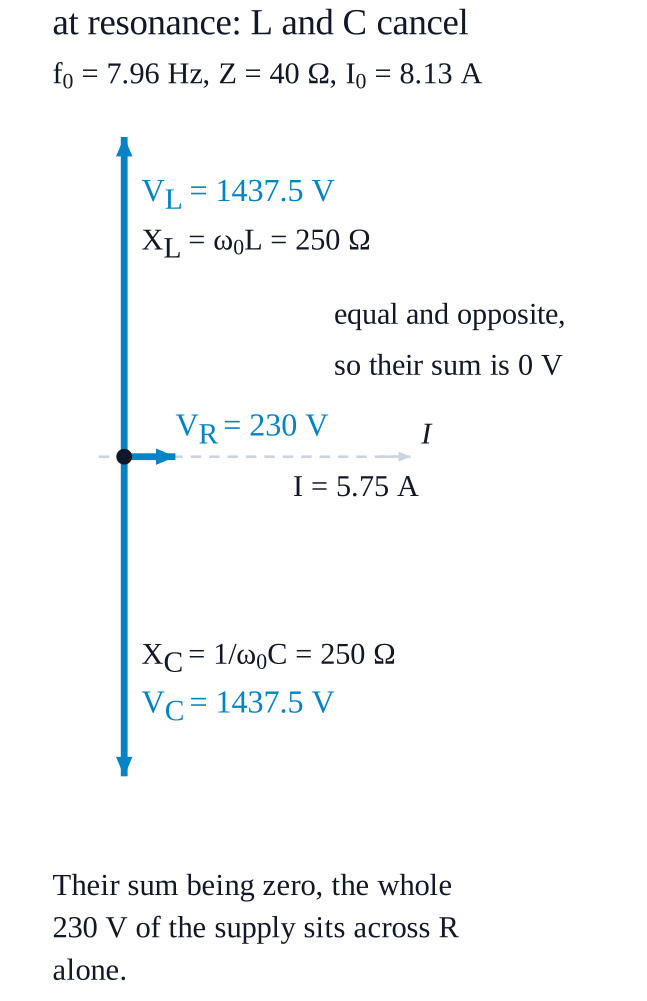
    Determine the rms potential drops across the three elements of the circuit. Show that the potential drop across the LC combination is zero at the resonating frequency.
    NCERT’s answer
    (a)
    $\displaystyle 50$ rad \(\displaystyle s^{-1}\) (b) $\displaystyle 40$ Ω, $\displaystyle 8.1$ A (c) \(\displaystyle V_{Lrms}\) = $\displaystyle 1437$ $\displaystyle 5$ . V, \(\displaystyle V_{Crms}\) = $\displaystyle 1437$ $\displaystyle 5$ . V , \(\displaystyle V_{Rrms}\) = $\displaystyle 230$ V V I L C LCrms rms = −    = ω ω $\displaystyle 0$ $\displaystyle 0$ $\displaystyle 1$ $\displaystyle 0$
    NCERT_Solution_Class12_Physics_Ch7_Q7-8
    (a)
    The resonant angular frequency of a series LCR circuit is \(\displaystyle \omega_0 = 1/\sqrt{LC}\).
    \[\omega_0 = \frac{1}{\sqrt{(5.0\,\mathrm{H})(80\times10^{-6}\,\mathrm{F})}} = \frac{1}{\sqrt{4\times10^{-4}}} = \frac{1}{0.02} = 50\,\mathrm{rad/s}\]
    \[f_0 = \frac{\omega_0}{2\pi} = \frac{50}{2\pi} = 7.96\,\mathrm{Hz}\]
    (b)
    At resonance \(\displaystyle X_L = X_C\), so the impedance is purely resistive:
    \[Z = R = 40\,\Omega\]
    The peak (amplitude) of the source voltage is \(\displaystyle V_0 = \sqrt{2}\,V_{rms} = \sqrt{2}(230\,\mathrm{V}) = 325.3\,\mathrm{V}\), so the amplitude of current at resonance is
    \[I_0 = \frac{V_0}{Z} = \frac{325.3\,\mathrm{V}}{40\,\Omega} = 8.13\,\mathrm{A}\]
    (equivalently, \(\displaystyle I_{rms} = V_{rms}/R = 230/40 = 5.75\,\mathrm{A}\), and \(\displaystyle I_0 = \sqrt{2}\,I_{rms} = 8.13\,\mathrm{A}\)).
    (c)
    rms drop across each element, using \(\displaystyle I_{rms} = 5.75\,\mathrm{A}\):
    Across R: \[V_R = I_{rms} R = (5.75\,\mathrm{A})(40\,\Omega) = 230\,\mathrm{V}\]
    Across L: \(\displaystyle X_L = \omega_0 L = (50)(5.0) = 250\,\Omega\)
    \[V_L = I_{rms} X_L = (5.75\,\mathrm{A})(250\,\Omega) = 1437.5\,\mathrm{V}\]
    Across C: \(\displaystyle X_C = 1/(\omega_0 C) = 1/[(50)(80\times10^{-6})] = 250\,\Omega\)
    \[V_C = I_{rms} X_C = (5.75\,\mathrm{A})(250\,\Omega) = 1437.5\,\mathrm{V}\]
    In the series LCR phasor diagram, \(\displaystyle V_L\) and \(\displaystyle V_C\) are exactly \(\displaystyle 180^\circ\) out of phase with each other (inductor voltage leads current by \(\displaystyle 90^\circ\), capacitor voltage lags current by \(\displaystyle 90^\circ\)), so their instantaneous values are always equal and opposite at resonance since \(\displaystyle X_L = X_C\). Hence the net rms drop across the series LC combination is
    \[V_{LC} = V_L - V_C = 1437.5\,\mathrm{V} - 1437.5\,\mathrm{V} = 0\]
    consistent with the full source voltage appearing entirely across R (\(\displaystyle V_R = 230\,\mathrm{V}\) = supply voltage) at resonance.
    \(\displaystyle f_0 \approx 7.96\,\mathrm{Hz}\); \(\displaystyle Z = 40\,\Omega\), \(\displaystyle I_0 \approx 8.13\,\mathrm{A}\); \(\displaystyle V_R = 230\,\mathrm{V}\), \(\displaystyle V_L = V_C = 1437.5\,\mathrm{V}\), and the LC combination's net rms drop is \(\displaystyle 0\,\mathrm{V}\).