Exercise 11.1
Find the
(a)
maximum frequency, and
(b)
minimum wavelength of X-rays produced by kV electrons.
NCERT’s answer
(a)
7.$\displaystyle 24$ × \(\displaystyle 10^{18}\) Hz (b) $\displaystyle 0.041$ nm
Each electron accelerated through potential \(\displaystyle V\) gains kinetic energy \(\displaystyle eV\). In X-ray production (inverse photoelectric effect), the maximum photon energy — corresponding to minimum wavelength — occurs when all this kinetic energy converts to a single photon: \(\displaystyle eV = h\nu_{max} = \dfrac{hc}{\lambda_{min}}\).
Given \(\displaystyle V = 30\ \mathrm{kV} = 3\times10^{4}\ \mathrm{V}\):
\[eV = (1.6\times10^{-19}\ \mathrm{C})(3\times10^{4}\ \mathrm{V}) = 4.8\times10^{-15}\ \mathrm{J}\]
(a)
Maximum frequency:
\[\nu_{max} = \frac{eV}{h} = \frac{4.8\times10^{-15}}{6.63\times10^{-34}} \approx 7.24\times10^{18}\ \mathrm{Hz}\]
(b)
Minimum wavelength:
\[\lambda_{min} = \frac{hc}{eV} = \frac{(6.63\times10^{-34})(3\times10^{8})}{4.8\times10^{-15}} \approx 4.14\times10^{-11}\ \mathrm{m}\]
Maximum frequency \(\displaystyle \approx 7.24\times10^{18}\ \mathrm{Hz}\); minimum wavelength \(\displaystyle \approx 4.14\times10^{-11}\ \mathrm{m} = 41.4\ \mathrm{pm}\).
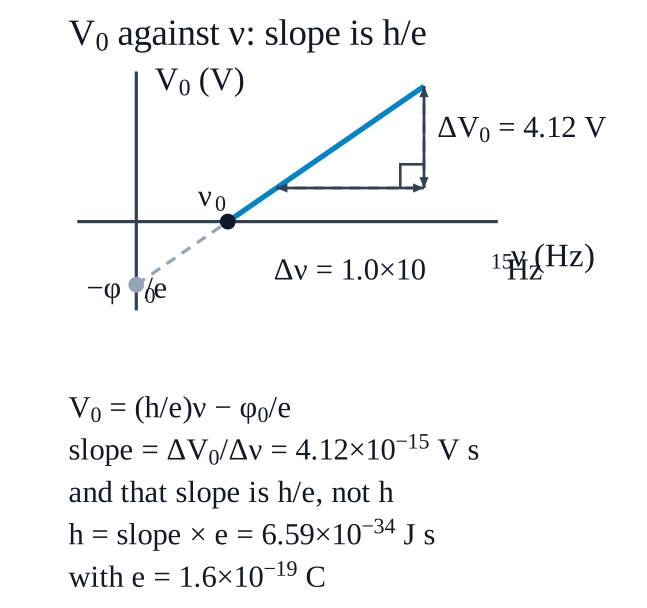 Einstein's equation \(\displaystyle eV_0 = h\nu - \phi_0\) rearranges to \(\displaystyle V_0 = \dfrac{h}{e}\nu - \dfrac{\phi_0}{e}\), a straight line in \(\displaystyle V_0\) vs \(\displaystyle \nu\) with slope \(\displaystyle \dfrac{h}{e}\).Given slope \(\displaystyle = 4.12\times10^{-15}\ \mathrm{V\,s}\):
\[h = (\text{slope})\times e = (4.12\times10^{-15})(1.6\times10^{-19}) \approx 6.59\times10^{-34}\ \mathrm{J\,s}\]\(\displaystyle h \approx 6.59\times10^{-34}\ \mathrm{J\,s}\), close to the standard value \(\displaystyle 6.63\times10^{-34}\ \mathrm{J\,s}\).
Einstein's equation \(\displaystyle eV_0 = h\nu - \phi_0\) rearranges to \(\displaystyle V_0 = \dfrac{h}{e}\nu - \dfrac{\phi_0}{e}\), a straight line in \(\displaystyle V_0\) vs \(\displaystyle \nu\) with slope \(\displaystyle \dfrac{h}{e}\).Given slope \(\displaystyle = 4.12\times10^{-15}\ \mathrm{V\,s}\):
\[h = (\text{slope})\times e = (4.12\times10^{-15})(1.6\times10^{-19}) \approx 6.59\times10^{-34}\ \mathrm{J\,s}\]\(\displaystyle h \approx 6.59\times10^{-34}\ \mathrm{J\,s}\), close to the standard value \(\displaystyle 6.63\times10^{-34}\ \mathrm{J\,s}\).