SolveItNCERT · CBSE Boards

NCERT Solutions · Class 12 Physics Moving Charges and Magnetism

13 exercises · 8 still being checked

Exercises 4.1–4.13

  1. Exercise 4.1

    A circular coil of wire consisting of $\displaystyle 100$ turns, each of radius $\displaystyle 8.0$ cm carries a current of $\displaystyle 0.40$ A. What is the magnitude of the magnetic field B at the centre of the coil?

    Disagrees with the book

    This working does not reach the answer printed in NCERT. One of the two is wrong and it has not yet been settled which — check it before you rely on it.

    NCERT’s answer
    π × \(\displaystyle 10^{-4}\) T ≃ $\displaystyle 3.1$ × \(\displaystyle 10^{-4}\) T
    By Ampere's law, the field at the centre of a circular coil of \(\displaystyle N\) turns is \[B=\frac{\mu_0 N I}{2r} \] Here \(\displaystyle N=100\), \(\displaystyle I=0.40\ \mathrm{A}\), \(\displaystyle r=8.0\ \mathrm{cm}=0.08\ \mathrm{m}\), \(\displaystyle \mu_0=4\pi\times10^{-7}\ \mathrm{T\,m/A}\). \[B=\frac{(4\pi\times10^{-7})(100)(0.40)}{2(0.08)}=\pi\times10^{-4}\ \mathrm{T} \] B ≈ $\displaystyle 3.14$ × $\displaystyle 10$⁻⁴ T, directed along the axis of the coil.
  2. Exercise 4.2

    A long straight wire carries a current of $\displaystyle 35$ A. What is the magnitude of the field B at a point $\displaystyle 20$ cm from the wire?

    Disagrees with the book

    This working does not reach the answer printed in NCERT. One of the two is wrong and it has not yet been settled which — check it before you rely on it.

    NCERT’s answer
    3.$\displaystyle 5$ × \(\displaystyle 10^{-5}\) T
    For a long straight wire, \[B=\frac{\mu_0 I}{2\pi r} \] With \(\displaystyle I=35\ \mathrm{A}\), \(\displaystyle r=20\ \mathrm{cm}=0.20\ \mathrm{m}\): \[B=\frac{(2\times10^{-7})(35)}{0.20} \] B = $\displaystyle 3.5$ × $\displaystyle 10$⁻⁵ T.
  3. Exercise 4.3

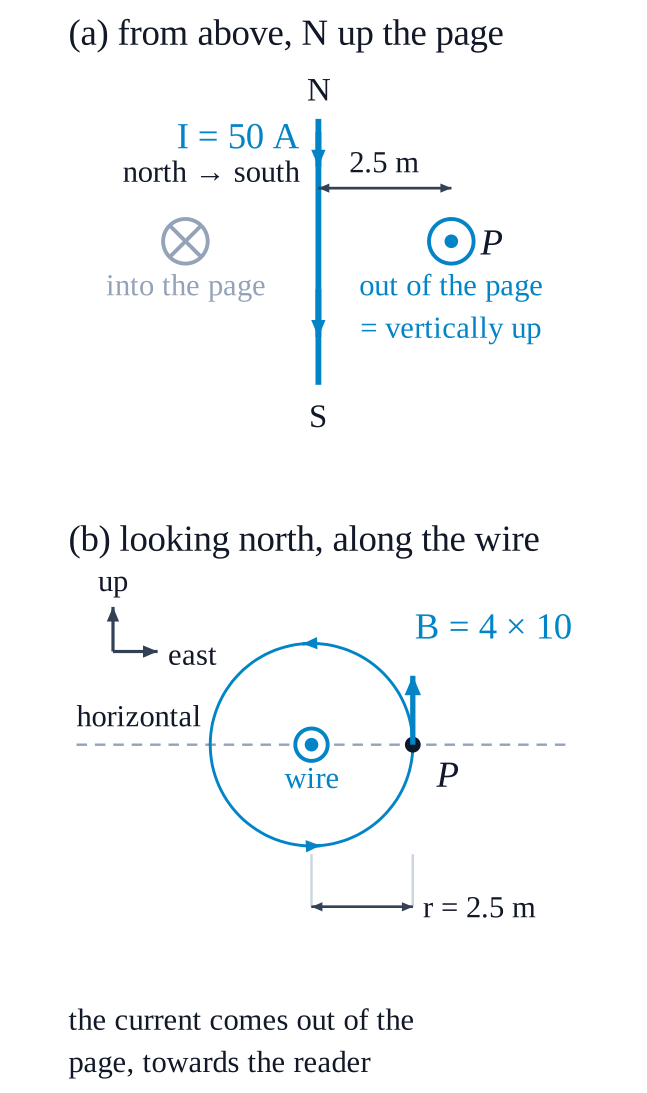
    A long straight wire in the horizontal plane carries a current of $\displaystyle 50$ A in north to south direction. Give the magnitude and direction of B at a point $\displaystyle 2.5$ m east of the wire.

    Disagrees with the book

    This working does not reach the answer printed in NCERT. One of the two is wrong and it has not yet been settled which — check it before you rely on it.

    NCERT’s answer
    $\displaystyle 4$ × \(\displaystyle 10^{-6}\) T, vertical up
    NCERT_Solution_Class12_Physics_Ch4_Q4-3Magnitude (long straight wire): \[B=\frac{\mu_0 I}{2\pi r}=\frac{(2\times10^{-7})(50)}{2.5} \] B = $\displaystyle 4$ × $\displaystyle 10$⁻⁶ T.Direction — apply the right-hand thumb rule with the thumb pointing along the current (north → south). Taking East = \(\displaystyle \hat x\), North = \(\displaystyle \hat y\), Up = \(\displaystyle \hat z\) (so \(\displaystyle \hat x\times\hat y=\hat z\)), the current direction is \(\displaystyle -\hat y\) and the point (east of the wire) lies along \(\displaystyle +\hat x\). The field direction is \[\hat B \propto (-\hat y)\times \hat x = \hat z \] so the field points vertically upward at the point $\displaystyle 2.5$ m east of the wire.
  4. Exercise 4.4

    A horizontal overhead power line carries a current of $\displaystyle 90$ A in east to west direction. What is the magnitude and direction of the magnetic field due to the current $\displaystyle 1.5$ m below the line?

    Disagrees with the book

    This working does not reach the answer printed in NCERT. One of the two is wrong and it has not yet been settled which — check it before you rely on it.

    NCERT’s answer
    1.$\displaystyle 2$ × \(\displaystyle 10^{-5}\) T, towards south
    Magnitude: \[B=\frac{\mu_0 I}{2\pi r}=\frac{(2\times10^{-7})(90)}{1.5} \] B = $\displaystyle 1.2$ × $\displaystyle 10$⁻⁵ T.Direction — current flows west → east (\(\displaystyle +\hat x\), with East=\(\displaystyle \hat x\), North=\(\displaystyle \hat y\), Up=\(\displaystyle \hat z\)); the point is $\displaystyle 1.5$ m below the wire, i.e. along \(\displaystyle -\hat z\) from the wire. By the right-hand rule, \[\hat B \propto \hat x \times(-\hat z) = \hat y \] so the field points horizontally, from south to north, at the point below the line.
  5. Exercise 4.5

    What is the magnitude of magnetic force per unit length on a wire carrying a current of $\displaystyle 8$ A and making an angle of $\displaystyle 30$º with the direction of a uniform magnetic field of $\displaystyle 0.15$ T?
    NCERT’s answer
    0.$\displaystyle 6$ N \(\displaystyle m^{-1}\)
    Force per unit length on a current-carrying wire in a uniform field: \[\frac{F}{L}=BI\sin\theta \] With \(\displaystyle I=8\ \mathrm{A}\), \(\displaystyle B=0.15\ \mathrm{T}\), \(\displaystyle \theta=30^\circ\): \[\frac{F}{L}=(0.15)(8)\sin30^\circ=(0.15)(8)(0.5) \] F/L = $\displaystyle 0.6$ N/m.
  6. Exercise 4.6

    A $\displaystyle 3.0$ cm wire carrying a current of $\displaystyle 10$ A is placed inside a solenoid perpendicular to its axis. The magnetic field inside the solenoid is given to be $\displaystyle 0.27$ T. What is the magnetic force on the wire?
    NCERT’s answer
    8.$\displaystyle 1$ × \(\displaystyle 10^{-2}\) N; direction of force given by Fleming’s left-hand rule
    Force on a current-carrying wire in a magnetic field: \(\displaystyle F=BIL\sin\theta\). Inside the solenoid \(\displaystyle B\) is along the axis, and the wire is placed perpendicular to the axis, so \(\displaystyle \theta=90^\circ\). \[F=(0.27)(10)(0.030)(1) \] F = $\displaystyle 0.081$ N, directed perpendicular to both the wire and the field (i.e. along \(\displaystyle I\vec L\times\vec B\)).
  7. Exercise 4.7

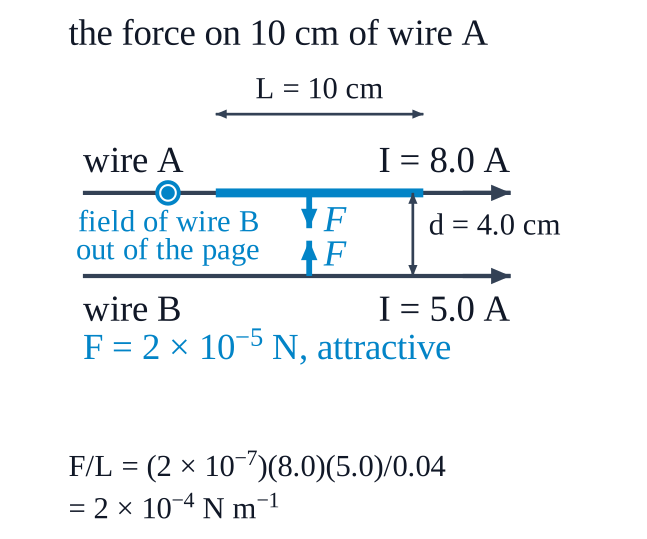
    Two long and parallel straight wires A and B carrying currents of $\displaystyle 8.0$ A and $\displaystyle 5.0$ A in the same direction are separated by a distance of $\displaystyle 4.0$ cm. Estimate the force on a $\displaystyle 10$ cm section of wire A.

    Disagrees with the book

    This working does not reach the answer printed in NCERT. One of the two is wrong and it has not yet been settled which — check it before you rely on it.

    NCERT’s answer
    $\displaystyle 2$ × \(\displaystyle 10^{-5}\) N; attractive force normal to A towards B
    NCERT_Solution_Class12_Physics_Ch4_Q4-7Force per unit length between two long parallel currents: \[\frac{F}{L}=\frac{\mu_0 I_A I_B}{2\pi d} \] With \(\displaystyle I_A=8.0\ \mathrm{A}\), \(\displaystyle I_B=5.0\ \mathrm{A}\), \(\displaystyle d=4.0\ \mathrm{cm}=0.04\ \mathrm{m}\): \[\frac{F}{L}=\frac{(2\times10^{-7})(8.0)(5.0)}{0.04}=2\times10^{-4}\ \mathrm{N/m} \] For a $\displaystyle 10$ cm = $\displaystyle 0.10$ m section of wire A: \[F=(2\times10^{-4})(0.10) \] F = $\displaystyle 2$ × $\displaystyle 10$⁻⁵ N, attractive (directed toward wire B), since the currents are in the same direction.
  8. Exercise 4.8

    A closely wound solenoid $\displaystyle 80$ cm long has $\displaystyle 5$ layers of windings of $\displaystyle 400$ turns each. The diameter of the solenoid is $\displaystyle 1.8$ cm. If the current carried is $\displaystyle 8.0$ A, estimate the magnitude of B inside the solenoid near its centre.

    Disagrees with the book

    This working does not reach the answer printed in NCERT. One of the two is wrong and it has not yet been settled which — check it before you rely on it.

    NCERT’s answer
    $\displaystyle 8$π × \(\displaystyle 10^{-3}\) T ≃ $\displaystyle 2.5$ × \(\displaystyle 10^{-2}\) T
    Field inside a long solenoid: \(\displaystyle B=\mu_0 n I\), where \(\displaystyle n\) is turns per unit length. Total turns \(\displaystyle N=5\times400=2000\), length \(\displaystyle l=80\ \mathrm{cm}=0.80\ \mathrm{m}\), so \[n=\frac{N}{l}=\frac{2000}{0.80}=2500\ \mathrm{turns/m} \] With \(\displaystyle I=8.0\ \mathrm{A}\): \[B=(4\pi\times10^{-7})(2500)(8.0)=8\pi\times10^{-3}\ \mathrm{T} \] B ≈ $\displaystyle 2.5$ × $\displaystyle 10$⁻² T (≈$\displaystyle 0.025$ T), along the axis near the centre (the diameter, $\displaystyle 1.8$ cm ≪ length, so the long-solenoid approximation is valid).
  9. Exercise 4.9

    A square coil of side $\displaystyle 10$ cm consists of $\displaystyle 20$ turns and carries a current of $\displaystyle 12$ A. The coil is suspended vertically and the normal to the plane of the coil makes an angle of $\displaystyle 30$º with the direction of a uniform horizontal magnetic field of magnitude $\displaystyle 0.80$ T. What is the magnitude of torque experienced by the coil?
    NCERT’s answer
    0.$\displaystyle 96$ N m
    Torque on a current loop of magnetic moment \(\displaystyle m=NIA\) in a field \(\displaystyle B\): \[\tau=NIAB\sin\theta \] Side \(\displaystyle =10\ \mathrm{cm}=0.10\ \mathrm{m}\Rightarrow A=0.01\ \mathrm{m^2}\); \(\displaystyle N=20\), \(\displaystyle I=12\ \mathrm{A}\), \(\displaystyle B=0.80\ \mathrm{T}\), \(\displaystyle \theta=30^\circ\) (angle between the normal and \(\displaystyle B\)): \[\tau=(20)(12)(0.01)(0.80)\sin30^\circ=(2.4)(0.80)(0.5) \] τ = $\displaystyle 0.96$ N·m.
  10. Exercise 4.10

    Two moving coil meters, \(\displaystyle M_{1}\) and \(\displaystyle M_{2}\) have the following particulars: \(\displaystyle R_{1}\) = $\displaystyle 10$ Ω, \(\displaystyle N_{1}\) = $\displaystyle 30$, \(\displaystyle A_{1}\) = $\displaystyle 3.6$ × \(\displaystyle 10^{-3}\) \(\displaystyle m^{2}\), \(\displaystyle B_{1}\) = $\displaystyle 0.25$ T \(\displaystyle R_{2}\) = $\displaystyle 14$ Ω, \(\displaystyle N_{2}\) = $\displaystyle 42$, \(\displaystyle A_{2}\) = $\displaystyle 1.8$ × \(\displaystyle 10^{-3}\) \(\displaystyle m^{2}\), \(\displaystyle B_{2}\) = $\displaystyle 0.50$ T (The spring constants are identical for the two meters). Determine the ratio of
    (a)
    current sensitivity and
    (b)
    voltage sensitivity of \(\displaystyle M_{2}\) and \(\displaystyle M_{1}\).
    NCERT’s answer
    (a)
    1.$\displaystyle 4$, (b) $\displaystyle 1$
    For a moving-coil galvanometer, current sensitivity \(\displaystyle I_S=\dfrac{N B A}{k}\) and voltage sensitivity \(\displaystyle V_S=\dfrac{N B A}{kR}=\dfrac{I_S}{R}\), with the spring constant \(\displaystyle k\) common to both meters.
    (a)
    \[\frac{I_{S2}}{I_{S1}}=\frac{N_2 B_2 A_2}{N_1 B_1 A_1}=\frac{(42)(0.50)(1.8\times10^{-3})}{(30)(0.25)(3.6\times10^{-3})}=\frac{0.0378}{0.0270} \]
    I_S2 / I_S1 = $\displaystyle 1.4$
    (b)
    \[\frac{V_{S2}}{V_{S1}}=\frac{I_{S2}}{I_{S1}}\cdot\frac{R_1}{R_2}=1.4\times\frac{10}{14} \]
    V_S2 / V_S1 = $\displaystyle 1.0$ (the two meters have equal voltage sensitivity).
  11. Exercise 4.11

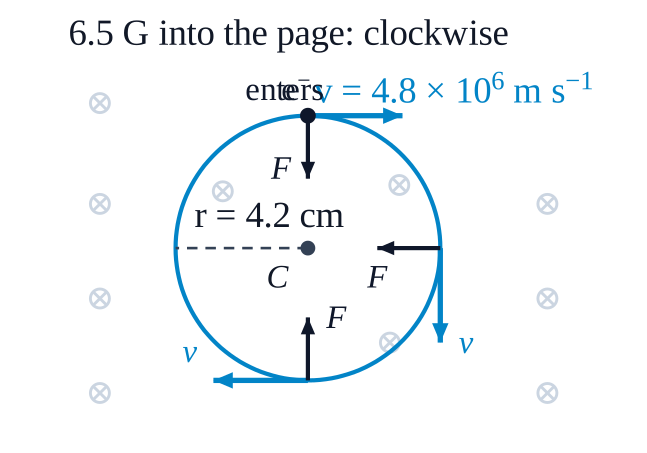
    In a chamber, a uniform magnetic field of $\displaystyle 6.5$ G ($\displaystyle 1$ G = \(\displaystyle 10^{-4}\) T) is maintained. An electron is shot into the field with a speed of $\displaystyle 4.8$ × \(\displaystyle 10^{6}\) m \(\displaystyle s^{-1}\) normal to the field. Explain why the path of the electron is a circle. Determine the radius of the circular orbit. (e = $\displaystyle 1.6$ × \(\displaystyle 10^{-19}\) C, \(\displaystyle m_{e}\) = $\displaystyle 9.1$×\(\displaystyle 10^{-31}\) kg)

    Matches the book, not yet reviewed

    This working reaches the answer NCERT prints. It has not yet been read through by hand.

    NCERT’s answer
    4.$\displaystyle 2$ cm
    NCERT_Solution_Class12_Physics_Ch4_Q4-11The magnetic force \(\displaystyle q\vec v\times\vec B\) is always perpendicular to \(\displaystyle \vec v\); since \(\displaystyle v\) and \(\displaystyle B\) are both constant in magnitude (uniform field, electron enters normal to \(\displaystyle B\)), this force has constant magnitude and always points toward a fixed centre — i.e. it acts purely as a centripetal force, so the electron moves in a circle.Balancing magnetic force and centripetal requirement: \[evB=\frac{mv^2}{r}\ \Rightarrow\ r=\frac{mv}{eB} \] With \(\displaystyle e=1.6\times10^{-19}\ \mathrm{C}\), \(\displaystyle m_e=9.1\times10^{-31}\ \mathrm{kg}\), \(\displaystyle v=4.8\times10^{6}\ \mathrm{m/s}\), \(\displaystyle B=6.5\ \mathrm{G}=6.5\times10^{-4}\ \mathrm{T}\): \[r=\frac{(9.1\times10^{-31})(4.8\times10^{6})}{(1.6\times10^{-19})(6.5\times10^{-4})}=\frac{4.368\times10^{-24}}{1.04\times10^{-22}} \] r ≈ $\displaystyle 4.2$ × $\displaystyle 10$⁻² m (≈ $\displaystyle 4.2$ cm).A misprint in the printed question. NCERT's question sheet gives the electron's charge as \(\displaystyle 1.5\times10^{-19}\ \mathrm{C}\). The elementary charge is \(\displaystyle 1.6\times10^{-19}\ \mathrm{C}\), and NCERT's own printed answer of $\displaystyle 4.2$ cm uses $\displaystyle 1.6$ — so $\displaystyle 1.6$ is used above. Carrying the misprinted $\displaystyle 1.5$ through instead gives $\displaystyle 4.48$ cm.
  12. Exercise 4.12

    In Exercise $\displaystyle 4.11$ obtain the frequency of revolution of the electron in its circular orbit. Does the answer depend on the speed of the electron? Explain.

    Matches the book, not yet reviewed

    This working reaches the answer NCERT prints. It has not yet been read through by hand.

    NCERT’s answer
    $\displaystyle 18$ MHz
    Frequency of revolution: \(\displaystyle \nu=\dfrac{v}{2\pi r}\). Substituting \(\displaystyle r=mv/(eB)\) gives \[\nu=\frac{eB}{2\pi m} \] Using the same values as in $\displaystyle 4.11$: \[\nu=\frac{(1.6\times10^{-19})(6.5\times10^{-4})}{2\pi(9.1\times10^{-31})}=\frac{1.04\times10^{-22}}{5.72\times10^{-30}} \] ν ≈ $\displaystyle 1.8$ × $\displaystyle 10$⁷ Hz (≈ $\displaystyle 18$ MHz).The expression \(\displaystyle \nu=eB/2\pi m\) contains no \(\displaystyle v\): although \(\displaystyle r\propto v\), the period \(\displaystyle T=2\pi r/v=2\pi m/(eB)\) is independent of \(\displaystyle v\) (a faster electron moves on a proportionally larger circle in the same time). So the frequency does not depend on the electron's speed.A misprint in the printed question. As in $\displaystyle 4.11$, the electron's charge is taken as \(\displaystyle 1.6\times10^{-19}\ \mathrm{C}\); the question sheet's \(\displaystyle 1.5\times10^{-19}\) is a misprint, and NCERT's printed answer of $\displaystyle 18$ MHz uses 1.6. The misprinted value would give $\displaystyle 17$ MHz.
  13. Exercise 4.13

    (a)
    A circular coil of $\displaystyle 30$ turns and radius $\displaystyle 8.0$ cm carrying a current of $\displaystyle 6.0$ A is suspended vertically in a uniform horizontal magnetic field of magnitude $\displaystyle 1.0$ T. The field lines make an angle of $\displaystyle 60$° with the normal of the coil. Calculate the magnitude of the counter torque that must be applied to prevent the coil from turning.
    (b)
    Would your answer change, if the circular coil in (a) were replaced by a planar coil of some irregular shape that encloses the same area? (All other particulars are also unaltered.)
    NCERT’s answer
    (a)
    3.$\displaystyle 1$ Nm, (b) No, the answer is unchanged because the formula τ = N I A × B is true for a planar loop of any shape.
    (a)
    The magnetic torque on the coil equals the (equal and opposite) counter torque needed to hold it in place:
    \[\tau=NIAB\sin\theta \]
    Here \(\displaystyle N=30\), \(\displaystyle I=6.0\ \mathrm{A}\), \(\displaystyle r=8.0\ \mathrm{cm}=0.08\ \mathrm{m}\Rightarrow A=\pi r^2=\pi(0.08)^2=2.011\times10^{-2}\ \mathrm{m^2}\), \(\displaystyle B=1.0\ \mathrm{T}\), and \(\displaystyle \theta=60^\circ\) (angle between the field and the normal, since the field lines make \(\displaystyle 60^\circ\) with the normal):
    \[\tau=(30)(6.0)(2.011\times10^{-2})(1.0)\sin60^\circ=(3.619)(0.866) \]
    τ ≈ $\displaystyle 3.13$ N·m — this is the counter torque that must be applied.
    (b)
    No, the answer would not change. The torque on a planar current loop is \(\displaystyle \tau=(NIA)B\sin\theta\), which depends only on the magnitude of the magnetic moment \(\displaystyle NIA\) (total current, turns, and enclosed area) and its orientation relative to \(\displaystyle B\) — not on the shape of the loop's boundary. Since the irregular coil has the same \(\displaystyle N\), \(\displaystyle I\), enclosed area, and orientation, it experiences the same torque.