SolveItNCERT · CBSE Boards

NCERT Solutions · Class 12 Physics Nuclei

9 exercises · 1 still being checked

Exercises 13.1–13.9

  1. You may find the following data useful in solving the exercises: e = $\displaystyle 1.6$×\(\displaystyle 10^{-19}\)C N = $\displaystyle 6.023$×\(\displaystyle 10^{23}\) per mole $\displaystyle 1$/(\(\displaystyle 4πε_{0}\)) = $\displaystyle 9$ × \(\displaystyle 10^{9}\) N \(\displaystyle m^{2}\)/\(\displaystyle C^{2}\) k = $\displaystyle 1.381$×\(\displaystyle 10^{-23}\)J \(\displaystyle K^{-1}\) $\displaystyle 1$ MeV = $\displaystyle 1.6$×\(\displaystyle 10^{-13}\)J $\displaystyle 1$ u = $\displaystyle 931.5$ MeV/\(\displaystyle c^{2}\) $\displaystyle 1$ year = $\displaystyle 3.154$×\(\displaystyle 10^{7}\) s mH = $\displaystyle 1.007825$ u mn = $\displaystyle 1.008665$ u m( $\displaystyle 4$ 2He ) = $\displaystyle 4.002603$ u me = $\displaystyle 0.000548$ u

    Exercise 13.1

    Obtain the binding energy (in MeV) of a nitrogen nucleus ( ) $\displaystyle 14$ $\displaystyle 7$ N , given m ( ) $\displaystyle 14$ $\displaystyle 7$ N =$\displaystyle 14.00307$ u
    NCERT’s answer
    104.$\displaystyle 7$ MeV
    Binding energy from the mass defect: \(\displaystyle ^{14}_{7}\mathrm{N}\) has \(\displaystyle Z=7\) protons and \(\displaystyle N=14-7=7\) neutrons.\[\Delta m = 7\,m_H + 7\,m_n - m(^{14}_{7}\mathrm{N})\]Using \(\displaystyle m_H = 1.007825\,\mathrm{u}\), \(\displaystyle m_n = 1.008665\,\mathrm{u}\):\[7m_H = 7.054775\,\mathrm{u}, \qquad 7m_n = 7.060655\,\mathrm{u}\] \[\Delta m = 14.115430 - 14.00307 = 0.112360\,\mathrm{u}\]\[BE = \Delta m \times 931.5\,\mathrm{MeV/u} = 0.112360 \times 931.5\]\(\displaystyle BE \approx 104.66\ \mathrm{MeV}\)
  2. Exercise 13.2

    Obtain the binding energy of the nuclei $\displaystyle 56$ 26Fe and $\displaystyle 209$ $\displaystyle 83$ Bi in units of MeV from the following data: m ( $\displaystyle 56$ 26Fe ) = $\displaystyle 55.934939$ u m ( $\displaystyle 209$ $\displaystyle 83$ Bi ) = $\displaystyle 208.980388$ u
    NCERT’s answer
    8.$\displaystyle 79$ MeV, $\displaystyle 7.84$ MeV
    Fe-$\displaystyle 56$ (\(\displaystyle Z=26\), \(\displaystyle N=30\)): \[\Delta m = 26m_H + 30m_n - m(^{56}_{26}\mathrm{Fe})\] \[= 26(1.007825)+30(1.008665) - 55.934939\] \[= 26.20345+30.25995-55.934939 = 0.528461\,\mathrm{u}\] \[BE = 0.528461\times931.5 \approx 492.26\ \mathrm{MeV}\] (per nucleon: \(\displaystyle 492.26/56 \approx 8.79\ \mathrm{MeV}\))Bi-$\displaystyle 209$ (\(\displaystyle Z=83\), \(\displaystyle N=126\)): \[\Delta m = 83m_H+126m_n-m(^{209}_{83}\mathrm{Bi})\] \[= 83.649475+127.09179-208.980388 = 1.760877\,\mathrm{u}\] \[BE = 1.760877\times931.5 \approx 1640.26\ \mathrm{MeV}\] (per nucleon: \(\displaystyle 1640.26/209 \approx 7.85\ \mathrm{MeV}\))\(\displaystyle BE(^{56}\mathrm{Fe}) \approx 492.26\ \mathrm{MeV}\) ($\displaystyle 8.79$ MeV/nucleon); \(\displaystyle BE(^{209}\mathrm{Bi}) \approx 1640.26\ \mathrm{MeV}\) ($\displaystyle 7.85$ MeV/nucleon)
  3. Exercise 13.3

    A given coin has a mass of $\displaystyle 3.0$ g. Calculate the nuclear energy that would be required to separate all the neutrons and protons from each other. For simplicity assume that the coin is entirely made of $\displaystyle 63$ 29Cu atoms (of mass $\displaystyle 62.92960$ u).
    NCERT’s answer
    1.$\displaystyle 584$ × \(\displaystyle 10^{25}\)MeV or $\displaystyle 2.535$×\(\displaystyle 10^{12}\)J
    Binding energy per \(\displaystyle ^{63}_{29}\mathrm{Cu}\) atom (\(\displaystyle Z=29\), \(\displaystyle N=34\)): \[\Delta m = 29m_H+34m_n-m(\mathrm{Cu}) = 29(1.007825)+34(1.008665)-62.92960\] \[= 29.226925+34.29461-62.92960 = 0.591935\,\mathrm{u}\] \[BE_{\text{atom}} = 0.591935\times931.5 \approx 551.39\ \mathrm{MeV}\]Number of Cu atoms in the coin, using \(\displaystyle N_A = 6.023\times10^{23}\,\mathrm{mol^{-1}}\) and molar mass \(\displaystyle 62.9296\,\mathrm{g/mol}\): \[n = \frac{3.0\,\mathrm{g}}{62.9296\,\mathrm{g/mol}}\times N_A = 0.047673\times6.023\times10^{23} \approx 2.871\times10^{22}\ \text{atoms}\]Total nuclear (separation) energy: \[E = n\times BE_{\text{atom}} = 2.871\times10^{22}\times551.39\ \mathrm{MeV} \approx 1.583\times10^{25}\ \mathrm{MeV}\] \[E = 1.583\times10^{25}\times1.6\times10^{-13}\,\mathrm{J}\]\(\displaystyle E \approx 2.53\times10^{12}\ \mathrm{J}\) — an enormous amount of energy, showing how strongly bound nucleons are.
  4. Exercise 13.4

    Obtain approximately the ratio of the nuclear radii of the gold isotope $\displaystyle 197$ $\displaystyle 79$ Au and the silver isotope $\displaystyle 107$ $\displaystyle 47$ Ag .
    NCERT’s answer
    1.$\displaystyle 23$
    Nuclear radius: \(\displaystyle R = R_0 A^{1/3}\), so \[\frac{R_{Au}}{R_{Ag}} = \left(\frac{A_{Au}}{A_{Ag}}\right)^{1/3} = \left(\frac{197}{107}\right)^{1/3} = (1.8411)^{1/3}\]\(\displaystyle \dfrac{R_{Au}}{R_{Ag}} \approx 1.23\) (the gold nucleus is about $\displaystyle 1.23$ times larger in radius than the silver nucleus).
  5. Exercise 13.5

    The Q value of a nuclear reaction A + b → C + d is defined by Q = [ \(\displaystyle m_{A}\) + \(\displaystyle m_{b}\) - \(\displaystyle m_{C}\) - \(\displaystyle m_{d}\)]\(\displaystyle c^{2}\) where the masses refer to the respective nuclei. Determine from the given data the Q-value of the following reactions and state whether the reactions are exothermic or endothermic.
    (i)
    $\displaystyle 1$ $\displaystyle 3$ $\displaystyle 2$ $\displaystyle 2$ $\displaystyle 1$ $\displaystyle 1$ $\displaystyle 1$ $\displaystyle 1$ H+ H H+ H →
    (ii)
    $\displaystyle 12$ $\displaystyle 12$ $\displaystyle 20$ $\displaystyle 4$ $\displaystyle 6$ $\displaystyle 6$ $\displaystyle 10$ $\displaystyle 2$ C+ C Ne+ He → Atomic masses are given to be m ( $\displaystyle 2$ $\displaystyle 1$ H ) = $\displaystyle 2.014102$ u m ( $\displaystyle 3$ $\displaystyle 1$ H) = $\displaystyle 3.016049$ u m ( $\displaystyle 12$ $\displaystyle 6$ C ) = $\displaystyle 12.000000$ u m ( $\displaystyle 20$ $\displaystyle 10$ Ne ) = $\displaystyle 19.992439$ u
    NCERT’s answer
    (i)
    Q = -$\displaystyle 4.03$ MeV; endothermic (ii) Q = $\displaystyle 4.62$ MeV; exothermic
    Q-value: \(\displaystyle Q = [\,\sum m_{\text{reactants}} - \sum m_{\text{products}}\,]c^2\), using \(\displaystyle 1\,\mathrm{u} = 931.5\,\mathrm{MeV}/c^2\).(i) \(\displaystyle ^{1}_{1}\mathrm{H} + {}^{3}_{1}\mathrm{H} \rightarrow {}^{2}_{1}\mathrm{H} + {}^{2}_{1}\mathrm{H}\) \[Q = [m_H + m(^3H) - 2m(^2H)]\times931.5\] \[= [1.007825+3.016049-2(2.014102)]\times931.5\] \[= [4.023874-4.028204]\times931.5 = -0.004330\times931.5\] \[Q \approx -4.03\ \mathrm{MeV}\] Negative Q — endothermic (energy must be supplied).(ii) \(\displaystyle ^{12}_{6}\mathrm{C} + {}^{12}_{6}\mathrm{C} \rightarrow {}^{20}_{10}\mathrm{Ne} + {}^{4}_{2}\mathrm{He}\) \[Q = [2m(^{12}C) - m(^{20}Ne) - m(^4He)]\times931.5\] \[= [24.000000-19.992439-4.002603]\times931.5\] \[= 0.004958\times931.5\] \[Q \approx +4.62\ \mathrm{MeV}\] Positive Q — exothermic (energy is released).Q(i) ≈ −$\displaystyle 4.03$ MeV (endothermic); Q(ii) ≈ +$\displaystyle 4.62$ MeV (exothermic)
  6. Exercise 13.6

    Suppose, we think of fission of a $\displaystyle 56$ 26Fe nucleus into two equal fragments, $\displaystyle 28$ $\displaystyle 13$ Al . Is the fission energetically possible? Argue by working out Q of the process. Given m ( $\displaystyle 56$ 26Fe ) = $\displaystyle 55.93494$ u and m ( $\displaystyle 28$ $\displaystyle 13$ Al ) = $\displaystyle 27.98191$ u.

    Disagrees with the book

    This working does not reach the answer printed in NCERT. One of the two is wrong and it has not yet been settled which — check it before you rely on it.

    NCERT’s answer
    Q = ( ) ( ) $\displaystyle 56$ $\displaystyle 28$ $\displaystyle 26$ $\displaystyle 13$ Fe - $\displaystyle 2$ Al m m = $\displaystyle 26.90$ MeV; not possible.
    Q-value for \(\displaystyle ^{56}_{26}\mathrm{Fe} \rightarrow 2\,{}^{28}_{13}\mathrm{Al}\): \[Q = [m(^{56}\mathrm{Fe}) - 2m(^{28}\mathrm{Al})]\times931.5\] \[= [55.93494 - 2(27.98191)]\times931.5\] \[= [55.93494-55.96382]\times931.5 = -0.02888\times931.5\] \[Q \approx -26.90\ \mathrm{MeV}\]\(\displaystyle Q \approx -26.90\ \mathrm{MeV}\) — negative, so this fission is not energetically possible; energy would have to be supplied rather than released.
  7. Exercise 13.7

    The fission properties of $\displaystyle 239$ $\displaystyle 94$ Pu are very similar to those of $\displaystyle 235$ $\displaystyle 92$ U . The average energy released per fission is $\displaystyle 180$ MeV. How much energy, in MeV, is released if all the atoms in $\displaystyle 1$ kg of pure $\displaystyle 239$ $\displaystyle 94$ Pu undergo fission?
    NCERT’s answer
    4.$\displaystyle 536$ × \(\displaystyle 10^{26}\)MeV
    Number of \(\displaystyle ^{239}_{94}\mathrm{Pu}\) atoms in $\displaystyle 1$ kg, using molar mass \(\displaystyle \approx 239\,\mathrm{g/mol}\) and \(\displaystyle N_A = 6.023\times10^{23}\,\mathrm{mol^{-1}}\): \[n = \frac{1000\,\mathrm{g}}{239\,\mathrm{g/mol}}\times N_A = 4.1841\times6.023\times10^{23} \approx 2.520\times10^{24}\ \text{atoms}\]Total fission energy, at $\displaystyle 180$ MeV per fission: \[E = n\times180\,\mathrm{MeV} = 2.520\times10^{24}\times180\]\(\displaystyle E \approx 4.54\times10^{26}\ \mathrm{MeV}\) (equivalently \(\displaystyle \approx 7.26\times10^{13}\,\mathrm{J}\), using \(\displaystyle 1\,\mathrm{MeV}=1.6\times10^{-13}\,\mathrm{J}\)).
  8. Exercise 13.8

    How long can an electric lamp of 100W be kept glowing by fusion of $\displaystyle 2.0$ kg of deuterium? Take the fusion reaction as $\displaystyle 2$ $\displaystyle 2$ $\displaystyle 3$ $\displaystyle 1$ $\displaystyle 1$ $\displaystyle 2$ H+ H He+n+$\displaystyle 3.27$ MeV →
    NCERT’s answer
    About $\displaystyle 4.9$ × \(\displaystyle 10^{4}\) y
    Reaction: \(\displaystyle ^{2}_{1}\mathrm{H} + {}^{2}_{1}\mathrm{H} \rightarrow {}^{3}_{2}\mathrm{He} + n + 3.27\,\mathrm{MeV}\) — each fusion event consumes $\displaystyle 2$ deuterium atoms and releases $\displaystyle 3.27$ MeV.Number of deuterium atoms in $\displaystyle 2.0$ kg, using molar mass \(\displaystyle m(^2H)=2.014102\,\mathrm{g/mol}\): \[n = \frac{2000\,\mathrm{g}}{2.014102\,\mathrm{g/mol}}\times N_A \approx 993.0\times6.023\times10^{23} \approx 5.981\times10^{26}\ \text{atoms}\]Number of fusion events: \[n_{\text{fusion}} = \frac{n}{2} \approx 2.990\times10^{26}\]Total energy released: \[E = n_{\text{fusion}}\times3.27\,\mathrm{MeV} \approx 9.78\times10^{26}\,\mathrm{MeV} = 9.78\times10^{26}\times1.6\times10^{-13}\,\mathrm{J} \approx 1.56\times10^{14}\,\mathrm{J}\]Time the $\displaystyle 100$ W lamp can be kept glowing: \[t = \frac{E}{P} = \frac{1.56\times10^{14}\,\mathrm{J}}{100\,\mathrm{W}} \approx 1.56\times10^{12}\,\mathrm{s}\]Converting using \(\displaystyle 1\,\mathrm{year}=3.154\times10^{7}\,\mathrm{s}\): \[t = \frac{1.56\times10^{12}}{3.154\times10^{7}}\ \mathrm{years}\]\(\displaystyle t \approx 4.96\times10^{4}\ \mathrm{years}\) (about $\displaystyle 49,600$ years).
  9. Exercise 13.9

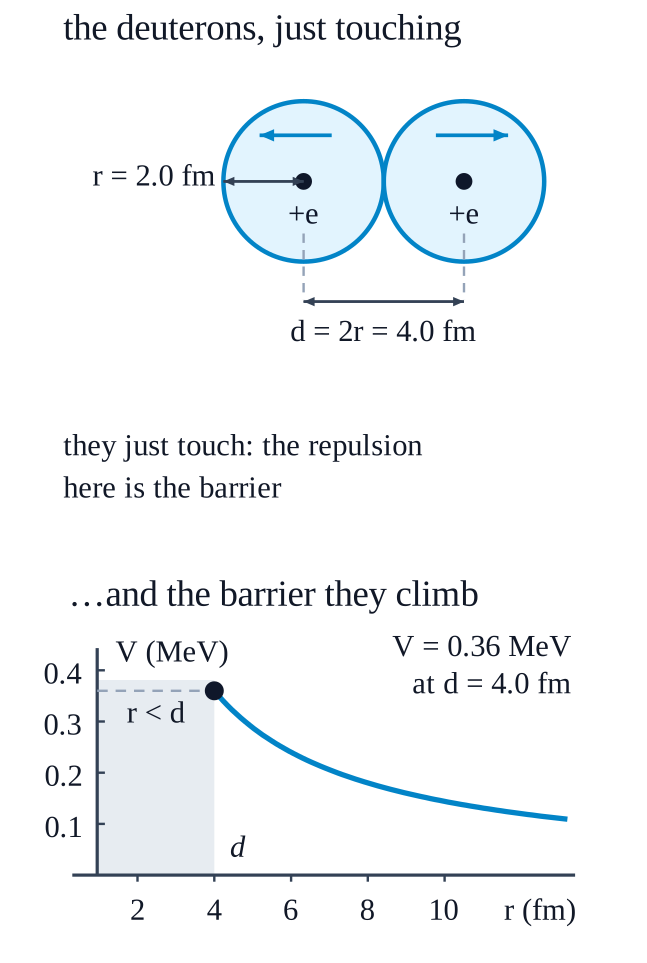
    Calculate the height of the potential barrier for a head on collision of two deuterons. (Hint: The height of the potential barrier is given by the Coulomb repulsion between the two deuterons when they just touch each other. Assume that they can be taken as hard spheres of radius $\displaystyle 2.0$ fm.) $\displaystyle 13.10$ From the relation R = \(\displaystyle R_{0}\)\(\displaystyle A^{1/3}\), where \(\displaystyle R_{0}\) is a constant and A is the mass number of a nucleus, show that the nuclear matter density is nearly constant (i.e. independent of A).
    NCERT’s answer
    $\displaystyle 360$ KeV
    NCERT_Solution_Class12_Physics_Ch13_Q13-9The potential barrier height equals the Coulomb potential energy when the two deuterons (each charge \(\displaystyle +e\), radius \(\displaystyle r=2.0\,\mathrm{fm}\)) just touch, i.e. centre-to-centre separation \(\displaystyle d = 2r = 4.0\,\mathrm{fm} = 4.0\times10^{-15}\,\mathrm{m}\): \[V = \frac{1}{4\pi\varepsilon_0}\frac{e^2}{d} = \frac{ke^2}{d}\]With \(\displaystyle k = 9\times10^{9}\,\mathrm{N\,m^2/C^2}\), \(\displaystyle e=1.6\times10^{-19}\,\mathrm{C}\): \[V = \frac{9\times10^{9}\times(1.6\times10^{-19})^2}{4.0\times10^{-15}} = \frac{2.304\times10^{-28}}{4.0\times10^{-15}} = 5.76\times10^{-14}\,\mathrm{J}\]Converting to MeV (\(\displaystyle 1\,\mathrm{MeV}=1.6\times10^{-13}\,\mathrm{J}\)): \[V = \frac{5.76\times10^{-14}}{1.6\times10^{-13}}\ \mathrm{MeV}\]\(\displaystyle V \approx 0.36\ \mathrm{MeV}\) (about $\displaystyle 360$ keV).