Exercise 6.1
 Predict the direction of induced current in the situations described by the following Figs. (a) to (f ).
Not cross-checked
NCERT prints no numerical answer for this exercise, so this working has not been cross-checked against the book.
NCERT’s answer
(a)
Along qrpq (b) Along prq, along yzx (c) Along yzx (d) Along zyx (e) Along xry (f ) No induced current since field lines lie in the plane of the loop.
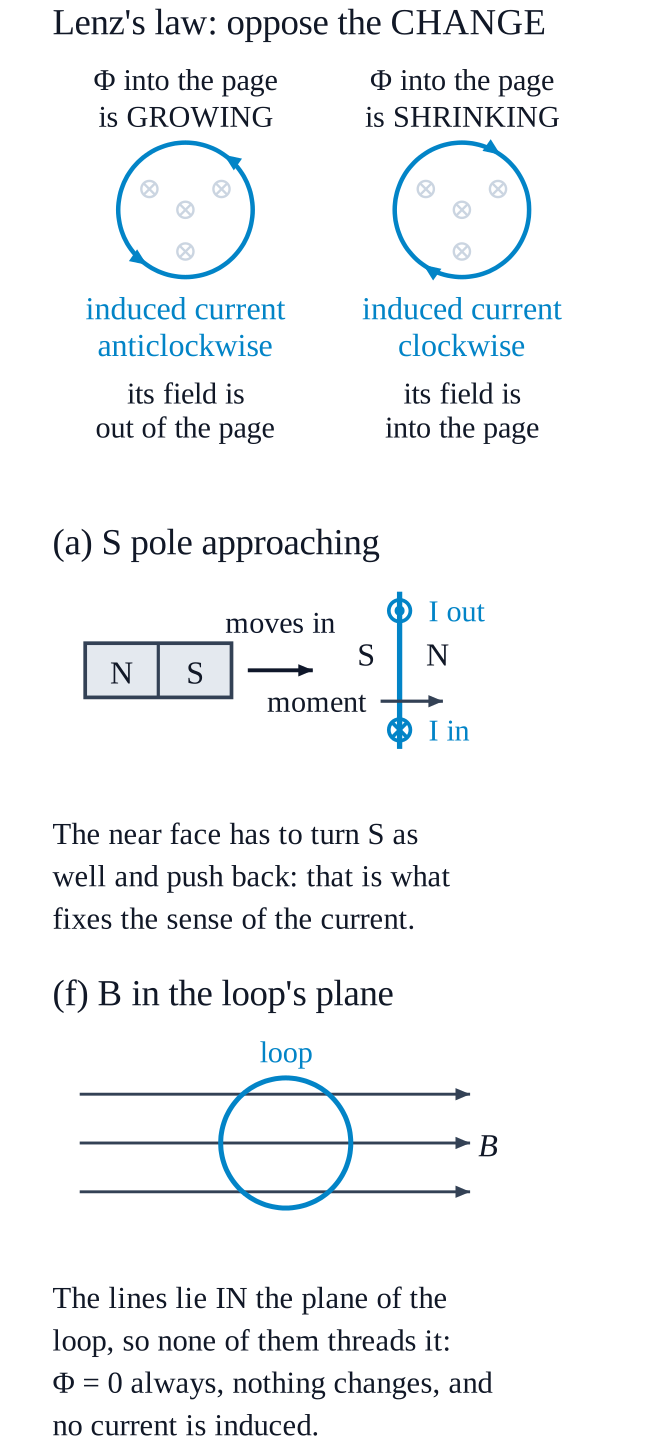 Lenz's law fixes the sense of every one of these: the induced current flows so that its own magnetic field OPPOSES the change in flux that produced it. Read each panel for (i) which way the flux through the loop points and (ii) whether it is growing or shrinking; the induced current then circulates so as to resist that change.Taking the vertex labels as printed in Fig $\displaystyle 6.15$:
 (a) Along \(\displaystyle qrpq\) — the magnet's south pole approaches the coil, so the flux linked with it grows and the near face must itself become a south pole to push back.
 (b) Along \(\displaystyle prq\) in the left loop and along \(\displaystyle yzx\) in the right one — the magnet recedes from one and approaches the other, so the two oppose opposite changes.
 (c) Along \(\displaystyle yzx\) — closing the tapping key starts a current in the left coil, so the flux through the right one rises from zero.
 (d) Along \(\displaystyle zyx\) — changing the rheostat changes the current, and hence the flux, in the opposite sense to (c).
 (e) Along \(\displaystyle xry\) — releasing the key collapses the current, so the flux falls and the induced current acts to maintain it.
 (f) No induced current. The field lines lie IN the plane of the loop, so the flux through it is zero however the current changes — there is no flux change to oppose.
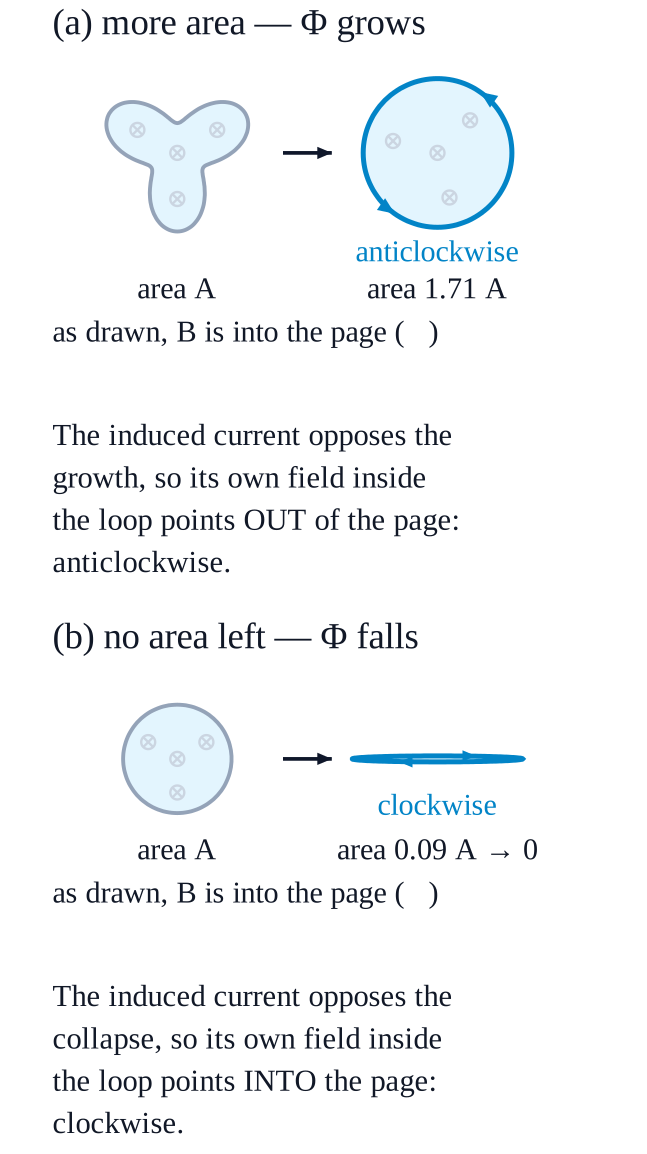 By Lenz's law the induced current always flows so as to oppose the change in magnetic flux \(\displaystyle \Phi_B = BA\) linked with the loop; since \(\displaystyle B\) is fixed here, this means opposing the change in enclosed area \(\displaystyle A\).(a) Irregular loop turning into a circular loop: For a given perimeter (length of wire), a circle encloses the maximum possible area. So as the irregular shape relaxes into a circle, the enclosed area — and hence \(\displaystyle \Phi_B\) — increases. By Lenz's law, the induced current opposes this increase: it flows in the sense whose own magnetic field inside the loop is directed opposite to \(\displaystyle B\) (i.e., it tries to shrink the loop back down, resisting the growth in area).(b) Circular loop deformed into a narrow straight wire: Here the enclosed area shrinks toward zero, so \(\displaystyle \Phi_B\) decreases. The induced current opposes this decrease: it flows in the sense whose own magnetic field inside the loop reinforces \(\displaystyle B\) (i.e., it tries to hold the loop open, resisting the collapse in area).In both cases the current direction is fixed by \(\displaystyle \text{(current's field)} \) opposing \(\displaystyle d\Phi_B/dt\); stating it explicitly as clockwise or anticlockwise additionally requires knowing whether \(\displaystyle B\) points into or out of the page in Fig. $\displaystyle 6.16$, which isn't given in the extracted text — the sense relative to the (unseen) field direction is: opposing growth in (a), opposing collapse in (b).
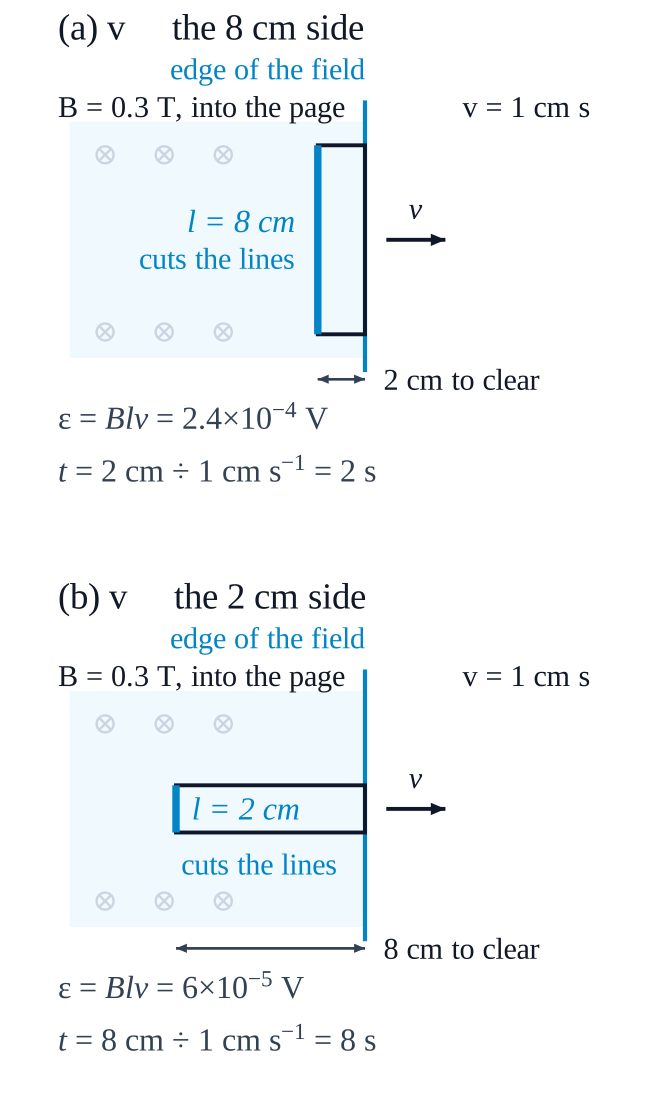 Principle: Motional emf, \(\displaystyle \varepsilon = B\,l\,v\), where \(\displaystyle l\) is the length of the side that is perpendicular to the velocity (the side that actually sweeps out area/cuts field lines as it exits the field). The emf lasts only as long as that side is still inside the field region, i.e. for a duration \(\displaystyle t = \dfrac{\text{length of the other side}}{v}\).Given: sides \(\displaystyle 8\ \mathrm{cm} = 0.08\ \mathrm{m}\) and \(\displaystyle 2\ \mathrm{cm} = 0.02\ \mathrm{m}\), \(\displaystyle B = 0.3\ \mathrm{T}\), \(\displaystyle v = 1\ \mathrm{cm\,s^{-1}} = 0.01\ \mathrm{m/s}\).(a) Velocity normal to the longer ($\displaystyle 8$ cm) side: here the $\displaystyle 8$ cm side is the one cutting field lines (\(\displaystyle l=0.08\,\mathrm{m}\)), and the loop must traverse the $\displaystyle 2$ cm dimension to fully exit.
\[\varepsilon = Blv = (0.3)(0.08)(0.01) = 2.4\times10^{-4}\ \mathrm{V}
\]
\[t = \frac{0.02}{0.01} = 2\ \mathrm{s}
\]
\(\displaystyle \varepsilon = 2.4\times10^{-4}\ \mathrm{V}\), lasting $\displaystyle 2$ s.(b) Velocity normal to the shorter ($\displaystyle 2$ cm) side: here the $\displaystyle 2$ cm side cuts field lines (\(\displaystyle l=0.02\,\mathrm{m}\)), and the loop must traverse the $\displaystyle 8$ cm dimension to fully exit.
\[\varepsilon = Blv = (0.3)(0.02)(0.01) = 6\times10^{-5}\ \mathrm{V}
\]
\[t = \frac{0.08}{0.01} = 8\ \mathrm{s}
\]
\(\displaystyle \varepsilon = 6\times10^{-5}\ \mathrm{V}\), lasting $\displaystyle 8$ s.
Principle: Motional emf, \(\displaystyle \varepsilon = B\,l\,v\), where \(\displaystyle l\) is the length of the side that is perpendicular to the velocity (the side that actually sweeps out area/cuts field lines as it exits the field). The emf lasts only as long as that side is still inside the field region, i.e. for a duration \(\displaystyle t = \dfrac{\text{length of the other side}}{v}\).Given: sides \(\displaystyle 8\ \mathrm{cm} = 0.08\ \mathrm{m}\) and \(\displaystyle 2\ \mathrm{cm} = 0.02\ \mathrm{m}\), \(\displaystyle B = 0.3\ \mathrm{T}\), \(\displaystyle v = 1\ \mathrm{cm\,s^{-1}} = 0.01\ \mathrm{m/s}\).(a) Velocity normal to the longer ($\displaystyle 8$ cm) side: here the $\displaystyle 8$ cm side is the one cutting field lines (\(\displaystyle l=0.08\,\mathrm{m}\)), and the loop must traverse the $\displaystyle 2$ cm dimension to fully exit.
\[\varepsilon = Blv = (0.3)(0.08)(0.01) = 2.4\times10^{-4}\ \mathrm{V}
\]
\[t = \frac{0.02}{0.01} = 2\ \mathrm{s}
\]
\(\displaystyle \varepsilon = 2.4\times10^{-4}\ \mathrm{V}\), lasting $\displaystyle 2$ s.(b) Velocity normal to the shorter ($\displaystyle 2$ cm) side: here the $\displaystyle 2$ cm side cuts field lines (\(\displaystyle l=0.02\,\mathrm{m}\)), and the loop must traverse the $\displaystyle 8$ cm dimension to fully exit.
\[\varepsilon = Blv = (0.3)(0.02)(0.01) = 6\times10^{-5}\ \mathrm{V}
\]
\[t = \frac{0.08}{0.01} = 8\ \mathrm{s}
\]
\(\displaystyle \varepsilon = 6\times10^{-5}\ \mathrm{V}\), lasting $\displaystyle 8$ s.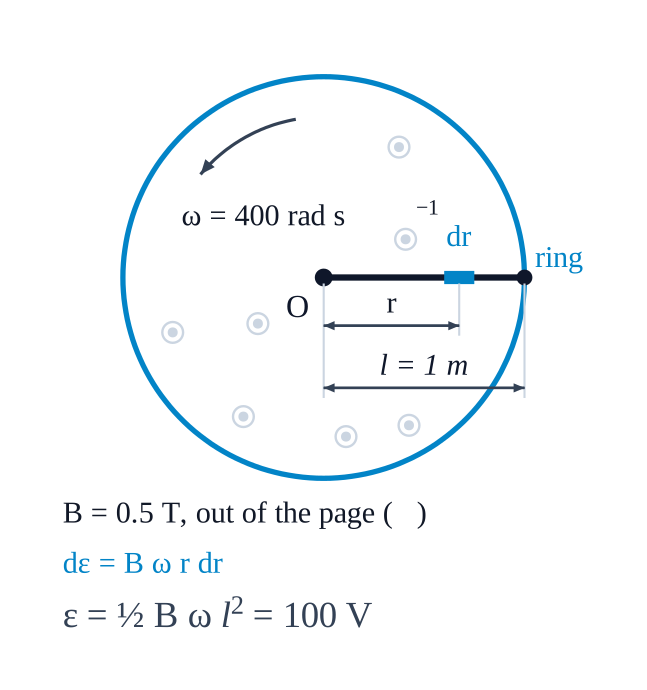 Principle: A rod of length \(\displaystyle l\) rotating with angular frequency \(\displaystyle \omega\) about an axis through one end, in a uniform field \(\displaystyle B\) parallel to the axis, develops an emf between centre (axis) and the far end (ring) given by treating it as a stack of concentric rings each contributing \(\displaystyle dq = B\,\omega\,r\,dr\):
\[\varepsilon = \int_0^l B\omega r\,dr = \tfrac{1}{2}B\omega l^2
\]Given: \(\displaystyle l = 1.0\ \mathrm{m}\), \(\displaystyle \omega = 400\ \mathrm{rad\,s^{-1}}\), \(\displaystyle B = 0.5\ \mathrm{T}\).\[\varepsilon = \tfrac12(0.5)(400)(1.0)^2 = 100\ \mathrm{V}
\]The emf developed between the centre and the ring is \(\displaystyle 100\ \mathrm{V}\).
Principle: A rod of length \(\displaystyle l\) rotating with angular frequency \(\displaystyle \omega\) about an axis through one end, in a uniform field \(\displaystyle B\) parallel to the axis, develops an emf between centre (axis) and the far end (ring) given by treating it as a stack of concentric rings each contributing \(\displaystyle dq = B\,\omega\,r\,dr\):
\[\varepsilon = \int_0^l B\omega r\,dr = \tfrac{1}{2}B\omega l^2
\]Given: \(\displaystyle l = 1.0\ \mathrm{m}\), \(\displaystyle \omega = 400\ \mathrm{rad\,s^{-1}}\), \(\displaystyle B = 0.5\ \mathrm{T}\).\[\varepsilon = \tfrac12(0.5)(400)(1.0)^2 = 100\ \mathrm{V}
\]The emf developed between the centre and the ring is \(\displaystyle 100\ \mathrm{V}\).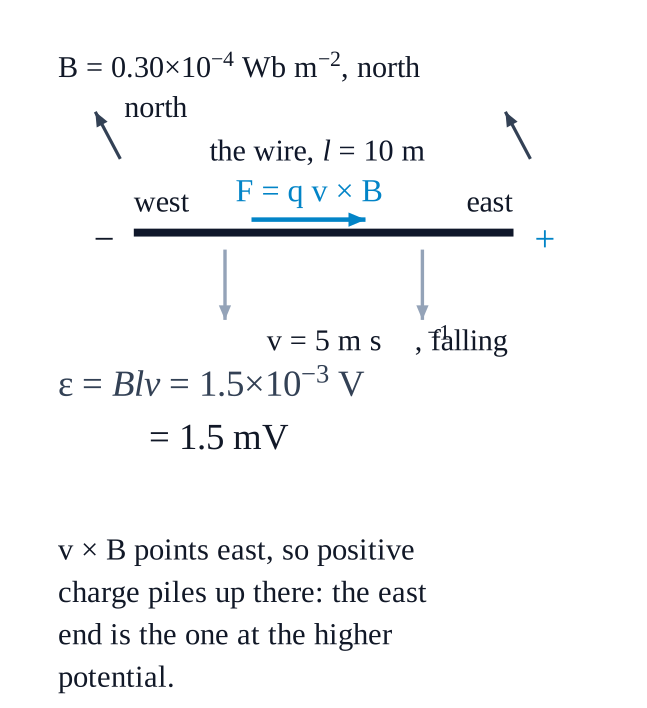 Principle: Motional emf, \(\displaystyle \varepsilon = B_H\,l\,v\), with the wire, velocity, and field mutually perpendicular; direction from \(\displaystyle \vec F = q\vec v \times \vec B\).Given: \(\displaystyle l = 10\ \mathrm{m}\), \(\displaystyle v = 5.0\ \mathrm{m/s}\) (downward, i.e. free fall), \(\displaystyle B_H = 0.30\times10^{-4}\ \mathrm{Wb\,m^{-2}}\) (horizontal, pointing geographic north).(a)
\[\varepsilon = B_H l v = (0.30\times10^{-4})(10)(5.0) = 1.5\times10^{-3}\ \mathrm{V} = 1.5\ \mathrm{mV}
\](b) Take east \(\displaystyle =\hat x\), north \(\displaystyle =\hat y\), up \(\displaystyle =\hat z\); velocity is \(\displaystyle -v\hat z\) (downward), field is \(\displaystyle B_H\hat y\) (north). Force on a positive charge:
\[\vec F = q\vec v\times\vec B = q(-v\hat z)\times(B_H\hat y) = qvB_H\,\hat x
\]
so the force on positive charges is directed eastward — the induced current in the wire (as a source) flows from west to east.(c) Positive charge is driven and accumulates toward the east end, so the east end of the wire is at the higher electrical potential.
Principle: Motional emf, \(\displaystyle \varepsilon = B_H\,l\,v\), with the wire, velocity, and field mutually perpendicular; direction from \(\displaystyle \vec F = q\vec v \times \vec B\).Given: \(\displaystyle l = 10\ \mathrm{m}\), \(\displaystyle v = 5.0\ \mathrm{m/s}\) (downward, i.e. free fall), \(\displaystyle B_H = 0.30\times10^{-4}\ \mathrm{Wb\,m^{-2}}\) (horizontal, pointing geographic north).(a)
\[\varepsilon = B_H l v = (0.30\times10^{-4})(10)(5.0) = 1.5\times10^{-3}\ \mathrm{V} = 1.5\ \mathrm{mV}
\](b) Take east \(\displaystyle =\hat x\), north \(\displaystyle =\hat y\), up \(\displaystyle =\hat z\); velocity is \(\displaystyle -v\hat z\) (downward), field is \(\displaystyle B_H\hat y\) (north). Force on a positive charge:
\[\vec F = q\vec v\times\vec B = q(-v\hat z)\times(B_H\hat y) = qvB_H\,\hat x
\]
so the force on positive charges is directed eastward — the induced current in the wire (as a source) flows from west to east.(c) Positive charge is driven and accumulates toward the east end, so the east end of the wire is at the higher electrical potential.