Exercise 9.1
A small candle, cm in size is placed at cm in front of a concave mirror of radius of curvature cm. At what distance from the mirror should a screen be placed in order to obtain a sharp image? Describe the nature and size of the image. If the candle is moved closer to the mirror, how would the screen have to be moved?
NCERT’s answer
v = -$\displaystyle 54$ cm. The image is real, inverted and magnified. The size of the image is $\displaystyle 5.0$ cm. As u → f, v → ∞; for u < f, image is virtual.
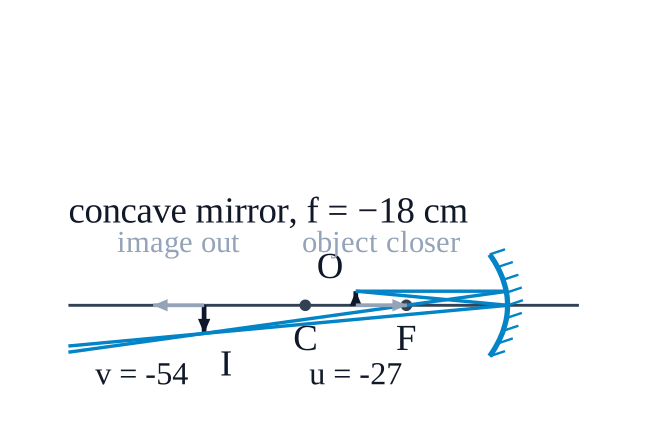 Mirror formula: \(\displaystyle \dfrac{1}{v}+\dfrac{1}{u}=\dfrac{1}{f}\), with \(\displaystyle f=\dfrac{R}{2}\).Concave mirror: \(\displaystyle R=36\ \mathrm{cm}\Rightarrow f=-18\ \mathrm{cm}\) (Cartesian sign convention, pole as origin, light travelling in \(\displaystyle -u\) direction taken negative for real objects). Object distance \(\displaystyle u=-27\ \mathrm{cm}\).\[\frac{1}{v}=\frac{1}{f}-\frac{1}{u}=\frac{1}{-18}-\frac{1}{-27}=-\frac{1}{18}+\frac{1}{27}=-\frac{3}{54}+\frac{2}{54}=-\frac{1}{54}\]\(\displaystyle v=-54\ \mathrm{cm}\).The screen must be placed $\displaystyle 54$ cm in front of the mirror.Magnification: \(\displaystyle m=-\dfrac{v}{u}=-\dfrac{-54}{-27}=-2\).Image height \(\displaystyle =m\times h=-2\times2.5\ \mathrm{cm}=-5\ \mathrm{cm}\).The image is real, inverted, magnified $\displaystyle 2$×, of size $\displaystyle 5$ cm, formed $\displaystyle 54$ cm in front of the mirror (beyond the centre of curvature, since the object lies between F and C).As the candle is moved closer to the mirror (toward F at $\displaystyle 18$ cm), \(\displaystyle |v|\) increases and the image recedes further from the mirror, so the screen must be moved farther away from the mirror; when the candle reaches F the image forms at infinity, and if it is brought still closer (inside F) the image becomes virtual and no longer falls on a screen.
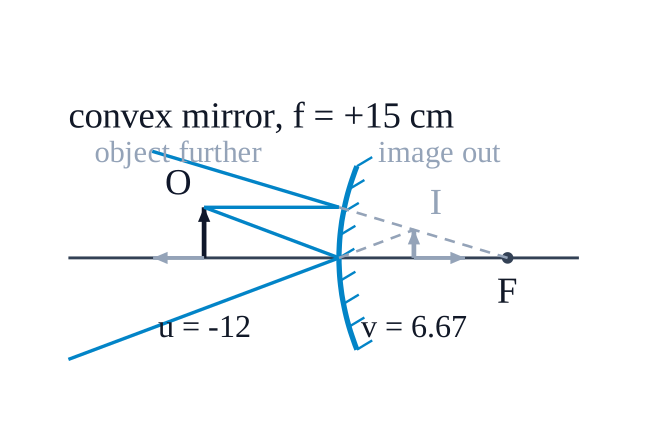 Convex mirror: \(\displaystyle f=+15\ \mathrm{cm}\) (behind the mirror, positive by convention), object distance \(\displaystyle u=-12\ \mathrm{cm}\).\[\frac{1}{v}=\frac{1}{f}-\frac{1}{u}=\frac{1}{15}-\frac{1}{-12}=\frac{1}{15}+\frac{1}{12}=\frac{4+5}{60}=\frac{9}{60}=\frac{3}{20}\]\(\displaystyle v=\dfrac{20}{3}=6.67\ \mathrm{cm}\) (positive → behind the mirror, virtual).Magnification: \(\displaystyle m=-\dfrac{v}{u}=-\dfrac{6.67}{-12}=0.556\).Image height \(\displaystyle =0.556\times4.5\ \mathrm{cm}=2.5\ \mathrm{cm}\).The image is virtual, erect, and diminished, located $\displaystyle 6.67$ cm behind the mirror, of height $\displaystyle 2.5$ cm.As the needle is moved farther away, \(\displaystyle |v|\) approaches \(\displaystyle f=15\ \mathrm{cm}\) and \(\displaystyle m\) keeps decreasing — the image stays virtual and erect, moves progressively closer to the focal point behind the mirror, and shrinks further in size.
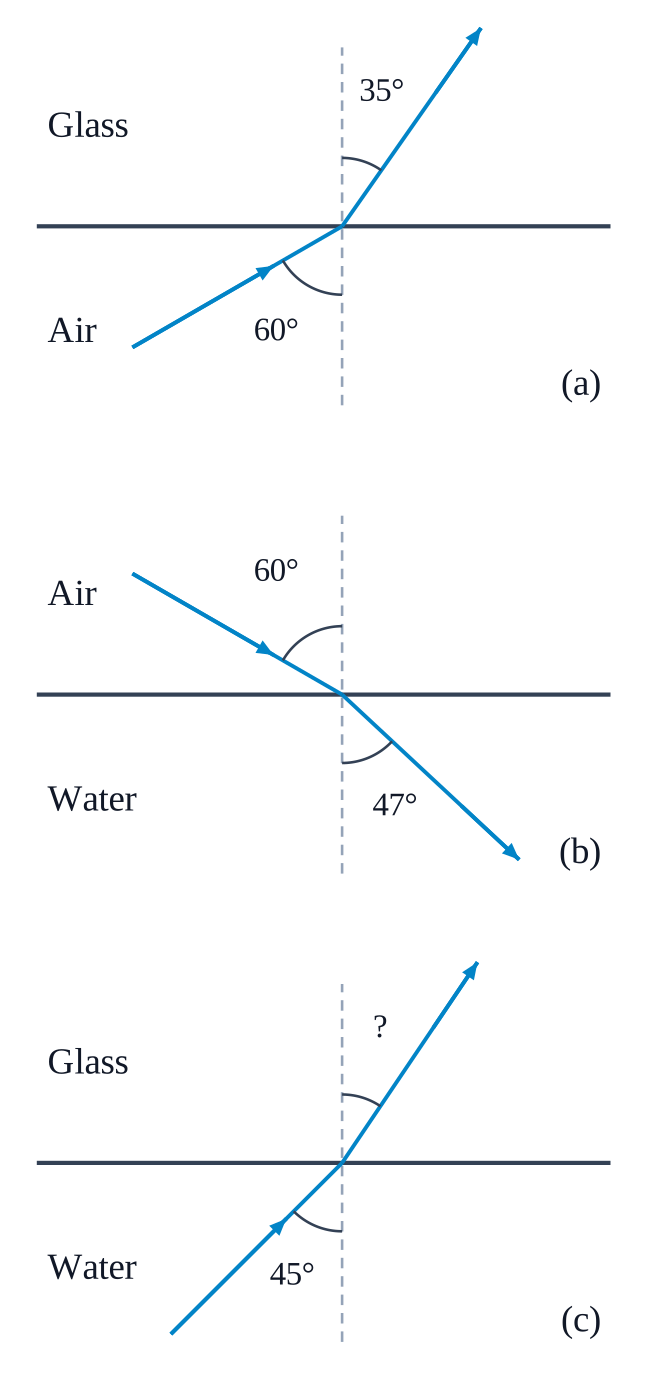 Figures
 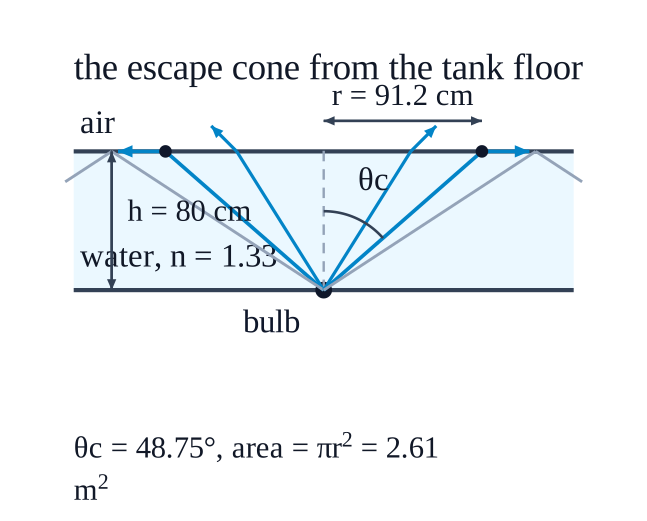 Light escapes the surface only within the cone of the critical angle \(\displaystyle \theta_c\), given by Snell's law at the water-air interface:\[\sin\theta_c=\frac{1}{n}=\frac{1}{1.33}=0.7519\ \Rightarrow\ \theta_c\approx48.75^\circ\]The illuminated circle on the surface has radius \(\displaystyle r=h\tan\theta_c\), where \(\displaystyle h=80\ \mathrm{cm}\) is the depth of the bulb.\[\cos\theta_c=\sqrt{1-\sin^2\theta_c}=\sqrt{1-0.5654}=0.6593,\qquad \tan\theta_c=\frac{0.7519}{0.6593}=1.140\]\[r=80\ \mathrm{cm}\times1.140=91.2\ \mathrm{cm}=0.912\ \mathrm{m}\]\[\text{Area}=\pi r^2=\pi\times(0.912\ \mathrm{m})^2\approx2.61\ \mathrm{m}^2\]The light emerges through a circle of area \(\displaystyle \approx 2.61\ \mathrm{m}^2\) on the water surface.
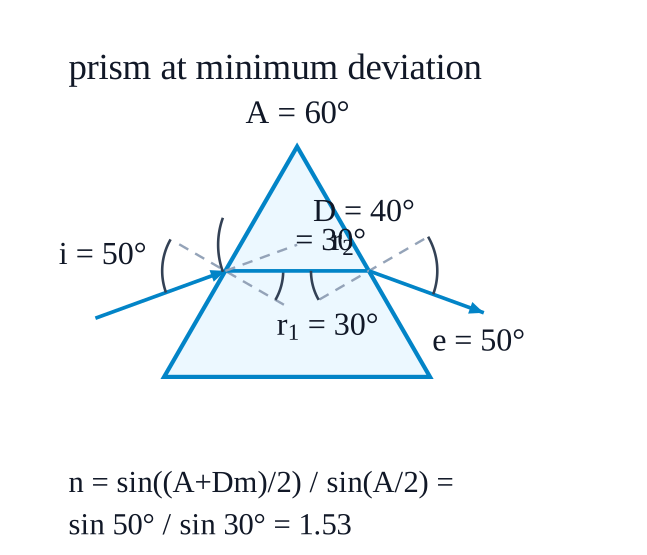 Prism formula at minimum deviation: \(\displaystyle n=\dfrac{\sin\left(\frac{A+D_m}{2}\right)}{\sin\left(\frac{A}{2}\right)}\), with \(\displaystyle A=60^\circ\), \(\displaystyle D_m=40^\circ\).\[n=\frac{\sin 50^\circ}{\sin 30^\circ}=\frac{0.7660}{0.5}=1.532\]Refractive index of the prism glass \(\displaystyle \approx 1.53\).In water (\(\displaystyle n_w=1.33\)), the relevant refractive index is the glass-relative-to-water ratio:\[n_{rel}=\frac{n_{glass}}{n_{water}}=\frac{1.532}{1.33}=1.152\]\[\sin\left(\frac{A+D_m'}{2}\right)=n_{rel}\sin\left(\frac{A}{2}\right)=1.152\times0.5=0.576\]\[\frac{A+D_m'}{2}=\sin^{-1}(0.576)\approx35.2^\circ \ \Rightarrow\ A+D_m'\approx70.4^\circ\]\[D_m'\approx70.4^\circ-60^\circ\approx10.4^\circ\]The new angle of minimum deviation in water is about \(\displaystyle 10.4^\circ\) — much smaller than in air, since the effective refractive index of the glass relative to water is close to 1.
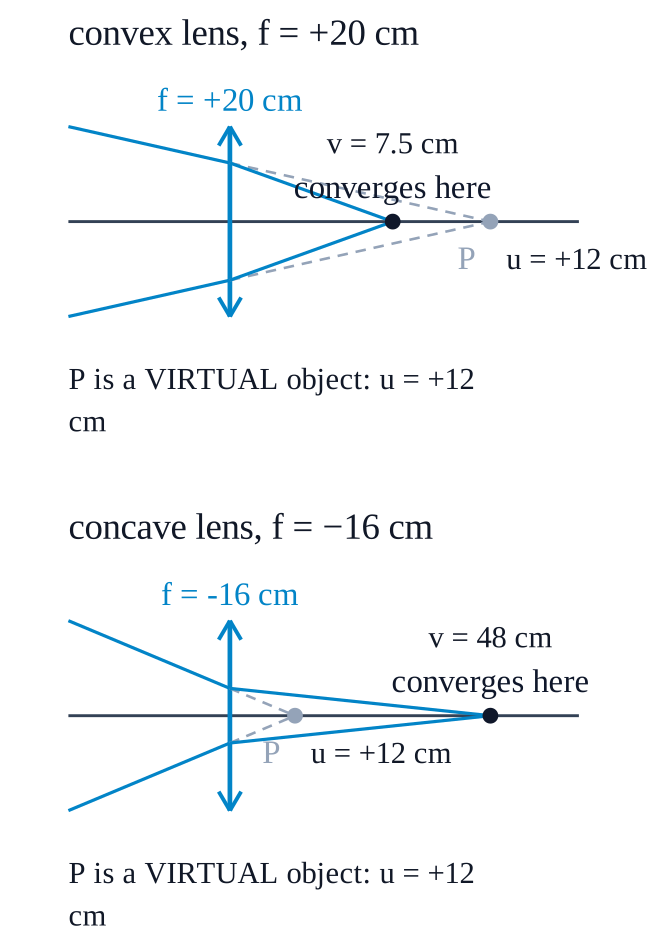 The beam is convergent toward P, so P acts as a virtual object for the lens: with light travelling toward P, \(\displaystyle u=+12\ \mathrm{cm}\) (virtual object, on the outgoing side of the lens).Thin lens formula: \(\displaystyle \dfrac{1}{v}-\dfrac{1}{u}=\dfrac{1}{f}\).(a) Convex lens, \(\displaystyle f=+20\ \mathrm{cm}\):\[\frac{1}{v}=\frac{1}{f}+\frac{1}{u}=\frac{1}{20}+\frac{1}{12}=\frac{3+5}{60}=\frac{8}{60}=\frac{2}{15}\]\(\displaystyle v=\dfrac{15}{2}=7.5\ \mathrm{cm}\).The beam now converges $\displaystyle 7.5$ cm from the lens — i.e., $\displaystyle 4.5$ cm closer to the lens than P, since the convex lens adds convergence.(b) Concave lens, \(\displaystyle f=-16\ \mathrm{cm}\):\[\frac{1}{v}=\frac{1}{f}+\frac{1}{u}=-\frac{1}{16}+\frac{1}{12}=\frac{-3+4}{48}=\frac{1}{48}\]\(\displaystyle v=48\ \mathrm{cm}\).The beam converges $\displaystyle 48$ cm from the lens — farther than P, since the concave lens introduces divergence that delays the convergence point.
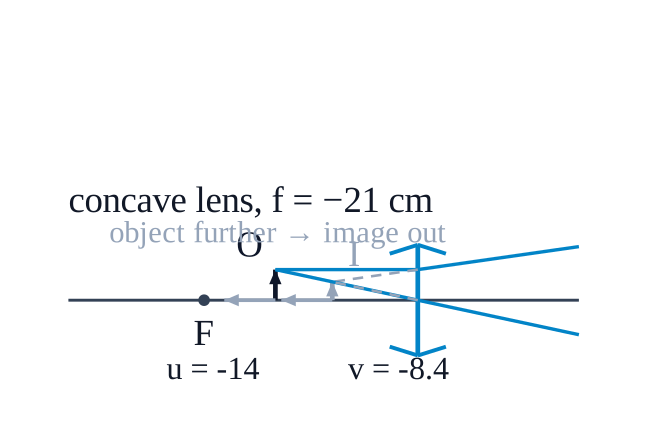 Concave lens: \(\displaystyle f=-21\ \mathrm{cm}\); object at \(\displaystyle u=-14\ \mathrm{cm}\), height \(\displaystyle h=3.0\ \mathrm{cm}\).\[\frac{1}{v}=\frac{1}{f}+\frac{1}{u}=-\frac{1}{21}-\frac{1}{14}=-\left(\frac{2}{42}+\frac{3}{42}\right)=-\frac{5}{42}\]\(\displaystyle v=-\dfrac{42}{5}=-8.4\ \mathrm{cm}\).Magnification: \(\displaystyle m=\dfrac{v}{u}=\dfrac{-8.4}{-14}=0.6\).Image height \(\displaystyle =0.6\times3.0\ \mathrm{cm}=1.8\ \mathrm{cm}\).The image is virtual, erect, and diminished, formed $\displaystyle 8.4$ cm from the lens on the same side as the object, of height $\displaystyle 1.8$ cm.As the object is moved farther away (\(\displaystyle |u|\to\infty\)), \(\displaystyle v\to f=-21\ \mathrm{cm}\): the image stays virtual and erect, moves progressively closer to the focus (approaching $\displaystyle 21$ cm from the lens), and keeps shrinking in size, never becoming real.