Exercise 1.11
A polythene piece rubbed with wool is found to have a negative charge of × C.
(a)
Estimate the number of electrons transferred (from which to which?)
(b)
Is there a transfer of mass from wool to polythene?
NCERT’s answer
(a)
$\displaystyle 2$ × \(\displaystyle 10^{12}\), from wool to polythene. (b) Yes, but of a negligible amount ( = $\displaystyle 2$ × \(\displaystyle 10^{-18}\) kg in the example).
(a) Charge is quantised, so the charge acquired is \(\displaystyle q = ne\):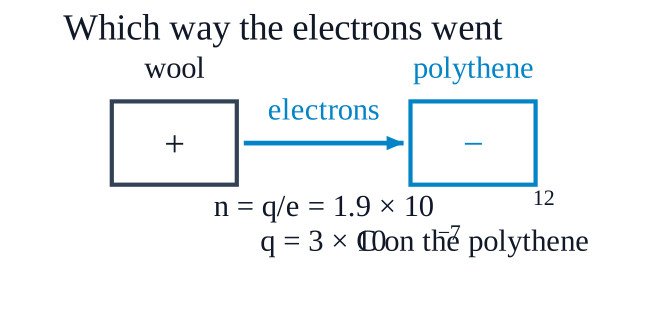 \[n = \frac{q}{e} = \frac{3\times10^{-7}}{1.6\times10^{-19}} = 1.9\times10^{12}\]
The polythene ends up negative, so it has gained electrons. The transfer is therefore from the wool to the polythene — and the wool is left with an equal positive charge.(b) Yes. Electrons carry mass, so moving them moves mass. The mass transferred is
\[n = \frac{q}{e} = \frac{3\times10^{-7}}{1.6\times10^{-19}} = 1.9\times10^{12}\]
The polythene ends up negative, so it has gained electrons. The transfer is therefore from the wool to the polythene — and the wool is left with an equal positive charge.(b) Yes. Electrons carry mass, so moving them moves mass. The mass transferred is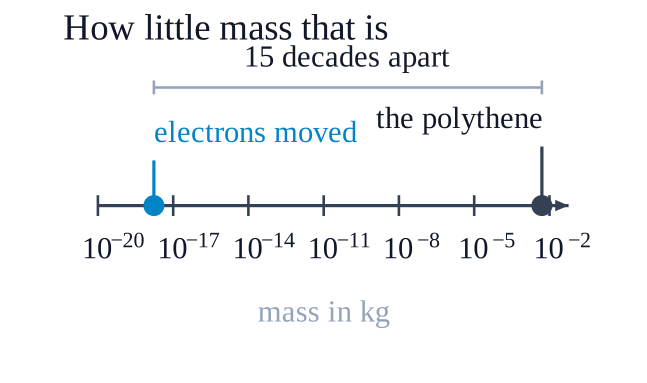 \[\Delta m = n\,m_e = (1.9\times10^{12})(9.11\times10^{-31}) \approx 1.7\times10^{-18}\,\mathrm{kg}\]
in the same direction as the electrons, from wool to polythene. It is an utterly negligible amount — about \(\displaystyle 10^{-18}\,\mathrm{kg}\) against a piece of polythene of a few grams — but it is not zero.
\[\Delta m = n\,m_e = (1.9\times10^{12})(9.11\times10^{-31}) \approx 1.7\times10^{-18}\,\mathrm{kg}\]
in the same direction as the electrons, from wool to polythene. It is an utterly negligible amount — about \(\displaystyle 10^{-18}\,\mathrm{kg}\) against a piece of polythene of a few grams — but it is not zero.
\[n = \frac{q}{e} = \frac{3\times10^{-7}}{1.6\times10^{-19}} = 1.9\times10^{12}\]
The polythene ends up negative, so it has gained electrons. The transfer is therefore from the wool to the polythene — and the wool is left with an equal positive charge.(b) Yes. Electrons carry mass, so moving them moves mass. The mass transferred is\[\Delta m = n\,m_e = (1.9\times10^{12})(9.11\times10^{-31}) \approx 1.7\times10^{-18}\,\mathrm{kg}\]
in the same direction as the electrons, from wool to polythene. It is an utterly negligible amount — about \(\displaystyle 10^{-18}\,\mathrm{kg}\) against a piece of polythene of a few grams — but it is not zero.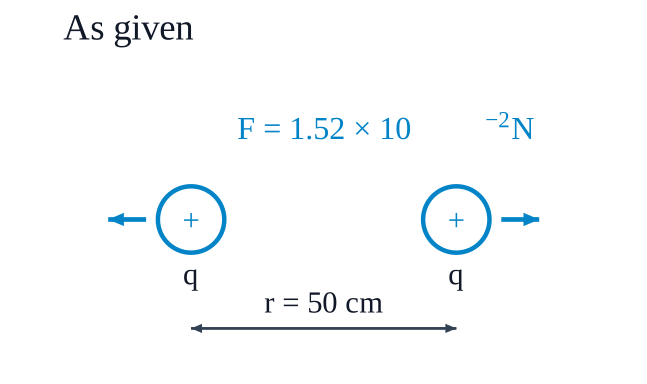 \[F = k\,\frac{q^2}{r^2} = \frac{(9\times10^{9})(6.5\times10^{-7})^2}{(0.50)^2} = \frac{3.80\times10^{-3}}{0.25}\]
\[F = 1.5\times10^{-2}\,\mathrm{N}\]
Both charges have the same sign, so the force is repulsive.(b) Rather than recompute from scratch, scale the result. Doubling each charge multiplies \(\displaystyle q^2\) by \(\displaystyle 4\); halving the separation divides \(\displaystyle r^2\) by \(\displaystyle 4\). The force therefore changes by a factor
\[F = k\,\frac{q^2}{r^2} = \frac{(9\times10^{9})(6.5\times10^{-7})^2}{(0.50)^2} = \frac{3.80\times10^{-3}}{0.25}\]
\[F = 1.5\times10^{-2}\,\mathrm{N}\]
Both charges have the same sign, so the force is repulsive.(b) Rather than recompute from scratch, scale the result. Doubling each charge multiplies \(\displaystyle q^2\) by \(\displaystyle 4\); halving the separation divides \(\displaystyle r^2\) by \(\displaystyle 4\). The force therefore changes by a factor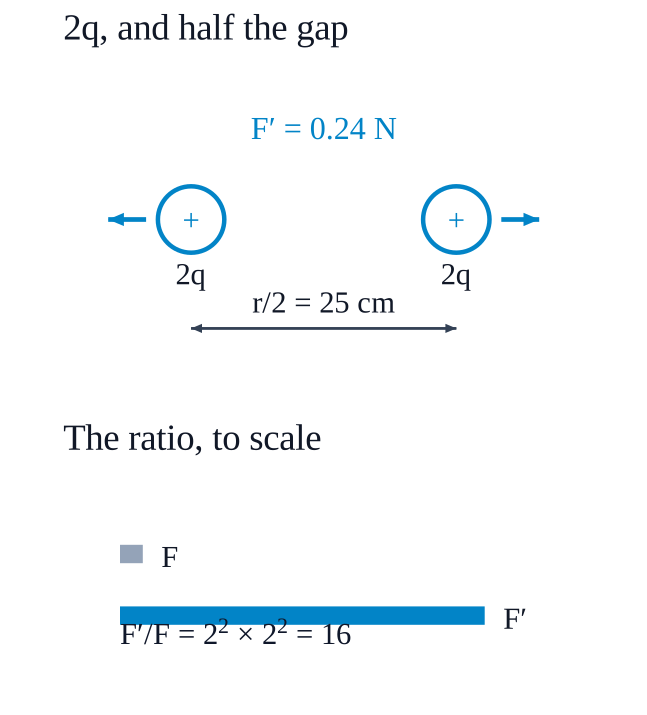 \[\frac{F'}{F} = \frac{(2q)(2q)}{q^2}\times\frac{r^2}{(r/2)^2} = 4\times 4 = 16\]
\[F' = 16 \times 1.5\times10^{-2} = 0.24\,\mathrm{N}\]
\[\frac{F'}{F} = \frac{(2q)(2q)}{q^2}\times\frac{r^2}{(r/2)^2} = 4\times 4 = 16\]
\[F' = 16 \times 1.5\times10^{-2} = 0.24\,\mathrm{N}\] Figure
 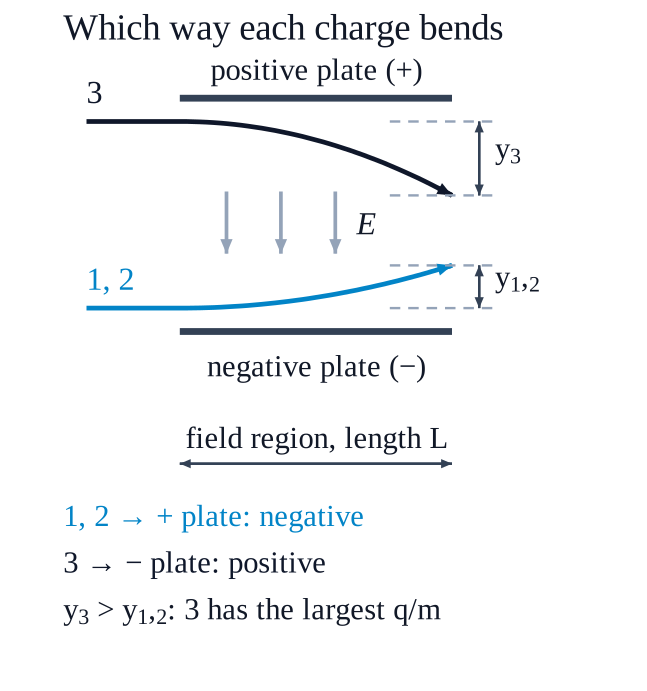 The plates carry opposite charges, so the field between them runs from the positive plate at the top to the negative plate at the bottom: \(\displaystyle \vec{E}\) points downward.The force on a charge in that field is \(\displaystyle \vec{F} = q\vec{E}\), so
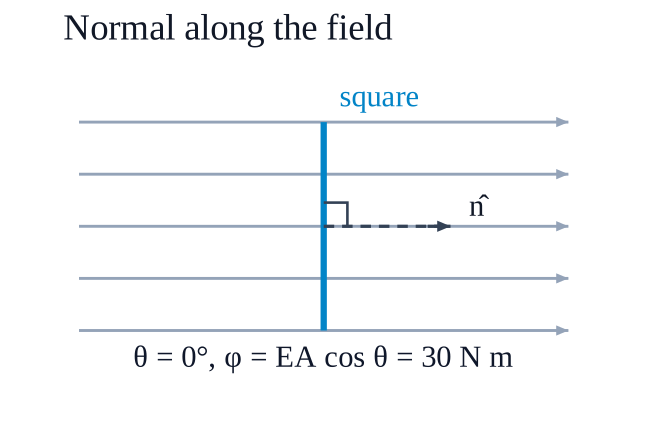 \[\phi = EA\cos 0^\circ = (3\times10^{3})(1\times10^{-2}) = 30\ \mathrm{N\,m^2\,C^{-1}}\](b) Now the normal makes \(\displaystyle 60^\circ\) with the \(\displaystyle x\)-axis, so \(\displaystyle \theta = 60^\circ\):
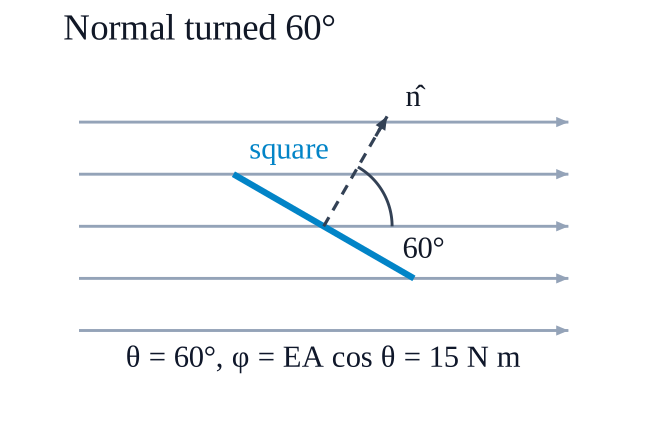 \[\phi = EA\cos 60^\circ = 30 \times 0.5 = 15\ \mathrm{N\,m^2\,C^{-1}}\]
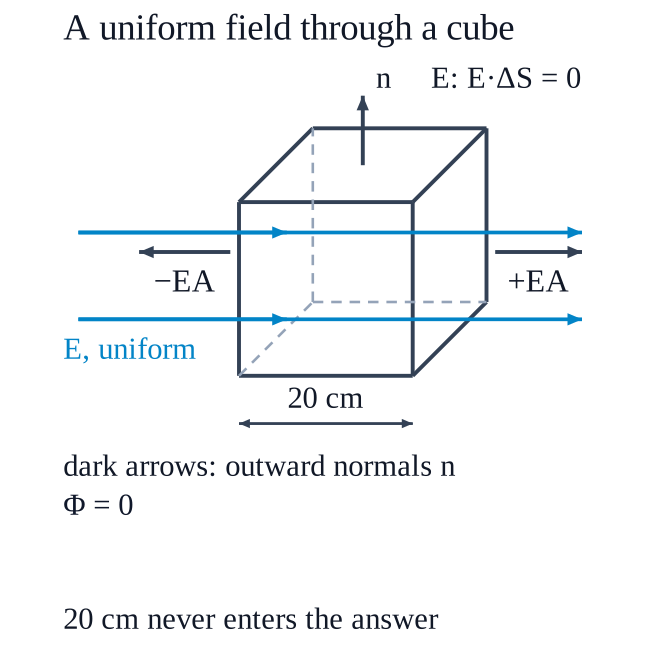 Zero.The cube is a closed surface, and the field is uniform. Consider the two faces perpendicular to \(\displaystyle \hat{i}\): the field enters through one and leaves through the other, over equal areas. On the entry face the outward normal is \(\displaystyle -\hat{i}\), giving \(\displaystyle -EA\); on the exit face it is \(\displaystyle +\hat{i}\), giving \(\displaystyle +EA\). These cancel exactly.The remaining four faces have their normals perpendicular to \(\displaystyle \vec{E}\), so \(\displaystyle \vec{E}\cdot\vec{A} = 0\) on each and they contribute nothing.
\[\phi_{\text{net}} = (+EA) + (-EA) + 0 + 0 + 0 + 0 = 0\]The same conclusion follows immediately from Gauss's law: the cube encloses no charge, so
\[\phi_{\text{net}} = \frac{q_{\text{enclosed}}}{\varepsilon_0} = 0\]
The side length of \(\displaystyle 20\,\mathrm{cm}\) never enters the answer.
Zero.The cube is a closed surface, and the field is uniform. Consider the two faces perpendicular to \(\displaystyle \hat{i}\): the field enters through one and leaves through the other, over equal areas. On the entry face the outward normal is \(\displaystyle -\hat{i}\), giving \(\displaystyle -EA\); on the exit face it is \(\displaystyle +\hat{i}\), giving \(\displaystyle +EA\). These cancel exactly.The remaining four faces have their normals perpendicular to \(\displaystyle \vec{E}\), so \(\displaystyle \vec{E}\cdot\vec{A} = 0\) on each and they contribute nothing.
\[\phi_{\text{net}} = (+EA) + (-EA) + 0 + 0 + 0 + 0 = 0\]The same conclusion follows immediately from Gauss's law: the cube encloses no charge, so
\[\phi_{\text{net}} = \frac{q_{\text{enclosed}}}{\varepsilon_0} = 0\]
The side length of \(\displaystyle 20\,\mathrm{cm}\) never enters the answer.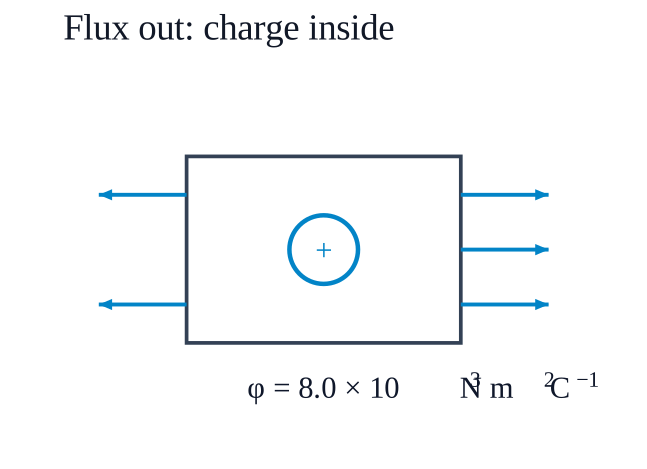 \[\phi = \frac{q}{\varepsilon_0}\ \Longrightarrow\ q = \varepsilon_0\,\phi\]
Substituting \(\displaystyle \varepsilon_0 = 8.854\times10^{-12}\,\mathrm{C^2\,N^{-1}\,m^{-2}}\) and \(\displaystyle \phi = 8.0\times10^{3}\,\mathrm{N\,m^2\,C^{-1}}\):
\[q = (8.854\times10^{-12})(8.0\times10^{3}) = 7.1\times10^{-8}\,\mathrm{C} = 0.07\,\mu\mathrm{C}\](b) No. Gauss's law fixes only the net charge enclosed. Zero net flux tells us
\[\phi = \frac{q}{\varepsilon_0}\ \Longrightarrow\ q = \varepsilon_0\,\phi\]
Substituting \(\displaystyle \varepsilon_0 = 8.854\times10^{-12}\,\mathrm{C^2\,N^{-1}\,m^{-2}}\) and \(\displaystyle \phi = 8.0\times10^{3}\,\mathrm{N\,m^2\,C^{-1}}\):
\[q = (8.854\times10^{-12})(8.0\times10^{3}) = 7.1\times10^{-8}\,\mathrm{C} = 0.07\,\mu\mathrm{C}\](b) No. Gauss's law fixes only the net charge enclosed. Zero net flux tells us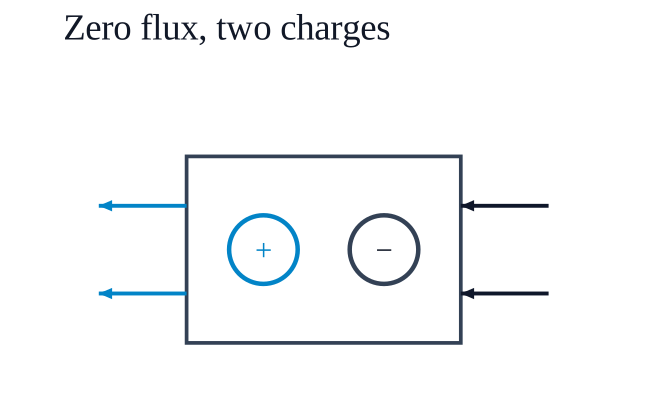 \[q_{\text{enclosed}} = 0\]
which is satisfied just as well by equal amounts of positive and negative charge inside the box as by no charge at all. To conclude the box is empty of charge one would need more than the total flux — for instance that \(\displaystyle \vec{E} = 0\) at every point of the surface.
\[q_{\text{enclosed}} = 0\]
which is satisfied just as well by equal amounts of positive and negative charge inside the box as by no charge at all. To conclude the box is empty of charge one would need more than the total flux — for instance that \(\displaystyle \vec{E} = 0\) at every point of the surface. A point charge +
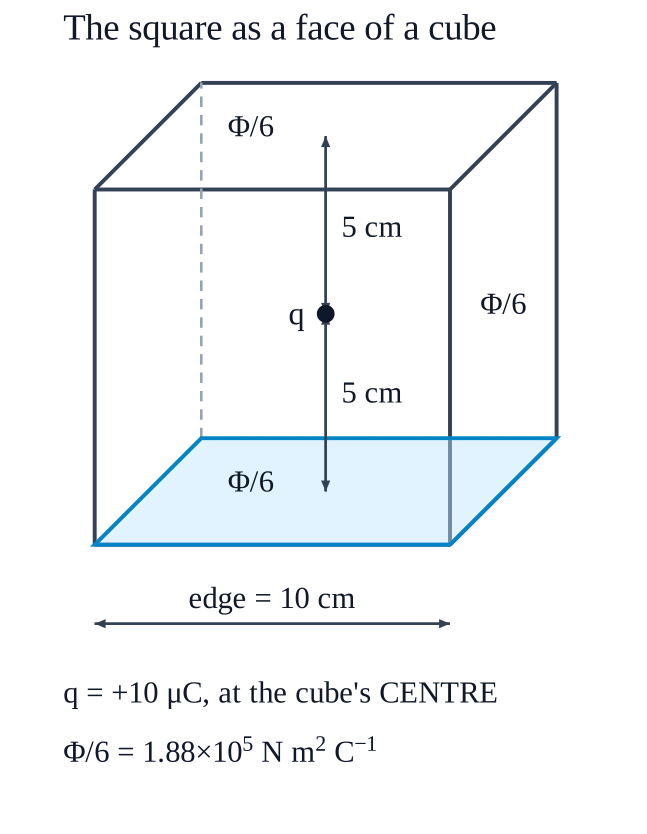 Take the square to be one face of a cube of edge \(\displaystyle 10\ \mathrm{cm}\). The charge sits \(\displaystyle 5\ \mathrm{cm}\) above the centre of the square, i.e. at the centre of that cube (half of \(\displaystyle 10\ \mathrm{cm}\) is \(\displaystyle 5\ \mathrm{cm}\)), so the square is a genuine closed-surface face and Gauss's law applies to the cube:\[\Phi_{\text{cube}}=\frac{q}{\varepsilon_0}
\]The six faces are equivalent by symmetry about the centre, so each carries one-sixth of the total flux:\[\Phi_{\text{square}}=\frac{1}{6}\cdot\frac{q}{\varepsilon_0}
\]Substituting \(\displaystyle q=10\ \mu\mathrm{C}=10\times10^{-6}\ \mathrm{C}\) and \(\displaystyle \varepsilon_0=8.854\times10^{-12}\ \mathrm{C^2\,N^{-1}m^{-2}}\):\[\Phi_{\text{square}}=\frac{10\times10^{-6}}{6\times 8.854\times10^{-12}}
=\frac{1.0\times10^{-5}}{5.312\times10^{-11}}
\]\[\Phi_{\text{square}}\approx 1.88\times10^{5}\ \mathrm{N\,m^{2}\,C^{-1}}
\]Magnitude of the electric flux through the square: \(\displaystyle \Phi\approx 1.88\times10^{5}\ \mathrm{N\,m^{2}\,C^{-1}}\) (directed outward, since the charge is positive).Note the step that is easy to lose: the one-sixth split is valid only because \(\displaystyle 5\ \mathrm{cm}\) is exactly half the edge, putting the charge at the cube's centre. Direct integration over the square is unnecessary.The printed answer key disagrees, and it is the key that is wrong. NCERT's appendix prints \(\displaystyle 2.2\times10^{5}\) N m² C⁻¹ against $\displaystyle 1.17$ and \(\displaystyle 1.9\times10^{5}\) against $\displaystyle 1.18$ — the two are transposed. \(\displaystyle 2.2\times10^{5}\) is \(\displaystyle q/\varepsilon_0\) for $\displaystyle 1.18$'s $\displaystyle 2.0$ μC cube; this question's square is one face of a cube around $\displaystyle 10$ μC, so its flux is \(\displaystyle q/6\varepsilon_0=1.9\times10^{5}\) N m² C⁻¹.
Take the square to be one face of a cube of edge \(\displaystyle 10\ \mathrm{cm}\). The charge sits \(\displaystyle 5\ \mathrm{cm}\) above the centre of the square, i.e. at the centre of that cube (half of \(\displaystyle 10\ \mathrm{cm}\) is \(\displaystyle 5\ \mathrm{cm}\)), so the square is a genuine closed-surface face and Gauss's law applies to the cube:\[\Phi_{\text{cube}}=\frac{q}{\varepsilon_0}
\]The six faces are equivalent by symmetry about the centre, so each carries one-sixth of the total flux:\[\Phi_{\text{square}}=\frac{1}{6}\cdot\frac{q}{\varepsilon_0}
\]Substituting \(\displaystyle q=10\ \mu\mathrm{C}=10\times10^{-6}\ \mathrm{C}\) and \(\displaystyle \varepsilon_0=8.854\times10^{-12}\ \mathrm{C^2\,N^{-1}m^{-2}}\):\[\Phi_{\text{square}}=\frac{10\times10^{-6}}{6\times 8.854\times10^{-12}}
=\frac{1.0\times10^{-5}}{5.312\times10^{-11}}
\]\[\Phi_{\text{square}}\approx 1.88\times10^{5}\ \mathrm{N\,m^{2}\,C^{-1}}
\]Magnitude of the electric flux through the square: \(\displaystyle \Phi\approx 1.88\times10^{5}\ \mathrm{N\,m^{2}\,C^{-1}}\) (directed outward, since the charge is positive).Note the step that is easy to lose: the one-sixth split is valid only because \(\displaystyle 5\ \mathrm{cm}\) is exactly half the edge, putting the charge at the cube's centre. Direct integration over the square is unnecessary.The printed answer key disagrees, and it is the key that is wrong. NCERT's appendix prints \(\displaystyle 2.2\times10^{5}\) N m² C⁻¹ against $\displaystyle 1.17$ and \(\displaystyle 1.9\times10^{5}\) against $\displaystyle 1.18$ — the two are transposed. \(\displaystyle 2.2\times10^{5}\) is \(\displaystyle q/\varepsilon_0\) for $\displaystyle 1.18$'s $\displaystyle 2.0$ μC cube; this question's square is one face of a cube around $\displaystyle 10$ μC, so its flux is \(\displaystyle q/6\varepsilon_0=1.9\times10^{5}\) N m² C⁻¹.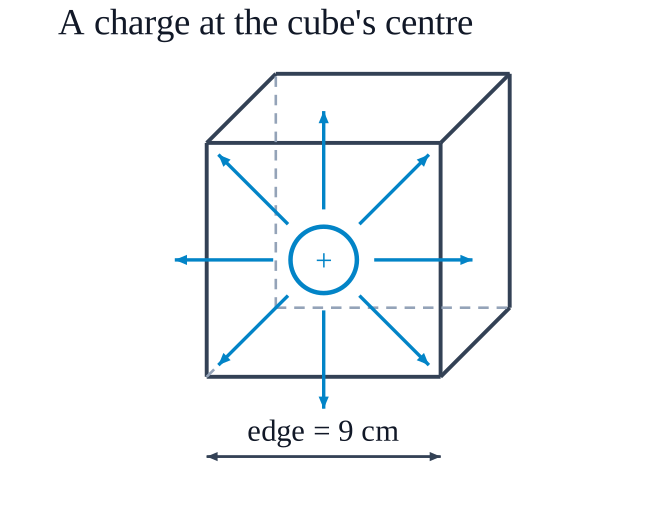 By Gauss's law, the net flux through any closed surface depends only on the charge enclosed, not on the size or shape of the surface:\[\Phi=\oint \vec{E}\cdot d\vec{S}=\frac{q_{\text{enc}}}{\varepsilon_0}
\]Here \(\displaystyle q_{\text{enc}}=2.0\ \mu\mathrm{C}=2.0\times10^{-6}\ \mathrm{C}\), and \(\displaystyle \varepsilon_0=8.854\times10^{-12}\ \mathrm{C^2\,N^{-1}m^{-2}}\):\[\Phi=\frac{2.0\times10^{-6}}{8.854\times10^{-12}}
\]\[\Phi\approx 2.26\times10^{5}\ \mathrm{N\,m^{2}\,C^{-1}}
\]Net electric flux through the cubical surface: \(\displaystyle \Phi\approx +2.26\times10^{5}\ \mathrm{N\,m^{2}\,C^{-1}}\), outward.The edge length \(\displaystyle 9.0\ \mathrm{cm}\) is deliberately irrelevant — nothing in Gauss's law refers to it. (Each of the six faces would carry \(\displaystyle \Phi/6\approx 3.76\times10^{4}\ \mathrm{N\,m^{2}\,C^{-1}}\), since the charge is at the centre.)The printed answer key disagrees, and it is the key that is wrong. NCERT's appendix prints \(\displaystyle 1.9\times10^{5}\) N m² C⁻¹ against $\displaystyle 1.18$ and \(\displaystyle 2.2\times10^{5}\) against $\displaystyle 1.17$ — the two are transposed. \(\displaystyle 1.9\times10^{5}\) is \(\displaystyle q/6\varepsilon_0\) for $\displaystyle 1.17$'s square; a closed cube encloses the whole charge, so the flux here is \(\displaystyle q/\varepsilon_0=2.3\times10^{5}\) N m² C⁻¹.
By Gauss's law, the net flux through any closed surface depends only on the charge enclosed, not on the size or shape of the surface:\[\Phi=\oint \vec{E}\cdot d\vec{S}=\frac{q_{\text{enc}}}{\varepsilon_0}
\]Here \(\displaystyle q_{\text{enc}}=2.0\ \mu\mathrm{C}=2.0\times10^{-6}\ \mathrm{C}\), and \(\displaystyle \varepsilon_0=8.854\times10^{-12}\ \mathrm{C^2\,N^{-1}m^{-2}}\):\[\Phi=\frac{2.0\times10^{-6}}{8.854\times10^{-12}}
\]\[\Phi\approx 2.26\times10^{5}\ \mathrm{N\,m^{2}\,C^{-1}}
\]Net electric flux through the cubical surface: \(\displaystyle \Phi\approx +2.26\times10^{5}\ \mathrm{N\,m^{2}\,C^{-1}}\), outward.The edge length \(\displaystyle 9.0\ \mathrm{cm}\) is deliberately irrelevant — nothing in Gauss's law refers to it. (Each of the six faces would carry \(\displaystyle \Phi/6\approx 3.76\times10^{4}\ \mathrm{N\,m^{2}\,C^{-1}}\), since the charge is at the centre.)The printed answer key disagrees, and it is the key that is wrong. NCERT's appendix prints \(\displaystyle 1.9\times10^{5}\) N m² C⁻¹ against $\displaystyle 1.18$ and \(\displaystyle 2.2\times10^{5}\) against $\displaystyle 1.17$ — the two are transposed. \(\displaystyle 1.9\times10^{5}\) is \(\displaystyle q/6\varepsilon_0\) for $\displaystyle 1.17$'s square; a closed cube encloses the whole charge, so the flux here is \(\displaystyle q/\varepsilon_0=2.3\times10^{5}\) N m² C⁻¹.
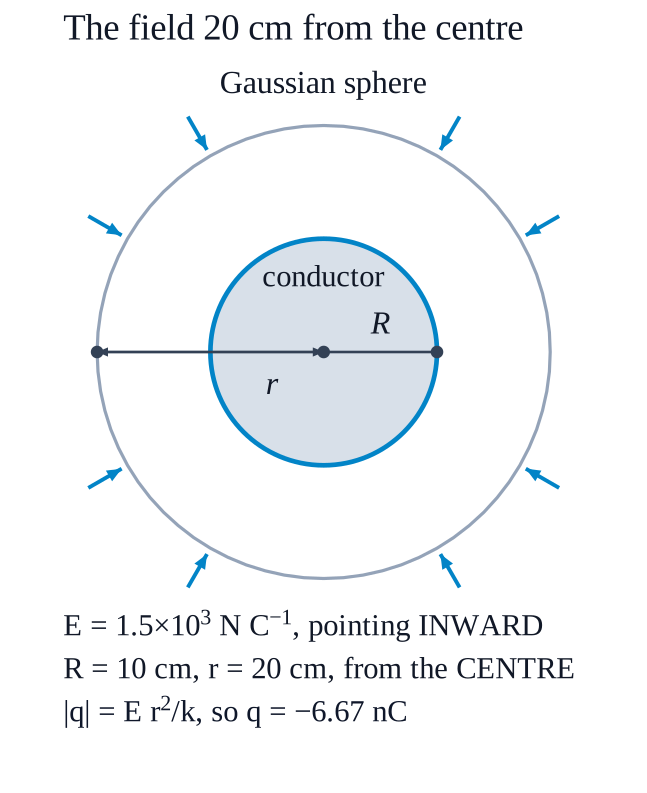 Outside a uniformly charged conducting sphere, the field is the same as that of a point charge of equal magnitude placed at the centre (a Gaussian sphere of radius \(\displaystyle r>R\) encloses the whole charge):\[E=\frac{1}{4\pi\varepsilon_0}\frac{|q|}{r^{2}}=\frac{k|q|}{r^{2}}
\]The field point is at \(\displaystyle r=20\ \mathrm{cm}=0.20\ \mathrm{m}\), which is outside the sphere (\(\displaystyle R=10\ \mathrm{cm}\)), so this formula is the right one — and note that \(\displaystyle r\) is measured from the centre, not from the surface.Solving for the magnitude of the charge:\[|q|=\frac{E\,r^{2}}{k}=\frac{(1.5\times10^{3}\ \mathrm{N\,C^{-1}})(0.20\ \mathrm{m})^{2}}{9\times10^{9}\ \mathrm{N\,m^{2}\,C^{-2}}}
\]\[|q|=\frac{1.5\times10^{3}\times 4.0\times10^{-2}}{9\times10^{9}}=\frac{60}{9\times10^{9}}
\]\[|q|=6.67\times10^{-9}\ \mathrm{C}
\]The field points radially inward, i.e. toward the sphere, so the charge must be negative.Net charge on the sphere: \(\displaystyle q\approx -6.67\times10^{-9}\ \mathrm{C}=-6.67\ \mathrm{nC}\).
Outside a uniformly charged conducting sphere, the field is the same as that of a point charge of equal magnitude placed at the centre (a Gaussian sphere of radius \(\displaystyle r>R\) encloses the whole charge):\[E=\frac{1}{4\pi\varepsilon_0}\frac{|q|}{r^{2}}=\frac{k|q|}{r^{2}}
\]The field point is at \(\displaystyle r=20\ \mathrm{cm}=0.20\ \mathrm{m}\), which is outside the sphere (\(\displaystyle R=10\ \mathrm{cm}\)), so this formula is the right one — and note that \(\displaystyle r\) is measured from the centre, not from the surface.Solving for the magnitude of the charge:\[|q|=\frac{E\,r^{2}}{k}=\frac{(1.5\times10^{3}\ \mathrm{N\,C^{-1}})(0.20\ \mathrm{m})^{2}}{9\times10^{9}\ \mathrm{N\,m^{2}\,C^{-2}}}
\]\[|q|=\frac{1.5\times10^{3}\times 4.0\times10^{-2}}{9\times10^{9}}=\frac{60}{9\times10^{9}}
\]\[|q|=6.67\times10^{-9}\ \mathrm{C}
\]The field points radially inward, i.e. toward the sphere, so the charge must be negative.Net charge on the sphere: \(\displaystyle q\approx -6.67\times10^{-9}\ \mathrm{C}=-6.67\ \mathrm{nC}\).
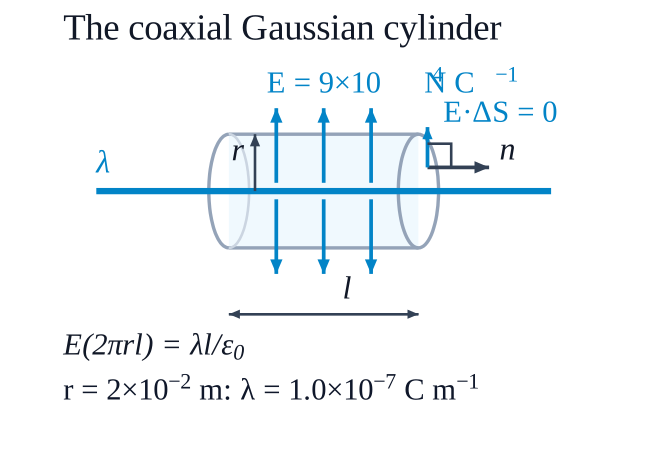 Apply Gauss's law to an infinite line charge of linear charge density \(\displaystyle \lambda\). Using a coaxial cylindrical Gaussian surface of radius \(\displaystyle r\) and length \(\displaystyle l\), only the curved surface contributes (\(\displaystyle \mathbf{E}\) is radial and parallel to the flat ends):\[E\,(2\pi r l) = \frac{\lambda l}{\varepsilon_{0}} \qquad\Longrightarrow\qquad E = \frac{\lambda}{2\pi\varepsilon_{0} r} \]Rearranging for the unknown:
\[\lambda = 2\pi\varepsilon_{0}\, r\, E \]Substitute \(\displaystyle E = 9\times10^{4}\ \mathrm{N/C}\) and \(\displaystyle r = 2\ \mathrm{cm} = 2\times10^{-2}\ \mathrm{m}\) (converting to metres is essential here):\[\lambda = 2\pi\,(8.854\times10^{-12}\ \mathrm{C^{2}\,N^{-1}\,m^{-2}})(2\times10^{-2}\ \mathrm{m})(9\times10^{4}\ \mathrm{N\,C^{-1}}) \]\[\lambda = (5.563\times10^{-11})(2\times10^{-2})(9\times10^{4})\ \mathrm{C\,m^{-1}} \]\[\lambda = 1.0\times10^{-7}\ \mathrm{C\,m^{-1}} \]Answer: \(\displaystyle \lambda \approx 1.0\times10^{-7}\ \mathrm{C/m} = 0.1\ \mu\mathrm{C/m}\). (The field points radially outward, so the line carries positive charge.)The printed answer key disagrees. NCERT's appendix gives $\displaystyle 10$ μC/m. From the data this question states — \(\displaystyle 9\times10^{4}\) N/C at $\displaystyle 2$ cm — \(\displaystyle \lambda=2\pi\varepsilon_0 rE=0.1\ \mu\mathrm{C/m}\); $\displaystyle 10$ μC/m is what the same formula returns at \(\displaystyle r=2\ \mathrm{m}\). One end of the printed pair is misprinted and the book does not say which, so the working above uses the distance the question actually gives.
Apply Gauss's law to an infinite line charge of linear charge density \(\displaystyle \lambda\). Using a coaxial cylindrical Gaussian surface of radius \(\displaystyle r\) and length \(\displaystyle l\), only the curved surface contributes (\(\displaystyle \mathbf{E}\) is radial and parallel to the flat ends):\[E\,(2\pi r l) = \frac{\lambda l}{\varepsilon_{0}} \qquad\Longrightarrow\qquad E = \frac{\lambda}{2\pi\varepsilon_{0} r} \]Rearranging for the unknown:
\[\lambda = 2\pi\varepsilon_{0}\, r\, E \]Substitute \(\displaystyle E = 9\times10^{4}\ \mathrm{N/C}\) and \(\displaystyle r = 2\ \mathrm{cm} = 2\times10^{-2}\ \mathrm{m}\) (converting to metres is essential here):\[\lambda = 2\pi\,(8.854\times10^{-12}\ \mathrm{C^{2}\,N^{-1}\,m^{-2}})(2\times10^{-2}\ \mathrm{m})(9\times10^{4}\ \mathrm{N\,C^{-1}}) \]\[\lambda = (5.563\times10^{-11})(2\times10^{-2})(9\times10^{4})\ \mathrm{C\,m^{-1}} \]\[\lambda = 1.0\times10^{-7}\ \mathrm{C\,m^{-1}} \]Answer: \(\displaystyle \lambda \approx 1.0\times10^{-7}\ \mathrm{C/m} = 0.1\ \mu\mathrm{C/m}\). (The field points radially outward, so the line carries positive charge.)The printed answer key disagrees. NCERT's appendix gives $\displaystyle 10$ μC/m. From the data this question states — \(\displaystyle 9\times10^{4}\) N/C at $\displaystyle 2$ cm — \(\displaystyle \lambda=2\pi\varepsilon_0 rE=0.1\ \mu\mathrm{C/m}\); $\displaystyle 10$ μC/m is what the same formula returns at \(\displaystyle r=2\ \mathrm{m}\). One end of the printed pair is misprinted and the book does not say which, so the working above uses the distance the question actually gives.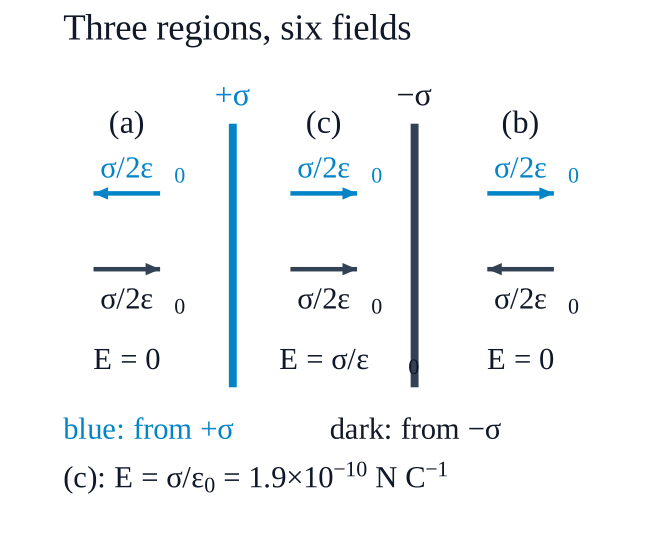 Each thin plate carries charge of magnitude density \(\displaystyle \sigma\) on its inner face; treat each as an infinite charged sheet, whose field is
\[E_{\text{sheet}} = \frac{\sigma}{2\varepsilon_{0}} \]
directed away from a positive sheet and toward a negative one. Superpose the two fields region by region — this is the step to get right: it is the directions that decide the answer, not the magnitudes.Let plate $\displaystyle 1$ carry \(\displaystyle +\sigma\) and plate $\displaystyle 2$ carry \(\displaystyle -\sigma\).(a) Outer region of the first plateHere the field of the positive sheet points left (away from it) and the field of the negative sheet points right (toward it). They are equal in magnitude and opposite:
\[E = \frac{\sigma}{2\varepsilon_{0}} - \frac{\sigma}{2\varepsilon_{0}} = 0 \](b) Outer region of the second plateBy the same cancellation,
\[E = \frac{\sigma}{2\varepsilon_{0}} - \frac{\sigma}{2\varepsilon_{0}} = 0 \](c) Between the platesHere both contributions point the same way (away from the positive plate, toward the negative plate), so they add:
\[E = \frac{\sigma}{2\varepsilon_{0}} + \frac{\sigma}{2\varepsilon_{0}} = \frac{\sigma}{\varepsilon_{0}} \]\[E = \frac{17.0\times10^{-22}\ \mathrm{C\,m^{-2}}}{8.854\times10^{-12}\ \mathrm{C^{2}\,N^{-1}\,m^{-2}}} = 1.92\times10^{-10}\ \mathrm{N\,C^{-1}} \]Answers: (a) \(\displaystyle E = 0\); (b) \(\displaystyle E = 0\); (c) \(\displaystyle E = 1.9\times10^{-10}\ \mathrm{N/C}\), directed from the positively charged plate to the negatively charged one (perpendicular to the plates).The printed answer key drops the exponent. NCERT's appendix gives (c) as "$\displaystyle 1.9$ N/C". \(\displaystyle \sigma/\varepsilon_0\) with \(\displaystyle \sigma=17.0\times10^{-22}\ \mathrm{C\,m^{-2}}\) is \(\displaystyle 1.9\times10^{-10}\) N/C — a field of $\displaystyle 1.9$ N/C would need a surface density ten orders of magnitude larger.
Each thin plate carries charge of magnitude density \(\displaystyle \sigma\) on its inner face; treat each as an infinite charged sheet, whose field is
\[E_{\text{sheet}} = \frac{\sigma}{2\varepsilon_{0}} \]
directed away from a positive sheet and toward a negative one. Superpose the two fields region by region — this is the step to get right: it is the directions that decide the answer, not the magnitudes.Let plate $\displaystyle 1$ carry \(\displaystyle +\sigma\) and plate $\displaystyle 2$ carry \(\displaystyle -\sigma\).(a) Outer region of the first plateHere the field of the positive sheet points left (away from it) and the field of the negative sheet points right (toward it). They are equal in magnitude and opposite:
\[E = \frac{\sigma}{2\varepsilon_{0}} - \frac{\sigma}{2\varepsilon_{0}} = 0 \](b) Outer region of the second plateBy the same cancellation,
\[E = \frac{\sigma}{2\varepsilon_{0}} - \frac{\sigma}{2\varepsilon_{0}} = 0 \](c) Between the platesHere both contributions point the same way (away from the positive plate, toward the negative plate), so they add:
\[E = \frac{\sigma}{2\varepsilon_{0}} + \frac{\sigma}{2\varepsilon_{0}} = \frac{\sigma}{\varepsilon_{0}} \]\[E = \frac{17.0\times10^{-22}\ \mathrm{C\,m^{-2}}}{8.854\times10^{-12}\ \mathrm{C^{2}\,N^{-1}\,m^{-2}}} = 1.92\times10^{-10}\ \mathrm{N\,C^{-1}} \]Answers: (a) \(\displaystyle E = 0\); (b) \(\displaystyle E = 0\); (c) \(\displaystyle E = 1.9\times10^{-10}\ \mathrm{N/C}\), directed from the positively charged plate to the negatively charged one (perpendicular to the plates).The printed answer key drops the exponent. NCERT's appendix gives (c) as "$\displaystyle 1.9$ N/C". \(\displaystyle \sigma/\varepsilon_0\) with \(\displaystyle \sigma=17.0\times10^{-22}\ \mathrm{C\,m^{-2}}\) is \(\displaystyle 1.9\times10^{-10}\) N/C — a field of $\displaystyle 1.9$ N/C would need a surface density ten orders of magnitude larger.