Exercise 9.13
Two elements, A and B, have the following configurations — A: , , (i) Which element is more reactive? (ii) Will A and B form ionic or covalent bonds when they combine? Explain using electron transfer or sharing. (iii) Predict the formula of the compound they would form.
NCERT’s answer
(i)
Element B (ii) Covalent (iii) \(\displaystyle AB_{3}\)
(i) Element B is the more reactive. It needs only one electron to complete its octet ($\displaystyle 7$ valence electrons), while A needs three ($\displaystyle 5$ valence electrons) — the smaller the gap, the more readily the atom reacts.
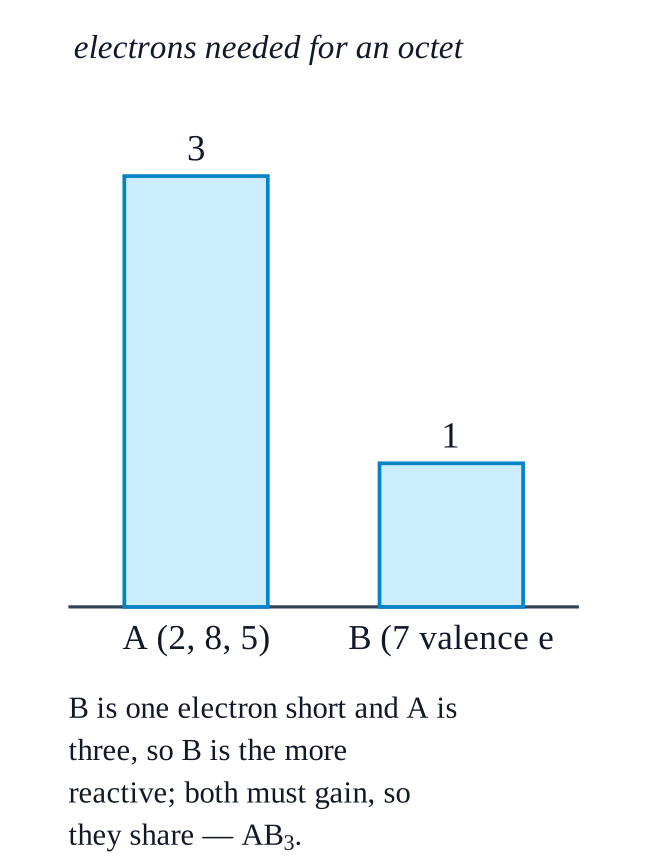
(ii) A covalent bond, formed by sharing. Both A and B have more than $\displaystyle 4$ valence electrons, so both need to gain and neither will donate; the only way both can reach an octet is to share electron pairs.
(iii) \(\displaystyle AB_3\). A must gain a share in $\displaystyle 3$ electrons and each B can offer a share in only $\displaystyle 1$, so one A atom shares one electron pair with each of three B atoms.
After bonding, A counts \(\displaystyle 5 + 3 = 8\) electrons and each B counts \(\displaystyle 7 + 1 = 8\) — every atom has its octet.