Exercise 9.14
Assertion (A): Copper sulfate conducts electricity in the molten state but not in the solid state. Reason (R): Copper and sulfate ions are fixed in the lattice in molten state, while in solid state they can move freely. Choose the correct option: (i) Both A and R are true, and R is the correct explanation of A. (ii) Both A and R are true, but R is not the correct explanation of A. (iii) A is true, but R is false. (iv) A is false, but R is true.
Not cross-checked
NCERT prints no numerical answer for this exercise, so this working has not been cross-checked against the book.
NCERT’s answer
(iii)
(iii) A is true, but R is false.
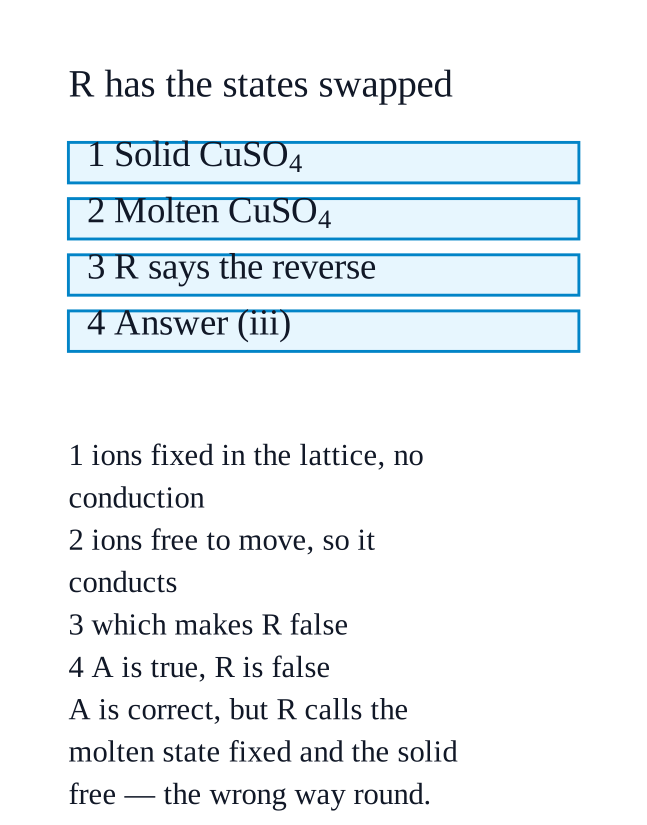
A is true. Copper sulfate is ionic; it does not conduct as a solid but does conduct once molten.
R is false because it has the two states the wrong way round. The ions are held in fixed positions in the solid lattice, and they become free to move in the molten state.
The chapter's rule is that ions must be free to move for a compound to conduct — which is why solid \(\displaystyle CuSO_4\) does not conduct, while its melt (and its solution in water) does.
Since R is false, it cannot explain A, and options (i), (ii) and (iv) are all ruled out.