Exercise 9.1
A particular element (A) has one electron in its third shell. There is another element (B) with six electrons in its second shell. (i) How many electrons does A tend to give or take to become stable? (ii) What kind of ion would it form? (iii) How many electrons does B tend to give or take to become stable? (iv) What kind of ion would it form? (v) If A and B were to combine, what kind of bond would be formed? (vi) What would be the formula for the compound thus formed?
NCERT’s answer
(i)
tends to give $\displaystyle 1$ electron (ii) Cation (\(\displaystyle A^{+}\)) (iii) tends to take $\displaystyle 2$ electrons (iv) Anion (\(\displaystyle B^{2-}\)) (v) Ionic (vi) \(\displaystyle A_{2}\)B
(i) A tends to give $\displaystyle 1$ electron.
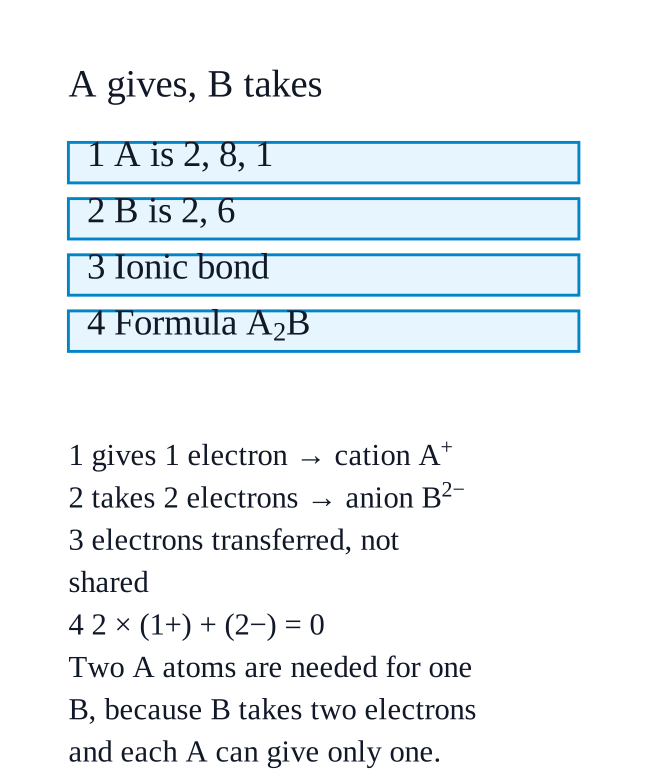
(ii) It forms a cation, \(\displaystyle A^+\).
(iii) B tends to take $\displaystyle 2$ electrons.
(iv) It forms an anion, \(\displaystyle B^{2-}\).
(v) An ionic bond — electrons are transferred from A to B, not shared.
(vi) \(\displaystyle A_2B\).
Working: "one electron in the third shell" fixes A's configuration as $\displaystyle 2$, $\displaystyle 8$, $\displaystyle 1$. Its valence shell has fewer than $\displaystyle 4$ electrons, so it donates its single electron and is left with the stable $\displaystyle 2$, 8.
"Six electrons in the second shell" fixes B as $\displaystyle 2$, $\displaystyle 6$. With more than $\displaystyle 4$ valence electrons it accepts $\displaystyle 2$ to complete its octet.
Two \(\displaystyle A^+\) ions are needed for each \(\displaystyle B^{2-}\) so the charges cancel: \(\displaystyle 2 \times (1+) + (2-) = 0\), giving \(\displaystyle A_2B\).