Exercise 9.1
A student burns g of ethanol in an open beaker. reaction, no residue is left in the beaker. Does this mean the Law of Conservation of Mass is violated? Explain.
Not cross-checked
NCERT prints no numerical answer for this exercise, so this working has not been cross-checked against the book.
No — the Law of Conservation of Mass is not violated.
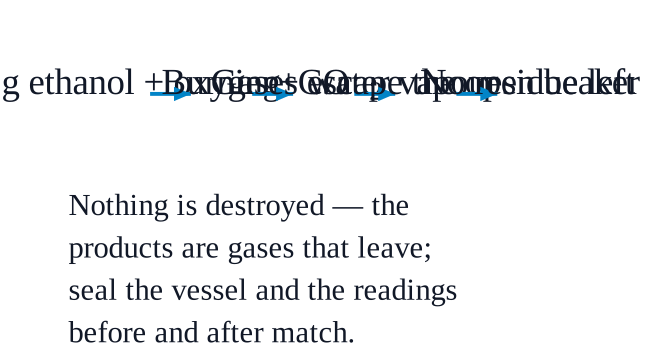
Burning is a chemical reaction: ethanol + oxygen (from the air) → carbon dioxide + water vapour.
Both products are gases, and the beaker is open, so they escape into the air — that is why no residue is left behind.
Nothing was destroyed; the mass simply left the beaker. Mass of ethanol + mass of oxygen used = mass of carbon dioxide + mass of water vapour formed.
This is Experimental set-up $\displaystyle 1$ of Activity $\displaystyle 9.2$ again: the balance read less only because the \(\displaystyle CO_2\) escaped. Sealing the system (set-up $\displaystyle 2$) made the initial and final readings match.
To test it properly, burn the ethanol in a closed vessel and weigh the vessel with everything inside it, before and after.
