Exercise 9.2
An element X has six electrons in its outer shell and forms a diatomic molecule. (i) Why would that be so? (ii) What kind of bond would it form? (iii) Draw the structure of the molecule it would form. (iv) A certain other element Y has two electrons in its second shell. Draw the structure of the molecule that X would form with Y.
Not cross-checked
NCERT prints no numerical answer for this exercise, so this working has not been cross-checked against the book.
(i) Because X has six valence electrons and needs two more to complete its octet, and no single X atom can supply them to itself. Two X atoms each share two of their electrons, so both reach $\displaystyle 8$ — hence the element exists as \(\displaystyle X_2\).
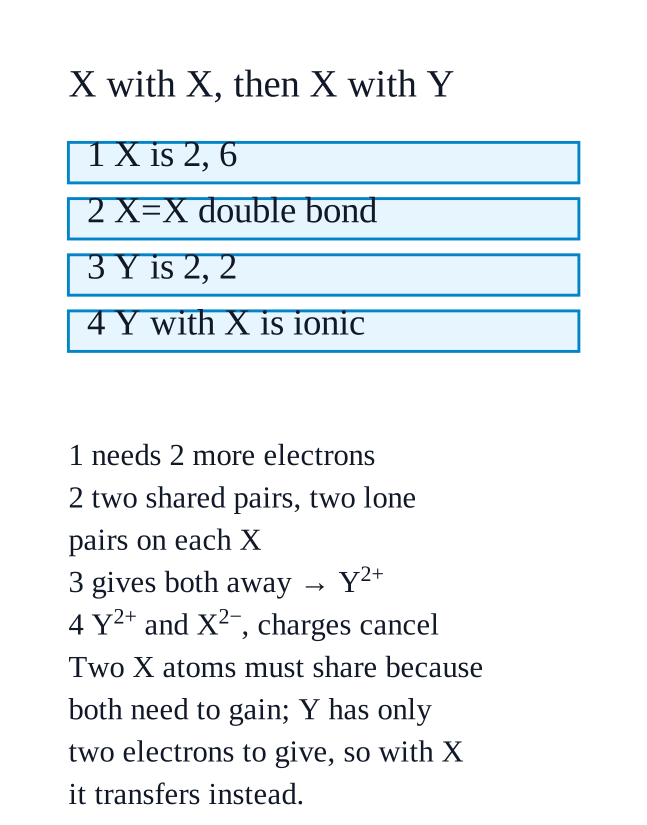
(ii) A covalent bond, and because two pairs are shared it is a double bond.
(iii) The drawing must show: two atoms labelled X side by side, each with its $\displaystyle 6$ valence electrons marked (dots on one atom, crosses on the other); two shared pairs — $\displaystyle 4$ electrons — in the overlap between them; two lone pairs left on each X; each X counting $\displaystyle 8$ electrons in all; and the line formula X=X written alongside, the two lines standing for the two shared pairs.
(iv) Y is $\displaystyle 2$, $\displaystyle 2$ — two valence electrons, fewer than four, so it donates both rather than sharing. Y becomes \(\displaystyle Y^{2+}\) (left with a complete duplet, $\displaystyle 2$) and X becomes \(\displaystyle X^{2-}\) $\displaystyle (2, 8)$, joined by an ionic bond in the ratio $\displaystyle 1$ : $\displaystyle 1$ → YX.
The drawing for (iv) must show: Y with shells $\displaystyle 2$, $\displaystyle 2$ on the left and X with shells $\displaystyle 2$, $\displaystyle 6$ on the right; two curved arrows labelled \(\displaystyle 2e^-\) running from Y's outer shell to X's outer shell; the products drawn as \(\displaystyle [2]^{2+}\) labelled \(\displaystyle Y^{2+}\) and \(\displaystyle [2,8]^{2-}\) labelled \(\displaystyle X^{2-}\), each in square brackets with its charge outside; the label ionic bond between them; and the formula YX written below.