SolveItClass 9 · NCERT

NCERT Solutions · Class 9 Science Exploration: Entering the World of Secondary Science

3 questions · 3 still being checked

Pause and Ponder 1.1–1.3

  1. Exercise 1.1

    Think of a prediction you or your family made recently (for example, the outcome of a cricket match). Was it based on evidence and reasoning, or mainly on guesswork? How can scientific thinking improve such predictions? Ready to Go Beyond Why do weather forecasts sometimes go wrong? Weather depends on many changing factors, such as temperature, pressure, humidity, and wind. Weather forecasts use measurements and models, but very tiny differences in conditions can grow over time and lead to something completely different. This is why forecasts are usually reliable for a few hours or even a few days, but less certain further into the future. 4\displaystyle 4 Exploration|Grade 9\displaystyle 9

    Not cross-checked

    NCERT prints no numerical answer for this exercise, so this working has not been cross-checked against the book.

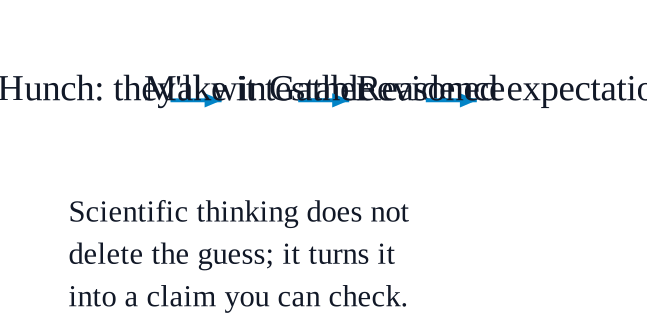
    Short answer: a family prediction like "our team will win today" is almost always mainly guesswork, and scientific thinking improves it by turning the hunch into a reasoned expectation based on evidence — named quantities and past patterns instead of an impression. The chapter says exactly this of scientific predictions: they are not guesses but reasoned expectations built on evidence and careful thinking.
    NCERT_Solution_Class9_Science_Ch1_PP_Q1-1
    The prediction (this part is yours; the one below is a worked sample). Before a one-day match my family said, "Our team will win today — they are in good form." The chapter itself offers the cricket match as the example, so this follows its hint.
    Was it evidence and reasoning, or guesswork? — Guesswork, judged by the chapter's own test in Example 1.2. There, "It will rain this afternoon because the clouds look dark" is not yet testable because it rests on an impression; the chapter's reply is that good scientific questions look for measurable evidence and past patterns. "In good form" is the cricket version of "the clouds look dark": no quantity is named, no past record is cited, and nothing in it could be checked before the match started. Apply the same test to your own example — if you can point to a number and to what happened in similar situations before, it was evidence and reasoning; if not, it was guesswork.
    How scientific thinking improves it, step $\displaystyle 1$ — identify the quantities that matter. The chapter's strategy is to first understand the situation, then identify the quantities that matter, and finally make a rough estimate to check whether an answer makes sense. For the match those quantities are the target score, the overs remaining, the wickets in hand and the side's usual scoring rate on that ground — not the players' reputation.
    Step $\displaystyle 2$ — make a rough estimate before committing to the prediction. Say $\displaystyle 120$ runs are needed off the last $\displaystyle 15$ overs. The required run rate is \(\displaystyle \dfrac{120\ \text{runs}}{15\ \text{overs}} = 8 \) runs per over. If the side has been managing about $\displaystyle 6$ runs per over on that ground, the estimate already shows the "easy win" claim to be doubtful. This is the chapter's point that an approximate estimate is often enough to tell whether a result is reasonable or impossible. (The run figures are invented to illustrate the method; the method is the chapter's.)
    Step $\displaystyle 3$ — ask questions with measurable answers, the way Meghna does. "Will they win?" is a yes/no question, which the chapter calls usually not so useful. "What is the required run rate now?", "What has this team scored on this ground in its last five matches?", "How many wickets are left?" ask for measurable data and past patterns.
    Step $\displaystyle 4$ — state what your model leaves out, and leave it out deliberately. In Example $\displaystyle 1.1$ the chapter keeps the mass of the ball and the speed and direction of the hit, and drops the brand of the bat, the colour of the ball and the grass on the field, adding that such choices are not mistakes but are made on purpose. A match-prediction model can likewise drop the crowd noise and the commentary and keep run rate, wickets and overs.
    Step $\displaystyle 5$ — compare the prediction with what actually happened. The chapter says that when predictions match observations confidence in the underlying science grows, and that when they do not, scientists re-examine their assumptions, models, or measurements. Note carefully: the chapter names these three together and sets no order of priority among them. It does not say to suspect the measurement first, or the assumption last — the fault may lie in any of the three, and finding out which is the work.
    Expect a limit even on a well-reasoned prediction. The chapter's box on why weather forecasts go wrong says weather depends on many changing factors and that very tiny differences in conditions can grow over time, so forecasts hold for a few hours or days and get less certain further ahead. A cricket match behaves the same way — one dropped catch redirects the rest of it — so scientific thinking makes the prediction better reasoned, not certain. (Carrying that box across from weather to cricket is my reasoning; the chapter states it only about weather forecasts.)
  2. Exercise 1.2

    Describe one situation where an approximate answer is good enough, and one where you would need a very exact value. After Grade 10\displaystyle 10, if you decide to study science, it will be divided into

    Not cross-checked

    NCERT prints no numerical answer for this exercise, so this working has not been cross-checked against the book.

    An approximate answer is enough when you only need to know whether a result is reasonable; an exact value is needed when acting on a wrong number is costly or dangerous.
    NCERT_Solution_Class9_Science_Ch1_PP_Q1-2
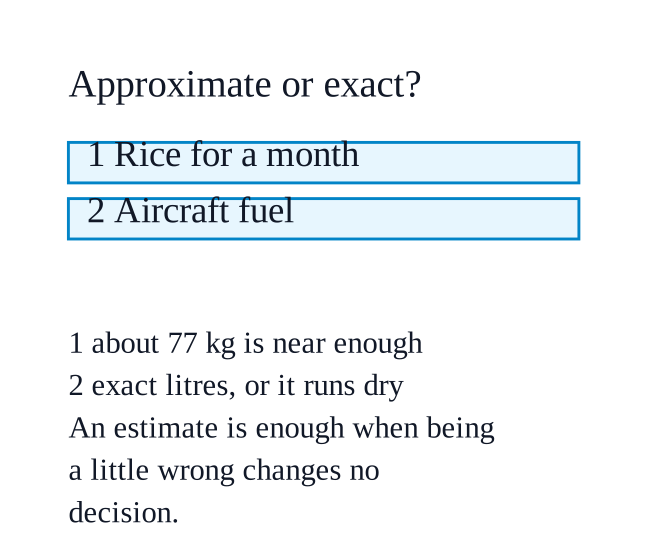
    Approximate is good enough — how much rice would feed a family of four for a month:
    Calorie need: \(\displaystyle 2250 \ \text{kcal/day} \times 4 \ \text{people} \times 30 \ \text{days} = 2{,}70{,}000 \ \text{kcal} \).
    Taking about \(\displaystyle 350 \ \text{kcal} \) from \(\displaystyle 100 \ \text{g} \) of uncooked rice: \(\displaystyle 2{,}70{,}000 \div 350 \approx 770 \) portions of \(\displaystyle 100 \ \text{g} \), i.e. roughly \(\displaystyle 77 \ \text{kg} \).
    The size of the answer is the whole point: it tells you at once that \(\displaystyle 100 \ \text{g} \) for a month is far too little and a few tonnes far too much. Whether the true figure is \(\displaystyle 70 \ \text{kg} \) or \(\displaystyle 85 \ \text{kg} \) changes no decision.
    A very exact value is needed — loading fuel into an aircraft:
    The flight needed \(\displaystyle 22{,}300 \ \text{kg} \) of fuel, but the ground crew used the density in pounds per litre instead of kilograms per litre.
    Since \(\displaystyle 1 \ \text{lb} \approx 0.454 \ \text{kg} \), the mass actually loaded was less than half of what was required — the aircraft ended up about \(\displaystyle 15{,}000 \ \text{L} \) short and ran out of fuel in mid-air.
    Here both the number and its unit must be exact; there is no safe margin for "roughly right".
    Two more of each kind from the chapter: estimating the \(\displaystyle \approx 10{,}000 \ \text{L} \) of air breathed in a day is fine as an estimate (Example $\displaystyle 1.3$), whereas the speed of light is fixed at exactly \(\displaystyle 299\,792\,458 \ \text{m/s} \), and a kilogram of vegetables must mean the same everywhere for trade to be fair.
    The rule behind both: estimate while reasoning, measure exactly while acting — estimation builds intuition and catches errors, but a quantity that others depend on must be exact and in standard SI units.
  3. Exercise 1.3

    Choose a real‑life object (maybe a pressure cooker or a mobile phone) or a problem (maybe a traffic jam near your school). Make a sketch listing what kind of ideas from physics, chemistry, biology, earth science, or mathematics are involved. Show how at least two branches of science connect with your example.

    Not cross-checked

    NCERT prints no numerical answer for this exercise, so this working has not been cross-checked against the book.

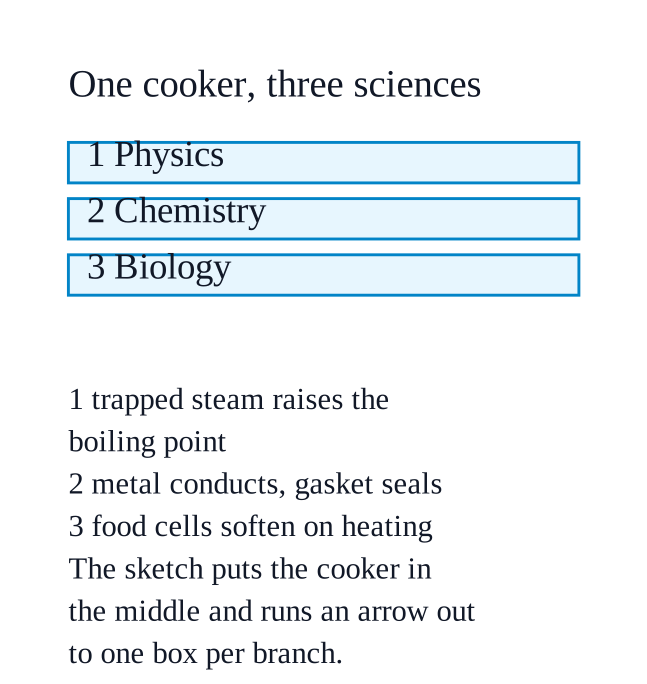
    A pressure cooker works only because physics and chemistry act together — trapped steam raises the pressure, the higher pressure raises the boiling point, and the hotter water breaks food down faster.
    NCERT_Solution_Class9_Science_Ch1_PP_Q1-3
    What your sketch must contain. Draw the cooker (pot, lid, gasket, weight/whistle, flame beneath) in the centre of the page, and run labelled arrows outward to four boxes, one per branch:
    Physics — heat conducted from flame to base to water; steam trapped by the sealed lid raising the pressure; the weight lifting to release steam above a set pressure; boiling point rising with pressure.
    Chemistry — the metal chosen for good conduction and for not reacting with food; starch and protein breaking down faster at the higher temperature; the rubber gasket as a polymer that seals well but hardens with age.
    Biology — food is plant and animal tissue whose cells soften on heating; the heat kills microorganisms, making the food safe; broken-down starch is easier to digest.
    Earth science and mathematics — cooking takes longer at high altitude because the atmospheric pressure is lower; number of whistles, cooking time and fuel used can be tabulated and a pattern fitted.
    Draw the two connecting arrows the question asks for, and write the sentence along each:
    Physics \(\displaystyle \rightarrow \) Chemistry: raising the pressure lifts the boiling point above \(\displaystyle 100\ ^\circ\mathrm{C} \), and the chemical breakdown of starch and protein runs much faster at that higher temperature — which is why the cooker saves both time and fuel.
    Chemistry \(\displaystyle \rightarrow \) Biology: softened tissue and killed microorganisms together make the cooked food safe to eat and easy to digest.
    Label the sketch "Pressure cooker — one object, four branches", and keep each branch box in a different colour so the crossings between them are easy to see.
    The idea being tested: exactly as with the mask in the chapter — physics for particle motion, chemistry for the polymer fibres, biology for the virus, mathematics for filtration efficiency — the divisions between branches are made by us to organise knowledge, not by nature, and a real object needs several of them at once.