Exercise 9.15
Illustrate how sodium sulfide (S) is formed. Name of ion Sodium Lithium Potassium Silver Calcium Barium Iron (Ferrous) Iron (Ferric) Copper (Cuprous) Copper (Cupric) Magnesium Zinc Aluminium Fluoride Chloride Bromide Iodide Oxide Sulfide
Not cross-checked
NCERT prints no numerical answer for this exercise, so this working has not been cross-checked against the book.
\(\displaystyle Na_2S\) is formed when each of two sodium atoms transfers one electron to a single sulfur atom.
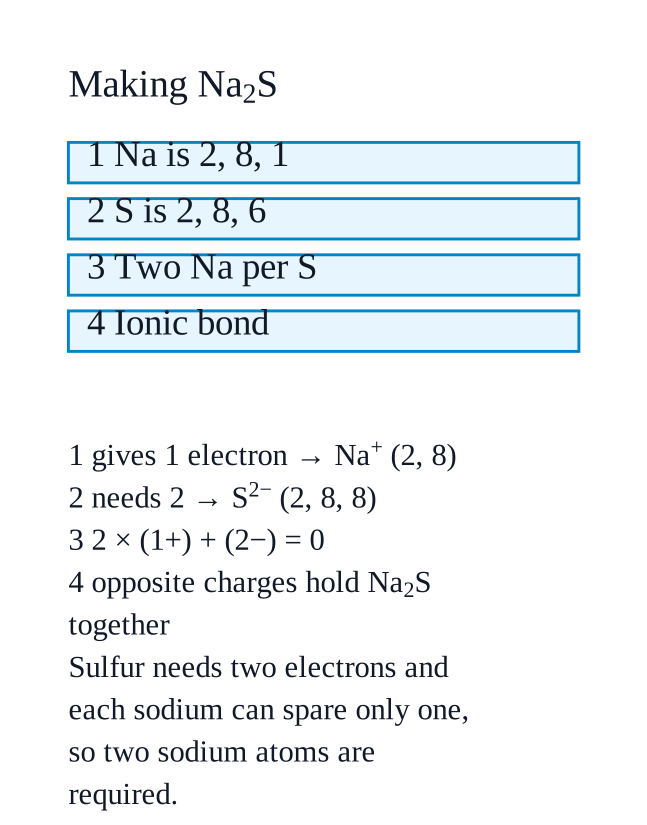
Sodium is $\displaystyle 2$, $\displaystyle 8$, $\displaystyle 1$ — one valence electron to give away; sulfur is $\displaystyle 2$, $\displaystyle 8$, $\displaystyle 6$ — two electrons short of an octet.
Each Na loses $\displaystyle 1$ electron → \(\displaystyle Na^+\) $\displaystyle (2, 8)$; sulfur accepts both → \(\displaystyle S^{2-}\) ($\displaystyle 2$, $\displaystyle 8$, $\displaystyle 8$).
Two sodium ions are needed for one sulfide ion so that the charges cancel: \(\displaystyle 2 \times (1+) + (2-) = 0\).
The oppositely charged ions are held together by the electrostatic force of attraction — an ionic bond — giving \(\displaystyle Na_2S\), sodium sulfide.
The illustration must show: two sodium atoms (shells $\displaystyle 2$, $\displaystyle 8$, $\displaystyle 1$) on the left and one sulfur atom ($\displaystyle 2$, $\displaystyle 8$, $\displaystyle 6$) on the right; one curved arrow labelled \(\displaystyle e^-\) from each sodium's valence shell to the sulfur's valence shell; the products drawn as \(\displaystyle [2,8]^+\) twice, labelled \(\displaystyle Na^+\), and \(\displaystyle [2,8,8]^{2-}\), labelled \(\displaystyle S^{2-}\); the label ionic bond between them; and the formula \(\displaystyle Na_2S\) written underneath.