Exercise 9.14
Show the formation of cations of potassium (K) and calcium (Ca) atoms, and the formation of their corresponding chlorides using diagrams.
Not cross-checked
NCERT prints no numerical answer for this exercise, so this working has not been cross-checked against the book.
Potassium forms \(\displaystyle K^+\) and calcium forms \(\displaystyle Ca^{2+}\); their chlorides are KCl and \(\displaystyle CaCl_2\).
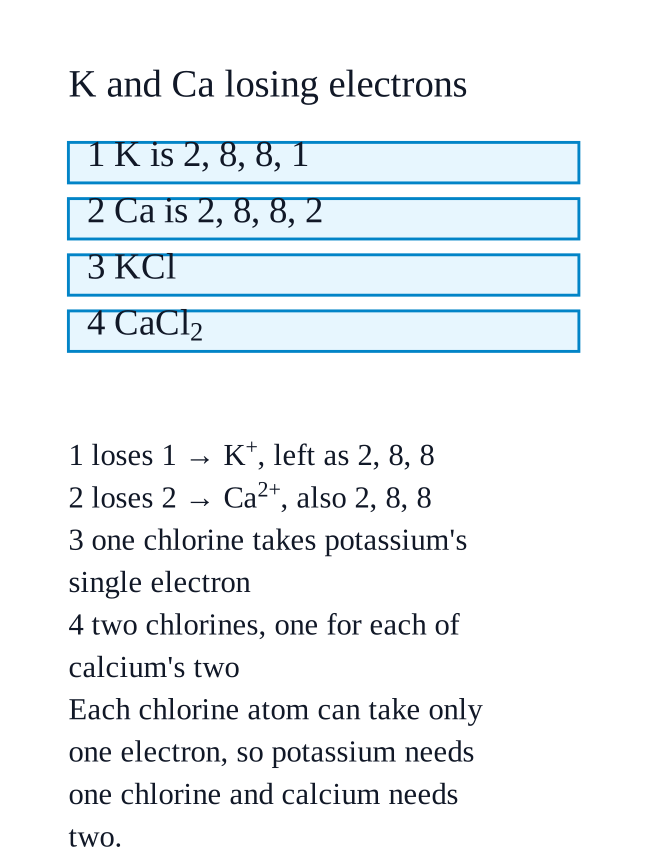
Potassium (\(\displaystyle Z = 19\)) is $\displaystyle 2$, $\displaystyle 8$, $\displaystyle 8$, $\displaystyle 1$. Losing its single valence electron leaves $\displaystyle 19$ protons and $\displaystyle 18$ electrons → \(\displaystyle K^+\), with the stable arrangement $\displaystyle 2$, $\displaystyle 8$, 8.
Calcium (\(\displaystyle Z = 20\)) is $\displaystyle 2$, $\displaystyle 8$, $\displaystyle 8$, $\displaystyle 2$. Losing both valence electrons leaves $\displaystyle 20$ protons and $\displaystyle 18$ electrons → \(\displaystyle Ca^{2+}\), also $\displaystyle 2$, $\displaystyle 8$, 8.
KCl: the one electron potassium loses is taken by one chlorine atom ($\displaystyle 2$, $\displaystyle 8$, $\displaystyle 7$ → $\displaystyle 2$, $\displaystyle 8$, $\displaystyle 8$); \(\displaystyle K^+\) and \(\displaystyle Cl^-\) are then held by electrostatic attraction → KCl.
\(\displaystyle CaCl_2\): calcium gives one electron to each of two chlorine atoms, since each chlorine can take only one → \(\displaystyle Ca^{2+}\) and two \(\displaystyle Cl^-\) → \(\displaystyle CaCl_2\).
The four diagrams must show:
K → \(\displaystyle K^+\): concentric shells holding $\displaystyle 2$, $\displaystyle 8$, $\displaystyle 8$, $\displaystyle 1$ electrons round a nucleus labelled $\displaystyle 19$ p; a curved arrow out of the outermost shell labelled \(\displaystyle e^-\); the product drawn as shells $\displaystyle 2$, $\displaystyle 8$, $\displaystyle 8$ inside square brackets with + outside, labelled "Potassium cation \(\displaystyle K^+\)".
Ca → \(\displaystyle Ca^{2+}\): shells $\displaystyle 2$, $\displaystyle 8$, $\displaystyle 8$, $\displaystyle 2$ round a nucleus labelled $\displaystyle 20$ p; two arrows labelled \(\displaystyle 2e^-\); the product as $\displaystyle 2$, $\displaystyle 8$, $\displaystyle 8$ in square brackets with $\displaystyle 2$+ outside, labelled "Calcium cation \(\displaystyle Ca^{2+}\)".
KCl: K ($\displaystyle 2$, $\displaystyle 8$, $\displaystyle 8$, $\displaystyle 1$) beside Cl ($\displaystyle 2$, $\displaystyle 8$, $\displaystyle 7$), one arrow from K's valence shell to Cl's valence shell; the products \(\displaystyle [2,8,8]^+\) and \(\displaystyle [2,8,8]^-\) labelled \(\displaystyle K^+\) and \(\displaystyle Cl^-\); the gap between them labelled ionic bond; the formula KCl written below.
\(\displaystyle CaCl_2\): Ca in the middle with a Cl on either side; one arrow from Ca to each Cl; the products \(\displaystyle Ca^{2+}\) and two \(\displaystyle Cl^-\), each in square brackets with its charge; the formula \(\displaystyle CaCl_2\) written below.