Exercise 9.13
Fill in the blanks. Among magnesium and chlorine, magnesium atom can give two electrons to become . However, chlorine can take only one electron to become ____________. Now, __________ ion of magnesium and __________ ions of chlorine combine to give magnesium chloride.
Not cross-checked
NCERT prints no numerical answer for this exercise, so this working has not been cross-checked against the book.
NCERT’s answer
Cl
Blank $\displaystyle 1$ = \(\displaystyle Cl^-\) (the chloride ion); blank $\displaystyle 2$ = one; blank $\displaystyle 3$ = two.
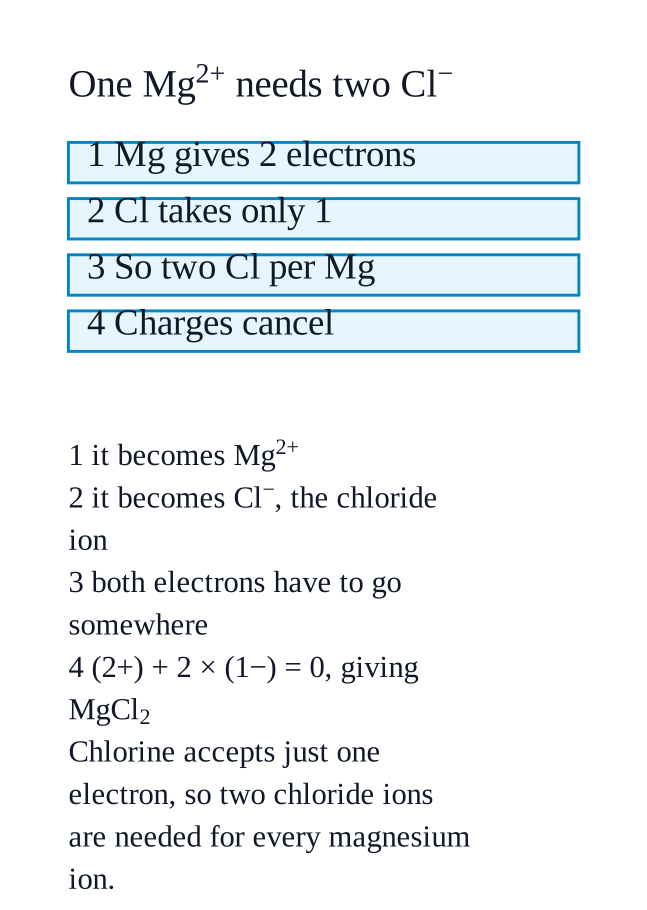
Chlorine is $\displaystyle 2$, $\displaystyle 8$, $\displaystyle 7$ — one electron short of an octet — so it accepts exactly one electron and becomes \(\displaystyle Cl^-\).
Magnesium gives away $\displaystyle 2$ electrons, but each chlorine atom can take only $\displaystyle 1$, so two chlorine atoms are needed for every magnesium atom.
The charges must cancel: \(\displaystyle (2+) + 2 \times (1-) = 0\).
One \(\displaystyle Mg^{2+}\) ion and two \(\displaystyle Cl^-\) ions therefore combine to give magnesium chloride, \(\displaystyle MgCl_2\).