Exercise 9.12
If a species has protons, neutrons and electrons then (i) what is its atomic number and mass number? (ii) is it neutral, a cation or an anion? Explain. (iii) write its electronic configuration. (iv) name the species.
NCERT’s answer
(i)
Z = $\displaystyle 11$; A = $\displaystyle 23$ (ii) Cation (iii) Electronic configuration $\displaystyle 2$, $\displaystyle 8$ (iv) Sodium cation (\(\displaystyle Na^{+}\))
(i) Atomic number \(\displaystyle Z = 11\) (the number of protons); mass number \(\displaystyle A = 11 + 12 = 23\).
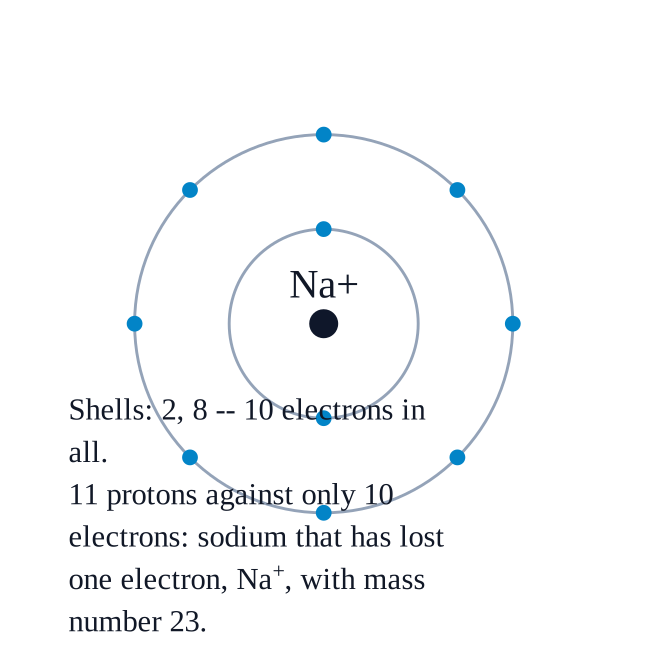
(ii) A cation. There are $\displaystyle 11$ positive protons against only $\displaystyle 10$ electrons, so one negative charge is missing and the species carries a net charge of $\displaystyle 1$+ — it has lost one electron.
(iii) Electronic configuration $\displaystyle 2$, $\displaystyle 8$ — the $\displaystyle 10$ electrons fill the K shell ($\displaystyle 2$) and the L shell ($\displaystyle 8$), which is why losing that electron made it stable.
(iv) The sodium cation, \(\displaystyle Na^+\): \(\displaystyle Z = 11\) identifies the element as sodium, and the $\displaystyle 1$+ charge makes it the cation.