Exercise 8.13
Complete the Table : Atomic number - - -
NCERT’s answer
Atomic Mass Number of Number of Number of Name of the number number neutrons protons electrons element $\displaystyle 5$ $\displaystyle 11$ $\displaystyle 6$ $\displaystyle 5$ $\displaystyle 5$ Boron $\displaystyle 7$ $\displaystyle 14$ $\displaystyle 7$ $\displaystyle 7$ $\displaystyle 7$ Nitrogen $\displaystyle 12$ $\displaystyle 24$ $\displaystyle 12$ $\displaystyle 12$ $\displaystyle 12$ Magnesium $\displaystyle 15$ $\displaystyle 31$ $\displaystyle 16$ $\displaystyle 15$ $\displaystyle 15$ Phosphorus $\displaystyle 1$ $\displaystyle 1$ $\displaystyle 0$ $\displaystyle 1$ $\displaystyle 1$ Hydrogen
Completed table:
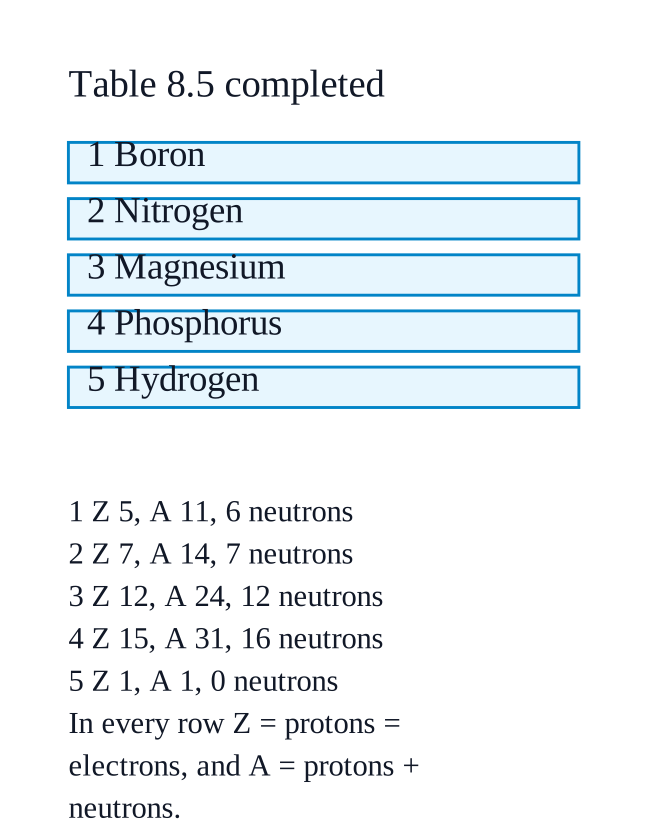
| Atomic number | Mass number | Neutrons | Protons | Electrons | Element |
| $\displaystyle 5$ | $\displaystyle 11$ | $\displaystyle 6$ | $\displaystyle 5$ | $\displaystyle 5$ | Boron |
| $\displaystyle 7$ | $\displaystyle 14$ | $\displaystyle 7$ | $\displaystyle 7$ | $\displaystyle 7$ | Nitrogen |
| $\displaystyle 12$ | $\displaystyle 24$ | $\displaystyle 12$ | $\displaystyle 12$ | $\displaystyle 12$ | Magnesium |
| $\displaystyle 15$ | $\displaystyle 31$ | $\displaystyle 16$ | $\displaystyle 15$ | $\displaystyle 15$ | Phosphorus |
| $\displaystyle 1$ | $\displaystyle 1$ | $\displaystyle 0$ | $\displaystyle 1$ | $\displaystyle 1$ | Hydrogen |
Two relations do all the work: \(\displaystyle Z = \text{protons} = \text{electrons}\) in a neutral atom, and \(\displaystyle A = \text{protons} + \text{neutrons}\).
Row $\displaystyle 1$ — \(\displaystyle Z = 5\) gives $\displaystyle 5$ protons and $\displaystyle 5$ electrons; \(\displaystyle A = 5 + 6 = 11\); \(\displaystyle Z = 5\) is boron.
Row $\displaystyle 2$ — $\displaystyle 7$ electrons gives $\displaystyle 7$ protons and \(\displaystyle Z = 7\); \(\displaystyle \text{neutrons} = 14 - 7 = 7\); this confirms nitrogen.
Row $\displaystyle 3$ — $\displaystyle 12$ protons gives \(\displaystyle Z = 12\) and $\displaystyle 12$ electrons; \(\displaystyle \text{neutrons} = 24 - 12 = 12\); \(\displaystyle Z = 12\) is magnesium.
Row $\displaystyle 4$ — \(\displaystyle Z = 15\) gives $\displaystyle 15$ protons and $\displaystyle 15$ electrons; \(\displaystyle A = 15 + 16 = 31\); \(\displaystyle Z = 15\) is phosphorus.
Row $\displaystyle 5$ — \(\displaystyle A = 1\) with $\displaystyle 0$ neutrons leaves $\displaystyle 1$ proton, so \(\displaystyle Z = 1\) and $\displaystyle 1$ electron; this is hydrogen, the only atom whose nucleus has no neutron.