SolveItClass 9 · NCERT

NCERT Solutions · Class 9 Science Journey Inside the Atom

33 questions · 19 still being checked

Pause and Ponder 8.16–8.18 (part 23 of 23)

  1. Exercise 8.16

    Solve this riddle: I am an atom with a mass number of 23\displaystyle 23 and 11\displaystyle 11 protons. I am a soft metal and react vigorously with water. Who am I and how many neutrons do I have? You can also create one such riddle.
    NCERT’s answer
    Sodium; $\displaystyle 12$
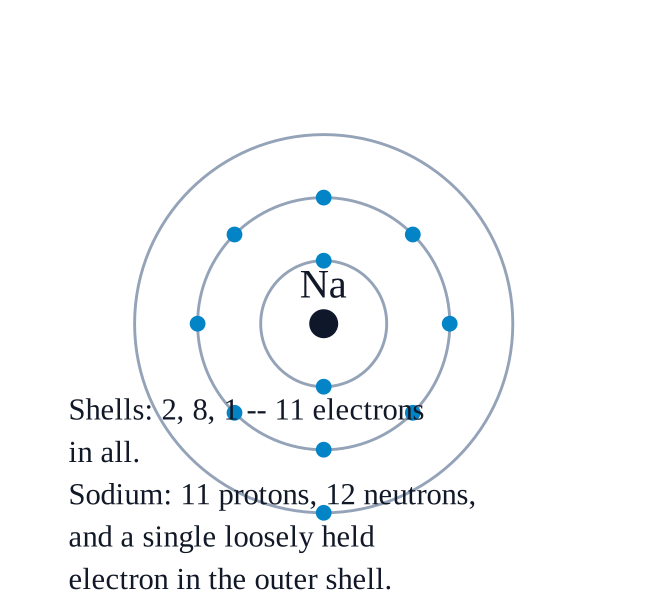
    Sodium (Na), with $\displaystyle 12$ neutrons.
    NCERT_Solution_Class9_Science_Ch8_PP_Q8-16
    $\displaystyle 11$ protons means \(\displaystyle Z = 11\), and the element of atomic number $\displaystyle 11$ is sodium.
    \(\displaystyle \text{neutrons} = A - Z = 23 - 11 = 12\), which is the neutron count Table $\displaystyle 8.4$ lists for sodium.
    The chapter's sodium fits: its configuration is $\displaystyle 2$, $\displaystyle 8$, $\displaystyle 1$, and it is worked as the atom that completes its octet by losing that one electron, so its valency is 1.
    "Soft metal" and "reacts vigorously with water" are the riddle's own clues, not the chapter's — but a single, loosely held valence electron is exactly the chapter-level reason such a metal is so reactive.
    Your own riddle, built the same way: "My single shell is full with just $\displaystyle 2$ electrons, my mass number is $\displaystyle 4$, and I refuse to react with anything at all. Who am I, and how many neutrons do I have?"
    Answer to it: helium, \(\displaystyle Z = 2\), neutrons \(\displaystyle = 4 - 2 = 2\) — unreactive because $\displaystyle 2$ electrons already complete its only shell.
  2. Exercise 8.17

    Two different atoms have 11\displaystyle 11 protons each, but one has 12\displaystyle 12 neutrons, and the other has 13\displaystyle 13 neutrons. How do their atomic numbers and mass numbers compare? Are they the same element or different elements?

    Not cross-checked

    NCERT prints no numerical answer for this exercise, so this working has not been cross-checked against the book.

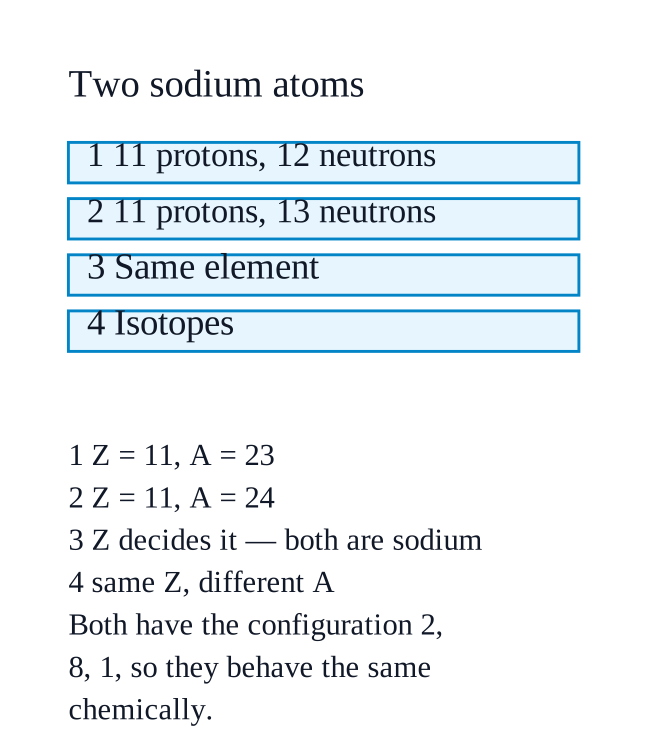
    Their atomic numbers are the same ($\displaystyle 11$ each); their mass numbers differ ($\displaystyle 23$ and $\displaystyle 24$). They are the same element — two isotopes of sodium.
    NCERT_Solution_Class9_Science_Ch8_PP_Q8-17
    Atomic number counts protons only, and both atoms have $\displaystyle 11$ protons, so \(\displaystyle Z = 11\) for both.
    Mass number counts protons and neutrons: \(\displaystyle 11 + 12 = 23\) and \(\displaystyle 11 + 13 = 24\).
    It is the atomic number, not the neutron count, that decides which element an atom is — so both are sodium.
    Atoms of the same element with the same \(\displaystyle Z\) but different \(\displaystyle A\) are called isotopes.
    Both have $\displaystyle 11$ electrons and the same configuration $\displaystyle 2$, $\displaystyle 8$, $\displaystyle 1$, so their chemical properties are the same; only physical properties such as mass differ.
  3. Exercise 8.18

    If a bromine atom is available in the form of, say two isotopes, average atomic mass of the bromine atom. You have learnt that the two atoms that have the same As we end our journey into the structure of the atom, likely to be, not exactly where they are. You will learn all these details in higher grades. The journey of exploring the mysteries of the atom is far from over,
    NCERT’s answer
    80.$\displaystyle 006$ u
    Average atomic mass of bromine \(\displaystyle = 80.006\ \text{u}\).
    NCERT_Solution_Class9_Science_Ch8_PP_Q8-18
    Use the weighted average: multiply each isotope's mass by its percentage abundance, then add.
    \(\displaystyle \text{average} = 79 \times \dfrac{49.7}{100} + 81 \times \dfrac{50.3}{100}\)
    \(\displaystyle = 39.263 + 40.743\)
    \(\displaystyle = 80.006\ \text{u}\)
    The value sits almost exactly midway between $\displaystyle 79$ and $\displaystyle 81$ because the two isotopes occur in nearly equal numbers.
    No single bromine atom weighs \(\displaystyle 80.006\ \text{u}\); the figure is what a large collection of bromine atoms averages out to.
