Exercise 8.15
In an atom, there are protons and neutrons in the nucleus. Now, imagine that all the electrons are replaced with some hypothetical particles that have the same charge as electrons but are times heavier. What effect will this replacement have on the atom’s: (i) Atomic number (ii) Atomic mass (iii) Mass number (iv) Overall charge
Not cross-checked
NCERT prints no numerical answer for this exercise, so this working has not been cross-checked against the book.
(i) Atomic number: unchanged, still 12.
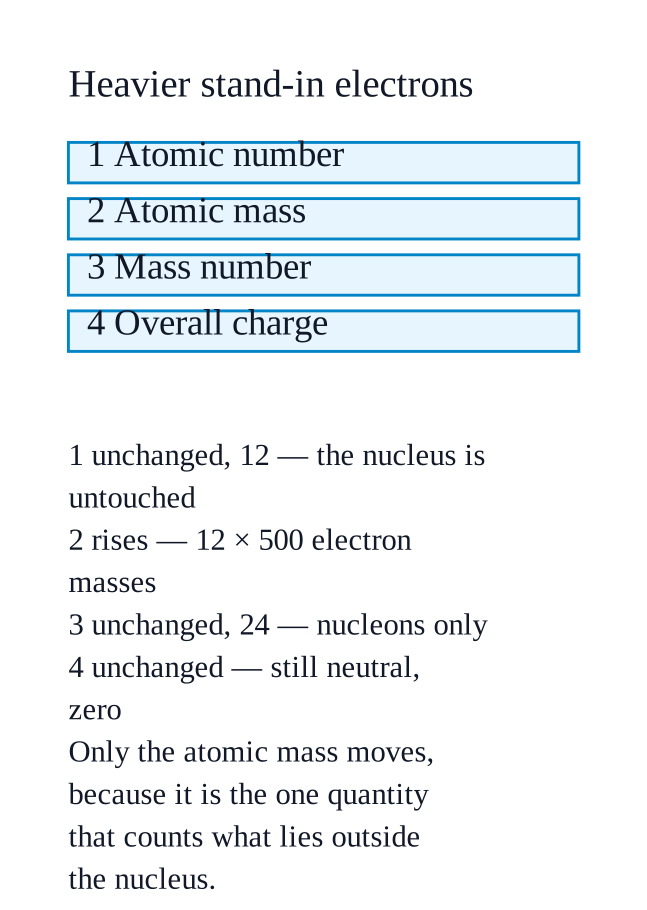
The atomic number counts protons in the nucleus, and the nucleus was not touched — the substitution happened outside it.
(ii) Atomic mass: it increases — the atom becomes measurably heavier.
Normally the $\displaystyle 12$ electrons can be ignored in mass calculations because an electron's mass is almost negligible.
Here the $\displaystyle 12$ replacement particles together carry \(\displaystyle 12 \times 500 = 6000\) times an electron's mass, which is no longer something you may throw away.
(iii) Mass number: unchanged, still 24.
Mass number counts nucleons only: \(\displaystyle A = \text{protons} + \text{neutrons} = 12 + 12 = 24\). Particles outside the nucleus never enter this count, however heavy they are.
(iv) Overall charge: unchanged — the atom is still neutral, total charge zero.
The hypothetical particles carry the same charge as electrons, so $\displaystyle 12$ of them still cancel the \(\displaystyle +12\) of the protons exactly.
Charge and mass are independent properties: making a particle heavier does not make it more negative.