Exercise 8.14
Identify the number of electrons in the outermost shell of the following elements: (i) C (ii) F (iii) Si
NCERT’s answer
(i)
$\displaystyle 4$ (ii) $\displaystyle 7$ (iii) $\displaystyle 4$
(i) $\displaystyle 4$ (ii) $\displaystyle 7$ (iii) $\displaystyle 4$
Shells fill from the nucleus outward — K first (maximum \(\displaystyle 2\times1^{2}=2\)), then L (maximum \(\displaystyle 2\times2^{2}=8\)), then M.
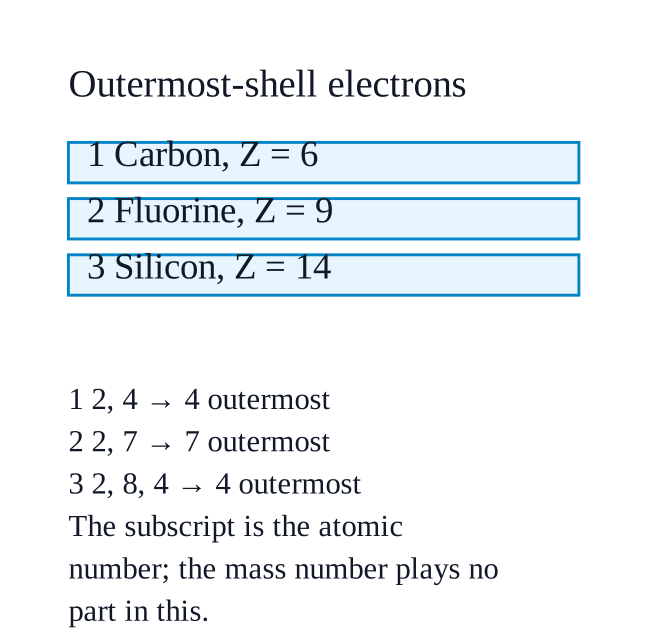
(i) Carbon, \(\displaystyle Z = 6\): $\displaystyle 2$ electrons in K, the remaining $\displaystyle 4$ in L → configuration $\displaystyle 2$, $\displaystyle 4$ → outermost shell has $\displaystyle 4$ electrons.
(ii) Fluorine, \(\displaystyle Z = 9\): $\displaystyle 2$ in K, the remaining $\displaystyle 7$ in L → configuration $\displaystyle 2$, $\displaystyle 7$ → outermost shell has $\displaystyle 7$ electrons.
(iii) Silicon, \(\displaystyle Z = 14\): $\displaystyle 2$ in K, $\displaystyle 8$ in L, the remaining $\displaystyle 4$ in M → configuration $\displaystyle 2$, $\displaystyle 8$, $\displaystyle 4$ → outermost shell has $\displaystyle 4$ electrons.
The subscript is the atomic number, which equals the number of electrons in a neutral atom; the superscript (mass number) plays no part here.