Exercise 5.7
Collect the layer of oil separately by opening the stopcock again. You now have two separate liquids. Can you think of any heterogeneous mixtures with a gas as one of the components? Gas particles are free to move in all directions, so they mix easily and uniformly with other gases. Hence, most mixtures of gases are homogeneous, such as a mixture of hydrogen and oxygen, which is used as a rocket fuel. On the other hand, smoke (solid particles suspended in air), fog (tiny liquid water droplets present in air) and dust in the air are some heterogeneous mixtures with gas as one of the components. Most of the solid-solid mixtures are heterogeneous. You can use a property of one of the solids to separate the mixture. You have learnt how to separate iron nails from sawdust using a magnet. Now, let us explore another technique to separate solid-solid mixtures.
Not cross-checked
NCERT prints no numerical answer for this exercise, so this working has not been cross-checked against the book.
Because the two liquids do not mix (they are immiscible) and they have different densities.
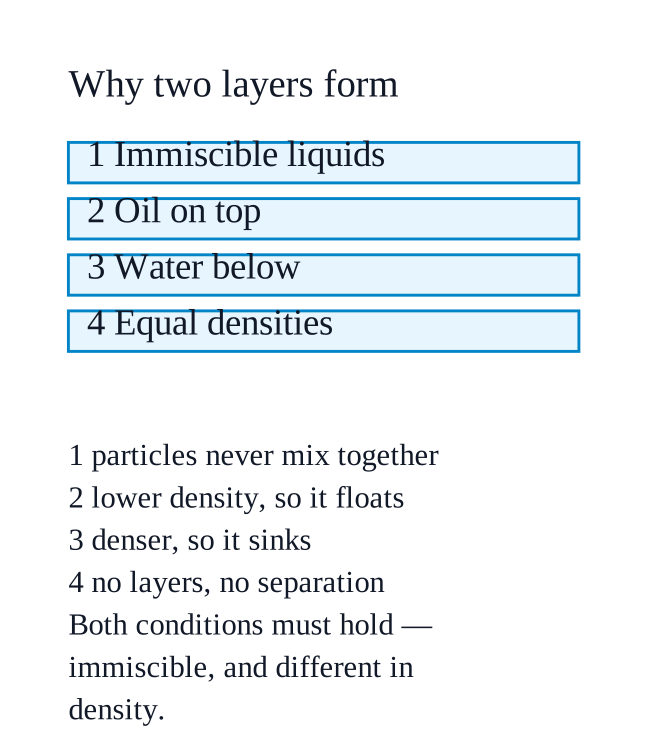
Being immiscible, the particles of one liquid do not spread in between the particles of the other, so the mixture stays heterogeneous however much it is shaken.
On standing, the liquid of lower density floats to the top and the denser liquid sinks, giving two clearly separated layers with a sharp boundary.
In Activity $\displaystyle 5.6$ the yellow mustard oil is less dense than water, so oil forms the upper layer and water the lower layer, which can then be run off through the stopcock.
If the two immiscible liquids had exactly the same density, neither would float on the other and no clean layers would form, so a separating funnel could not separate them.