SolveItClass 9 · NCERT

NCERT Solutions · Class 9 Science Exploring Mixtures and their Separation

25 questions · 21 still being checked

Pause and Ponder 5.9–5.10 (part 13 of 14)

  1. Exercise 5.9

    Clouds are made up of tiny water droplets or ice crystals floating in the air. Based on what you know about solutions, suspensions and colloids, what type of mixture do you think clouds are and why?

    Not cross-checked

    NCERT prints no numerical answer for this exercise, so this working has not been cross-checked against the book.

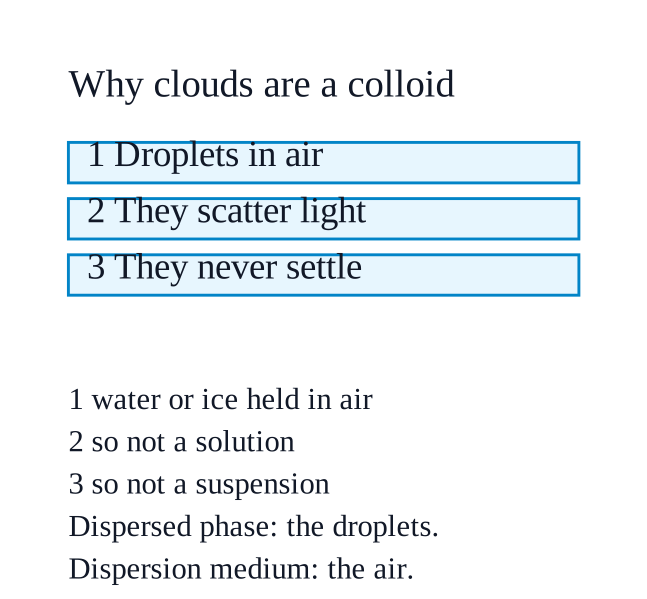
    Clouds are a colloid — tiny water droplets or ice crystals forming the dispersed phase, with air as the dispersion medium.
    NCERT_Solution_Class9_Science_Ch5_PP_Q5-9
    They are not a solution: in a solution the particles are smaller than $\displaystyle 1$ nm and the path of a light beam is not visible, but clouds clearly scatter light, which is why we see them as bright white masses.
    They are not a true suspension either: suspension particles are visible to the naked eye and settle down when left undisturbed, whereas cloud droplets stay evenly dispersed and float in the air for hours.
    Staying uniformly dispersed while still scattering light is exactly the behaviour of a colloid, like smoke (solid particles in air) which the chapter treats the same way.
  2. Exercise 5.10

    Why do cities with a lot of smoke and dust in the air often look hazy? S. No. 1. Nature (homogeneous/heterogeneous) 2. Particle size 3. Visibility 4. Separation by filtration 5. Settling 6. Tyndall effect 88\displaystyle 88 Exploration|Grade 9\displaystyle 9

    Not cross-checked

    NCERT prints no numerical answer for this exercise, so this working has not been cross-checked against the book.

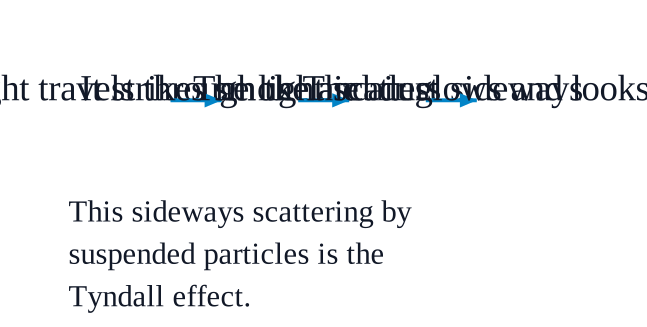
    Because the smoke and dust particles suspended in the air scatter the light passing through them — this is the Tyndall effect.
    NCERT_Solution_Class9_Science_Ch5_PP_Q5-10
    Instead of travelling straight to your eye, sunlight is spread sideways by the particles, so the whole air glows faintly and distant buildings lose their sharpness.
    The chapter's other examples of the same scattering are a fine beam of light entering a dark room through a small hole, and the visible beams of floodlights in a sports stadium.
    Clean air has no such particles, so it scatters far less light and the view stays clear.