SolveItClass 9 · NCERT

NCERT Solutions · Class 9 Science Exploring Mixtures and their Separation

25 questions · 21 still being checked

Revise, Reflect, Refine 5.10–5.15 (part 14 of 14)

  1. Exercise 5.10

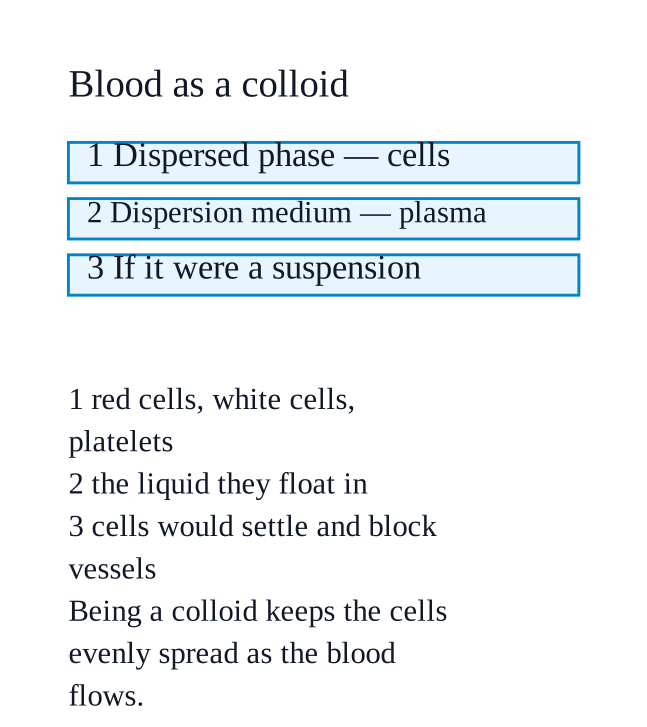
    Blood is an example of a colloidal mixture. (i) What would happen if blood behaved like a true suspension inside the body? (ii) In a blood sample, identify the dispersed phase and the dispersion medium.

    Not cross-checked

    NCERT prints no numerical answer for this exercise, so this working has not been cross-checked against the book.

    (i) If blood behaved like a true suspension, its cells would settle out of the plasma instead of staying evenly dispersed.
    NCERT_Solution_Class9_Science_Ch5_RRR_Q5-10
    Suspension particles are large and sink when left undisturbed, so the heavier red blood cells would sediment wherever the blood flowed slowly, and could clump and block the narrow vessels.
    Blood could then no longer do its job of connecting the parts of the body by carrying nutrients, gases and hormones evenly to every tissue.
    The cells would also be big enough to be seen with the naked eye and could be strained out by simple filtration, which is not what happens.
    Being a colloid is what keeps the cells uniformly spread throughout the plasma while the blood circulates.
    (ii) Dispersed phase = the blood cells — red blood cells, white blood cells and platelets. Dispersion medium = the plasma, the liquid in which they are suspended.
  2. Exercise 5.11

    You are given a mixture of sand, common salt and naphthalene (Fig. 5.25a). The Fig. 5.25b depicts various steps used to separate the components of this mixture. Identify and write down the correct sequence of separation techniques.NCERT_Question_Class9_Science_Ch5_RRR_Q5-11

    Not cross-checked

    NCERT prints no numerical answer for this exercise, so this working has not been cross-checked against the book.

    Correct sequence: 1. Sublimation → 2. Dissolving in water and filtration → 3. Evaporation (crystallization) of the filtrate.
    Step $\displaystyle 1$ — Sublimation. Heat the dry mixture gently in a china dish covered with an inverted funnel whose nozzle is plugged with cotton. Naphthalene changes straight into vapour and deposits as a white solid on the inner wall of the funnel; sand and common salt stay in the dish because they do not sublime.
    Step $\displaystyle 2$ — Dissolving and filtration. Add water to what is left and stir. Common salt dissolves; sand does not. Filter the mixture: sand is the residue on the filter paper and salt solution is the filtrate.
    Step $\displaystyle 3$ — Evaporation or crystallization. Heat the filtrate to drive off the water, or let it cool slowly from a hot saturated state, and common salt is obtained as a solid.
    The order matters: sublimation must come first, because it needs a dry mixture — once water has been added, the naphthalene could not be sublimed out cleanly.
  3. Exercise 5.12

    Why is distillation an effective method for separating a mixture of water and acetone?

    Not cross-checked

    NCERT prints no numerical answer for this exercise, so this working has not been cross-checked against the book.

    Because water and acetone are miscible but their boiling points are far apart.
    NCERT_Solution_Class9_Science_Ch5_RRR_Q5-12
    Being miscible they form a single homogeneous layer, so a separating funnel is of no use — the separation has to be based on boiling point instead.
    Acetone boils at about $\displaystyle 56$ °C and water at $\displaystyle 100$ °C: \(\displaystyle 100\ ^\circ\text{C} - 56\ ^\circ\text{C} = 44\ ^\circ\text{C} \), well above the minimum difference of about $\displaystyle 25$ °C that distillation needs.
    That large gap means acetone vaporises well before water forms vapour in any significant amount, so the vapour leaving the flask is almost pure acetone.
    The vapour is cooled in the condenser, condenses to pure liquid acetone and is collected in the receiver, while the water stays behind in the distillation flask — and both liquids are recovered.
  4. Exercise 5.13

    Answer the following questions with the help of the data given in Salts Potassium nitrate Sodium chloride Potassium chloride Ammonium chloride (i) What mass of potassium nitrate would be needed to prepare its saturated solution in 50\displaystyle 50 g of water at 40\displaystyle 40 °C? (ii) A student makes a saturated solution of potassium chloride in water at 80\displaystyle 80 °C and leaves the solution to cool at room temperature (25\displaystyle 25 °C). What would she observe as the solution cools? Explain. (iii) What is the effect of a change in temperature on the solubility of salts? Also, compare the changes in the solubility of the four given salts with increasing temperature from 10\displaystyle 10 °C to 80\displaystyle 80 °C.

    Not cross-checked

    NCERT prints no numerical answer for this exercise, so this working has not been cross-checked against the book.

    (i) $\displaystyle 31$ g of potassium nitrate.
    NCERT_Solution_Class9_Science_Ch5_RRR_Q5-13
    From Table $\displaystyle 5.4$, $\displaystyle 62$ g of potassium nitrate saturates $\displaystyle 100$ g of water at $\displaystyle 40$ °C.
    \(\displaystyle \text{Mass needed} = \dfrac{62\ \text{g}}{100\ \text{g}} \times 50\ \text{g} = 31\ \text{g} \)
    (ii) She would see crystals of potassium chloride separating out and settling at the bottom as the solution cools.
    Solubility of potassium chloride at $\displaystyle 80$ °C = $\displaystyle 54$ g per $\displaystyle 100$ g of water; at $\displaystyle 25$ °C it is about $\displaystyle 36$ g per $\displaystyle 100$ g of water ($\displaystyle 35$ g at $\displaystyle 20$ °C and $\displaystyle 37.4$ g at $\displaystyle 30$ °C).
    \(\displaystyle 54\ \text{g} - 36\ \text{g} = 18\ \text{g} \) of salt per $\displaystyle 100$ g of water can no longer stay dissolved.
    Reason: solubility of a solid falls as the temperature falls, so the cooling solution can hold less salt than it started with and the excess crystallises out — this is exactly the principle of crystallization.
    (iii) The solubility of all four salts increases as the temperature rises, but by very different amounts.
    From $\displaystyle 10$ °C to $\displaystyle 80$ °C: potassium nitrate \(\displaystyle 21 \rightarrow 167 \), an increase of $\displaystyle 146$ g; ammonium chloride \(\displaystyle 24 \rightarrow 66 \), an increase of $\displaystyle 42$ g; potassium chloride \(\displaystyle 35 \rightarrow 54 \), an increase of $\displaystyle 19$ g; sodium chloride \(\displaystyle 36 \rightarrow 37 \), an increase of just $\displaystyle 1$ g.
    Order of increase: potassium nitrate > ammonium chloride > potassium chloride > sodium chloride.
    Sodium chloride is almost unaffected by temperature, which is why common salt is obtained by evaporating seawater rather than by cooling a hot saturated solution.
  5. Exercise 5.14

    Three students, A, B and C, are preparing sugar solutions for an experiment: y Student A dissolves 20\displaystyle 20 g of sugar in 80\displaystyle 80 g of water. y Student B dissolves 20\displaystyle 20 g of sugar in 100\displaystyle 100 g of water. y Student C dissolves 30\displaystyle 30 g of sugar in 80\displaystyle 80 g of water. (i) Calculate the mass percentage (% m/m) concentration of sugar in each student’s solution. (ii) Whose solution is the most concentrated? Explain why.
    NCERT’s answer
    (i)
    Student A = $\displaystyle 20$%; Student B = $\displaystyle 16.67$%; Student C = $\displaystyle 27.27$% (ii) Student C
    (i) Mass by mass percentage \(\displaystyle = \dfrac{\text{Mass of sugar}}{\text{Mass of sugar} + \text{Mass of water}} \times 100 \)
    NCERT_Solution_Class9_Science_Ch5_RRR_Q5-14
    Student A: \(\displaystyle \dfrac{20}{20 + 80} \times 100 = \dfrac{20}{100} \times 100 = 20\ \%\ m/m \)
    Student B: \(\displaystyle \dfrac{20}{20 + 100} \times 100 = \dfrac{20}{120} \times 100 = 16.67\ \%\ m/m \)
    Student C: \(\displaystyle \dfrac{30}{30 + 80} \times 100 = \dfrac{30}{110} \times 100 = 27.27\ \%\ m/m \)
    (ii) Student C's solution is the most concentrated, at $\displaystyle 27.27$ % m/m.
    C uses the most sugar ($\displaystyle 30$ g) in the least water ($\displaystyle 80$ g), so the largest mass of solute sits in the smallest mass of solution.
    Comparing in pairs makes it clear: C beats A because both use $\displaystyle 80$ g of water but C adds more sugar; A beats B because both use $\displaystyle 20$ g of sugar but A uses less water.
  6. Exercise 5.15

    Examine Fig. 5.26. (i) Identify the separation technique marked as ‘S’. (ii) Label the apparatus A, B and C. (iii) Which of the following mixtures can be separated by the technique identified above? Use the data given in Table 5.5. Mixtures: (a) water — acetone (c) acetone — alcohol (e) alcohol — chloroform (f) alcohol — benzene Solvent Temperature (°C) y Demonstrate the Tyndall effect using different colloids. Create a series of experiments showcasing how light scatters in colloids making the beam visible. Use laser pointers (Safety first: Use it under the supervision of an adult), flashlights, or other light sources for your demonstrations. y Make crystals of different compounds (common salt, epsom salt, sugar, borax, nickel sulfate, etc.). Observe them under a magnifying glass or a microscope. Note down their colours and shapes. y Do red leaves also contain green pigments? Investigate it using paper chromatography. y You can try chromatography to find the number of components present in a food colour (green, orange, yellow, etc.) or in coloured mouth fresheners (fennel seeds). y Design an educational game where players identify and apply separation techniques to different mixtures through interactive challenges and hands-on activities. y If you are camping outdoors and running short on clean water, you can obtain clean water by distillation. Can you think of a set-up with the items available to you? y To learn more about the states of matter and concentration of solutions, you can explore the links given below: Š https://phet.colorado.edu/sims/html/states-of-matter-basics/latest/ states-of-matter-basics_en.html Š https://phet.colorado.edu/sims/html/concentration/latest/ concentration_all.html The Quest Continues … Can we create artificial blood that works just as real blood for all patients?NCERT_Question_Class9_Science_Ch5_RRR_Q5-15

    Not cross-checked

    NCERT prints no numerical answer for this exercise, so this working has not been cross-checked against the book.

    (i) The technique marked 'S' is distillation (simple distillation).
    (ii) The three parts of the set-up are: A — the distillation flask holding the mixture, heated on a wire gauze over a burner, with the thermometer fitted at its mouth; B — the water condenser, in which the vapour is cooled by water entering at the lower inlet and leaving at the upper outlet; C — the conical flask (receiver), which collects the distillate.
    (iii) Only (a) water — acetone and (b) water — salt can be separated by this technique.
    (a) Water — acetone: \(\displaystyle 100\ ^\circ\text{C} - 56\ ^\circ\text{C} = 44\ ^\circ\text{C} \), far more than $\displaystyle 25$ °C — separable.
    (b) Water — salt: distillation also recovers a liquid from a solution containing a dissolved solid; the water distils over and the salt stays in the flask — separable.
    (c) Acetone — alcohol: \(\displaystyle 78\ ^\circ\text{C} - 56\ ^\circ\text{C} = 22\ ^\circ\text{C} \), less than $\displaystyle 25$ °C — not separable by simple distillation; it needs fractional distillation.
    (d) Sand — salt: a solid–solid mixture with no boiling points involved — separate it by dissolving in water, filtering off the sand and evaporating the filtrate.
    (e) Alcohol — chloroform: \(\displaystyle 78\ ^\circ\text{C} - 61\ ^\circ\text{C} = 17\ ^\circ\text{C} \) — too close.
    (f) Alcohol — benzene: \(\displaystyle 80\ ^\circ\text{C} - 78\ ^\circ\text{C} = 2\ ^\circ\text{C} \) — far too close.


