SolveItClass 9 · NCERT

NCERT Solutions · Class 9 Science Exploring Mixtures and their Separation

25 questions · 21 still being checked

Revise, Reflect, Refine 5.8–5.9 (part 12 of 14)

  1. Exercise 5.8

    Two miscible liquids, A and B, are present in a mixture. The boiling point of A is 60\displaystyle 60 °C and the boiling point of B is 90\displaystyle 90 °C. Suggest a method to separate them. Also, draw a labelled diagram of the method suggested.

    Not cross-checked

    NCERT prints no numerical answer for this exercise, so this working has not been cross-checked against the book.

    Separate them by distillation.
    NCERT_Solution_Class9_Science_Ch5_RRR_Q5-8
    The difference in boiling points is \(\displaystyle 90\ ^\circ\text{C} - 60\ ^\circ\text{C} = 30\ ^\circ\text{C} \), which is more than the minimum of about $\displaystyle 25$ °C that distillation needs.
    They are miscible, so they form one homogeneous layer and a separating funnel cannot be used.
    On heating, A (the lower-boiling liquid) vaporises first at $\displaystyle 60$ °C; its vapour passes into the condenser, is cooled by the circulating water and is collected as pure liquid A in the receiver, while B is left behind in the distillation flask.
    Diagram to draw and label: a distillation flask holding the mixture of A and B, standing on a wire gauze over a tripod stand with a burner beneath it; a thermometer fitted through the mouth of the flask with its bulb level with the side tube; the side tube leading into a water condenser clamped to a laboratory stand, with the water inlet at its lower end and the water outlet at its upper end; and a conical flask at the far end of the condenser collecting the distillate (liquid A).
  2. Exercise 5.9

    Compare evaporation, crystallization and distillation. In which situation, would you prefer each of these over the others?

    Not cross-checked

    NCERT prints no numerical answer for this exercise, so this working has not been cross-checked against the book.

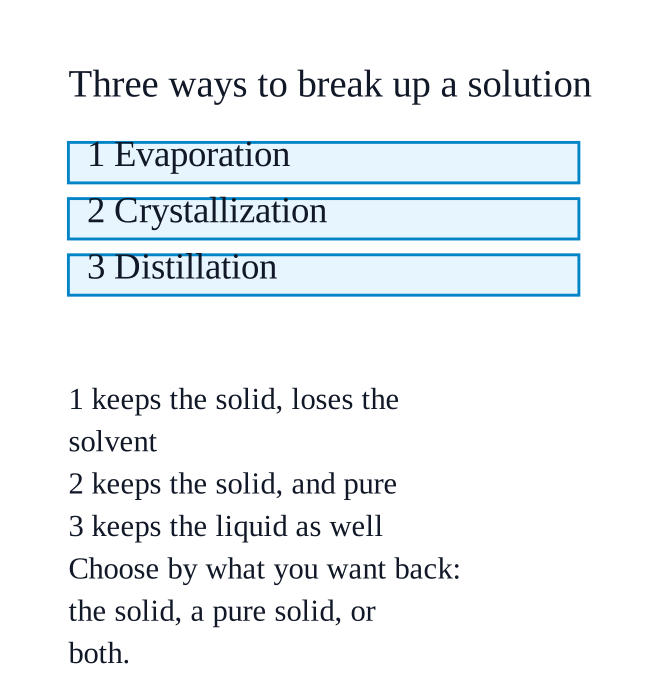
    All three separate a solution, but they differ in what is recovered and how pure it is.
    NCERT_Solution_Class9_Science_Ch5_RRR_Q5-9
    Evaporation — the solution is heated until the solvent escapes as vapour and the dissolved solid is left behind. The solvent is lost, and any soluble impurity stays with the solid. Prefer it when only the solid is wanted, it is stable to heat, and purity does not matter — obtaining common salt from seawater.
    Crystallization — a hot saturated solution is filtered hot and then cooled slowly, so that the excess solute separates as pure crystals while the impurities remain dissolved. Prefer it when the solid must be pure and well-formed, or when it would decompose on strong heating — purifying copper sulfate, or making candy sugar.
    Distillation — the mixture is boiled, the vapour is condensed and collected, so both components are recovered. Prefer it when the liquid is wanted as well as the solid, or when the mixture is two miscible liquids whose boiling points differ by at least about $\displaystyle 25$ °C — separating acetone from water, or getting drinking water back from a salt solution.
    In short: evaporation to keep the solid, crystallization to keep the solid pure, distillation to keep the liquid as well.