Exercise 5.7
How would you separate the mixtures given in Table ? Mention the reason for choosing your method. If a mixture cannot be separated, explain why. Mixture Mud from muddy water Plasma from other components in the blood sample Naphthalene and sand Chalk powder and common salt Common salt and water Oil from water Pigments of the flower
Not cross-checked
NCERT prints no numerical answer for this exercise, so this working has not been cross-checked against the book.
Mud from muddy water — sedimentation and decantation, with coagulation (alum) and filtration for the fine particles. Mud is a suspension, so the heavy particles settle on standing and the water above can be poured off; the fine particles that keep it cloudy are clumped together by adding powdered alum, and the clumps settle by gravity and are removed by decantation or filtration.
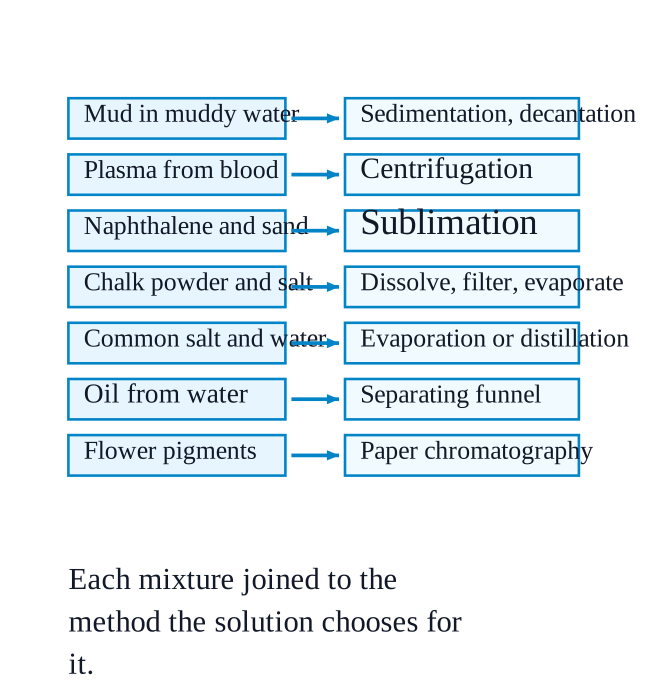
Plasma from the other components of a blood sample — centrifugation. Blood is a colloid, so its particles will not stay on filter paper; spinning the tube at high speed throws the heavier red blood cells, white blood cells and platelets outwards to the bottom and leaves the lighter plasma on top.
Naphthalene and sand — sublimation. On gentle heating naphthalene passes straight from the solid to the vapour state and deposits as a white solid on the cool inverted funnel, while sand does not sublime and stays in the china dish.
Chalk powder and common salt — dissolve in water, filter, then evaporate or crystallise the filtrate. Salt is soluble in water and chalk is not, so chalk is left on the filter paper as residue and the salt is recovered from the filtrate.
Common salt and water — evaporation if only the salt is wanted, distillation if the water is wanted too. Evaporation drives the water off and leaves the salt; in distillation the water vaporises, is condensed and collected, and the salt stays behind in the distillation flask.
Oil from water — separating funnel. The two liquids are immiscible and differ in density, so they settle into two layers that can be run off one after the other through the stopcock.
Pigments of the flower — paper chromatography. The colour of a petal is a mixture of pigments that move up the paper at different rates with the solvent, so they separate into distinct coloured spots.
All seven mixtures in the table can be separated. A mixture that could not be separated by these physical methods is an alloy such as brass, because its metals are mixed uniformly in the solid.