Exercise 1
 Justify why the plane cannot be tiled with a regular pentagon. (Hint: Read the first sentences of 'Think and Reflect' in the section on tiling.) (There are many ways to tile the plane using a suitable irregular pentagon. The most recent method was found in 2015.)
Not cross-checked
This solution has not been cross-checked against the answer printed in NCERT.
Each angle of a regular pentagon is
\[\frac{(5-2)\times 180^\circ}{5} = 108^\circ \]
At a vertex of a tiling the angles add to \(\displaystyle 360^\circ\). If \(\displaystyle k\) pentagons meet there,
\[108^\circ \times k = 360^\circ \;\Rightarrow\; k = \frac{10}{3} \]
which is not a whole number.
\[3 \times 108^\circ = 324^\circ \ (\text{gap } 36^\circ), \qquad 4 \times 108^\circ = 432^\circ > 360^\circ \ (\text{overlap}) \]
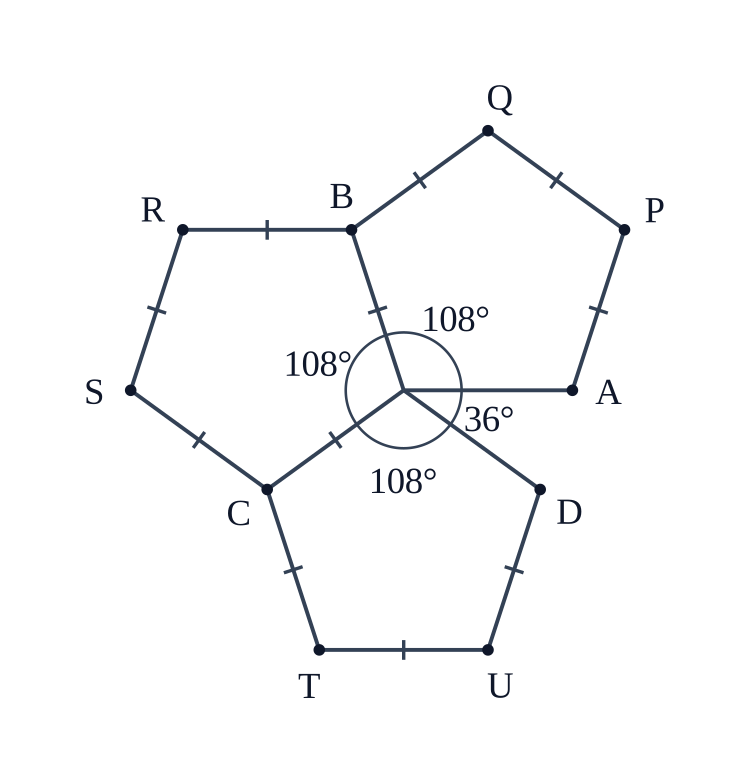 A vertex on the side of another pentagon needs
\[108^\circ \times k = 180^\circ \;\Rightarrow\; k = \frac{5}{3} \]
which also fails.Answer: No whole number of \(\displaystyle 108^\circ\) angles adds to \(\displaystyle 360^\circ\) (or \(\displaystyle 180^\circ\)), so regular pentagons cannot tile the plane.
A vertex on the side of another pentagon needs
\[108^\circ \times k = 180^\circ \;\Rightarrow\; k = \frac{5}{3} \]
which also fails.Answer: No whole number of \(\displaystyle 108^\circ\) angles adds to \(\displaystyle 360^\circ\) (or \(\displaystyle 180^\circ\)), so regular pentagons cannot tile the plane.
A vertex on the side of another pentagon needs
\[108^\circ \times k = 180^\circ \;\Rightarrow\; k = \frac{5}{3} \]
which also fails.Answer: No whole number of \(\displaystyle 108^\circ\) angles adds to \(\displaystyle 360^\circ\) (or \(\displaystyle 180^\circ\)), so regular pentagons cannot tile the plane.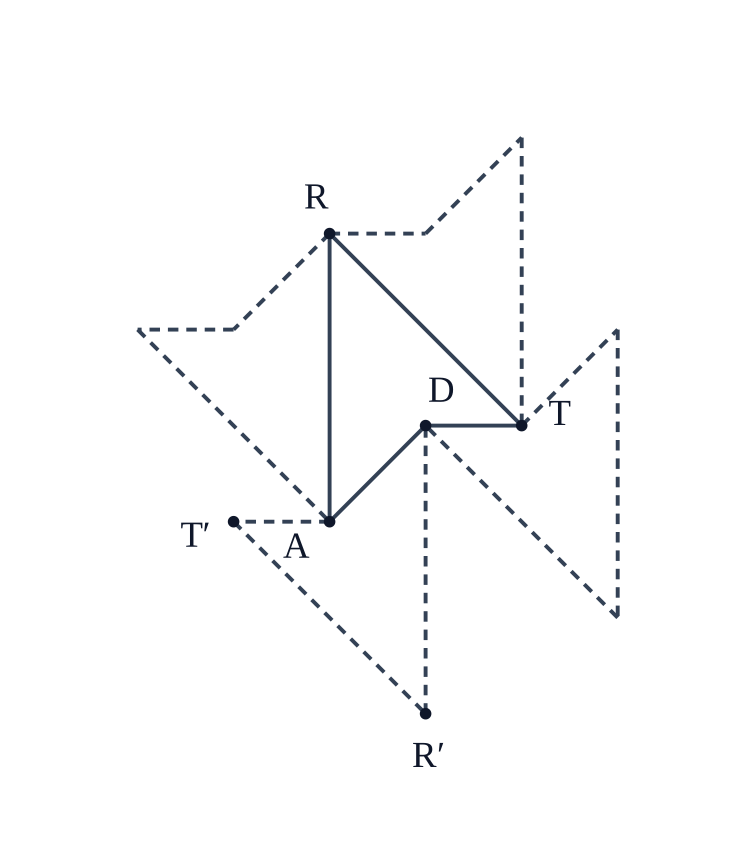 Method 2. Midpoint Theorem in \(\displaystyle \triangle DAR\) and \(\displaystyle \triangle ART\):
\[M_1M_2\parallel DR,\ \ M_1M_2=\tfrac12 DR;\qquad M_2M_3\parallel AT,\ \ M_2M_3=\tfrac12 AT \]
So \(\displaystyle M_1M_2M_3M_4\) is the Varignon parallelogram. Draw its grid; on every second cell of every second row fit a same-way-up DART. Each gap is a half-turned DART.Answer: DART \(\displaystyle D(2,2),\,A(0,0),\,R(0,6),\,T(4,2)\) tiles the plane by either method; I prefer Method $\displaystyle 1$ (one rule, no grid), but either is valid.
Method 2. Midpoint Theorem in \(\displaystyle \triangle DAR\) and \(\displaystyle \triangle ART\):
\[M_1M_2\parallel DR,\ \ M_1M_2=\tfrac12 DR;\qquad M_2M_3\parallel AT,\ \ M_2M_3=\tfrac12 AT \]
So \(\displaystyle M_1M_2M_3M_4\) is the Varignon parallelogram. Draw its grid; on every second cell of every second row fit a same-way-up DART. Each gap is a half-turned DART.Answer: DART \(\displaystyle D(2,2),\,A(0,0),\,R(0,6),\,T(4,2)\) tiles the plane by either method; I prefer Method $\displaystyle 1$ (one rule, no grid), but either is valid.