Exercise 1

(i)
If are the midpoints of sides respectively of , show that is congruent to and to two other triangles which you should identify.
(ii)
Suppose someone erases , leaving only on the paper. Can you reconstruct from ?
Not cross-checked
This solution has not been cross-checked against the answer printed in NCERT.
(i) In the given figure, the Midpoint Theorem gives
\[PQ = \tfrac12 BC,\quad QR = \tfrac12 AB,\quad RP = \tfrac12 AC \]
and P, Q, R are midpoints, so
\[AP = PB = \tfrac12 AB,\quad AQ = QC = \tfrac12 AC,\quad BR = RC = \tfrac12 BC \]
By SSS:
\[PQ = QP,\ QR = PA,\ RP = AQ \;\Rightarrow\; \triangle PQR \cong \triangle QPA \]
\[PQ = RB,\ QR = BP,\ RP = PR \;\Rightarrow\; \triangle PQR \cong \triangle RBP \]
\[PQ = CR,\ QR = RQ,\ RP = QC \;\Rightarrow\; \triangle PQR \cong \triangle CRQ \](ii) Yes. Through P, Q, R draw lines \(\displaystyle \ell_P \parallel QR\), \(\displaystyle \ell_Q \parallel RP\), \(\displaystyle \ell_R \parallel PQ\), and let
\[A = \ell_P \cap \ell_Q,\quad B = \ell_P \cap \ell_R,\quad C = \ell_Q \cap \ell_R \]
APRQ and PBRQ are parallelograms, so
\[AP = QR = PB \]
with A, P, B on \(\displaystyle \ell_P\): P is the midpoint of AB. Likewise Q is the midpoint of AC and R of BC.Answer: (i) \(\displaystyle \triangle PQR \cong \triangle QPA \cong \triangle RBP \cong \triangle CRQ\). (ii) Yes: the lines through P, Q, R parallel to QR, RP, PQ bound \(\displaystyle \triangle ABC\).
 In
In  In a quadrilateral
 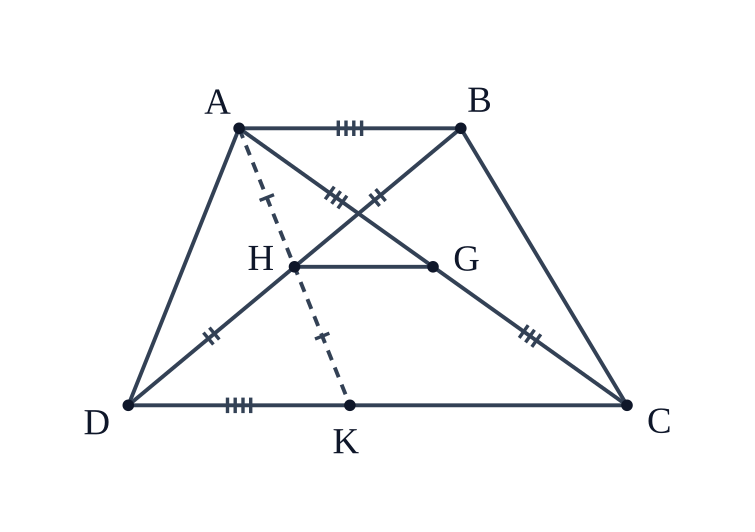 \[BH = DH \quad \text{(H is the midpoint of BD)} \]
\[\angle ABH = \angle KDH \quad \text{(alternate angles, } AB \parallel DC) \]
\[\angle AHB = \angle KHD \quad \text{(vertically opposite angles)} \]
\[\triangle ABH \cong \triangle KDH \ \text{(ASA)} \;\Rightarrow\; AH = HK,\quad DK = AB \]
In \(\displaystyle \triangle ACK\), G and H are the midpoints of AC and AK, so
\[GH \parallel CK \ \text{(Midpoint Theorem)}, \ \text{i.e. } GH \parallel DC \parallel AB \]
\[GH = \tfrac12 CK = \tfrac12 |CD - AB| \]
If AB = CD, then ABCD is a parallelogram (Theorem $\displaystyle 5$) and its diagonals bisect each other, so G = H and there is no line GH.Answer: \(\displaystyle GH \parallel AB\) and \(\displaystyle GH = \tfrac12 |CD - AB|\); AB \(\displaystyle \neq\) CD is assumed so that G and H are different points.
\[BH = DH \quad \text{(H is the midpoint of BD)} \]
\[\angle ABH = \angle KDH \quad \text{(alternate angles, } AB \parallel DC) \]
\[\angle AHB = \angle KHD \quad \text{(vertically opposite angles)} \]
\[\triangle ABH \cong \triangle KDH \ \text{(ASA)} \;\Rightarrow\; AH = HK,\quad DK = AB \]
In \(\displaystyle \triangle ACK\), G and H are the midpoints of AC and AK, so
\[GH \parallel CK \ \text{(Midpoint Theorem)}, \ \text{i.e. } GH \parallel DC \parallel AB \]
\[GH = \tfrac12 CK = \tfrac12 |CD - AB| \]
If AB = CD, then ABCD is a parallelogram (Theorem $\displaystyle 5$) and its diagonals bisect each other, so G = H and there is no line GH.Answer: \(\displaystyle GH \parallel AB\) and \(\displaystyle GH = \tfrac12 |CD - AB|\); AB \(\displaystyle \neq\) CD is assumed so that G and H are different points.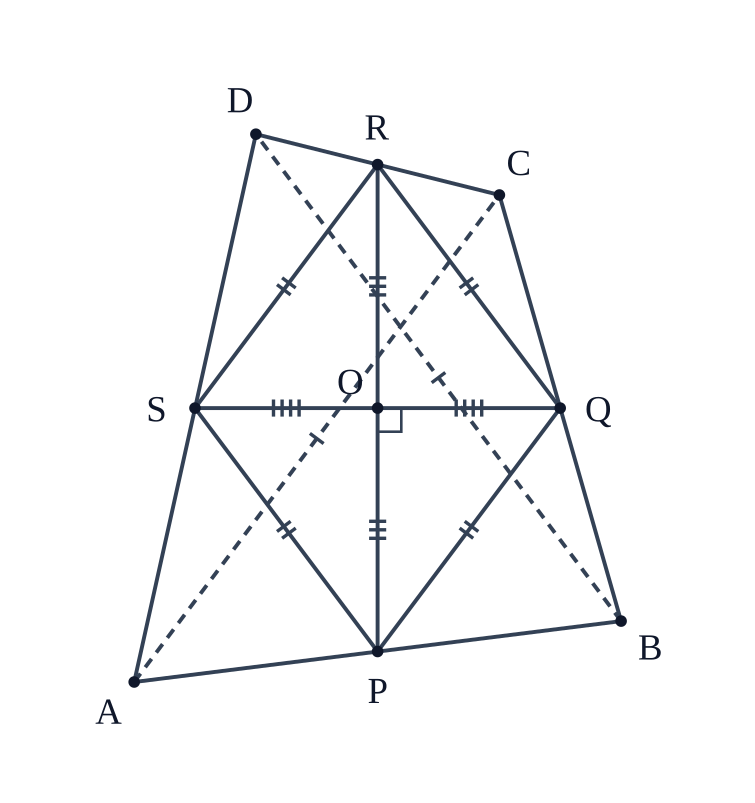 (i) Midpoint Theorem in \(\displaystyle \triangle ABC\) and \(\displaystyle \triangle ADC\):
\[PQ \parallel AC \parallel SR,\qquad PQ = \tfrac12 AC = SR \]
So PQRS is a parallelogram (Theorem $\displaystyle 5$). Its diagonals bisect each other (Theorem $\displaystyle 1$); with O their crossing point:
\[OP = OR,\quad OQ = OS \](ii) Midpoint Theorem in \(\displaystyle \triangle BCD\) and \(\displaystyle \triangle ABD\): \(\displaystyle QR = PS = \tfrac12 BD\). If \(\displaystyle AC = BD\):
\[PQ = \tfrac12 AC = \tfrac12 BD = QR \]
\[PQ = RQ,\ OP = OR,\ OQ = OQ \;\Rightarrow\; \triangle POQ \cong \triangle ROQ \ \text{(SSS)} \]
\[\angle POQ = \angle ROQ,\quad \angle POQ + \angle ROQ = 180^\circ \;\Rightarrow\; \angle POQ = 90^\circ \]
Converse: True. If \(\displaystyle PR \perp QS\):
\[OQ = OS,\ \angle POQ = \angle POS = 90^\circ,\ OP = OP \;\Rightarrow\; \triangle POQ \cong \triangle POS \ \text{(SAS)} \]
\[PQ = PS \;\Rightarrow\; \tfrac12 AC = \tfrac12 BD \;\Rightarrow\; AC = BD \]Answer: (i) PR and QS bisect each other. (ii) \(\displaystyle AC = BD \Rightarrow PR \perp QS\); the converse is true.
(i) Midpoint Theorem in \(\displaystyle \triangle ABC\) and \(\displaystyle \triangle ADC\):
\[PQ \parallel AC \parallel SR,\qquad PQ = \tfrac12 AC = SR \]
So PQRS is a parallelogram (Theorem $\displaystyle 5$). Its diagonals bisect each other (Theorem $\displaystyle 1$); with O their crossing point:
\[OP = OR,\quad OQ = OS \](ii) Midpoint Theorem in \(\displaystyle \triangle BCD\) and \(\displaystyle \triangle ABD\): \(\displaystyle QR = PS = \tfrac12 BD\). If \(\displaystyle AC = BD\):
\[PQ = \tfrac12 AC = \tfrac12 BD = QR \]
\[PQ = RQ,\ OP = OR,\ OQ = OQ \;\Rightarrow\; \triangle POQ \cong \triangle ROQ \ \text{(SSS)} \]
\[\angle POQ = \angle ROQ,\quad \angle POQ + \angle ROQ = 180^\circ \;\Rightarrow\; \angle POQ = 90^\circ \]
Converse: True. If \(\displaystyle PR \perp QS\):
\[OQ = OS,\ \angle POQ = \angle POS = 90^\circ,\ OP = OP \;\Rightarrow\; \triangle POQ \cong \triangle POS \ \text{(SAS)} \]
\[PQ = PS \;\Rightarrow\; \tfrac12 AC = \tfrac12 BD \;\Rightarrow\; AC = BD \]Answer: (i) PR and QS bisect each other. (ii) \(\displaystyle AC = BD \Rightarrow PR \perp QS\); the converse is true.
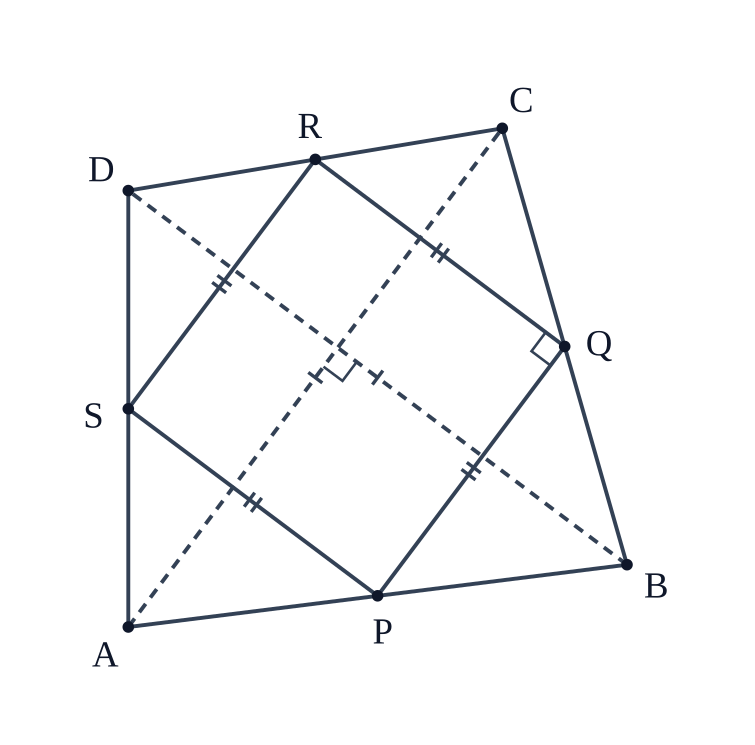 If PQRS is a square:
\[QR \perp PQ,\ PQ \parallel AC \;\Rightarrow\; QR \perp AC;\qquad BD \parallel QR \;\Rightarrow\; BD \perp AC \]
\[\tfrac12 AC = PQ = QR = \tfrac12 BD \;\Rightarrow\; AC = BD \]
Converse: let \(\displaystyle AC = BD\) and \(\displaystyle AC \perp BD\).
\[PQ = SR = \tfrac12 AC = \tfrac12 BD = QR = PS \]
\[PQ \parallel AC,\ QR \parallel BD,\ AC \perp BD \;\Rightarrow\; \angle PQR = 90^\circ \]
A rhombus with a right angle is a square.Answer: (i) Fit the four corner triangles of ABCD onto PQRS. (ii) Collinear at S, P, Q, R with equal sides and angles, so A'B'C'D' \(\displaystyle \cong\) ABCD. (iii) PQRS is a square exactly when \(\displaystyle AC = BD\) and \(\displaystyle AC \perp BD\).
If PQRS is a square:
\[QR \perp PQ,\ PQ \parallel AC \;\Rightarrow\; QR \perp AC;\qquad BD \parallel QR \;\Rightarrow\; BD \perp AC \]
\[\tfrac12 AC = PQ = QR = \tfrac12 BD \;\Rightarrow\; AC = BD \]
Converse: let \(\displaystyle AC = BD\) and \(\displaystyle AC \perp BD\).
\[PQ = SR = \tfrac12 AC = \tfrac12 BD = QR = PS \]
\[PQ \parallel AC,\ QR \parallel BD,\ AC \perp BD \;\Rightarrow\; \angle PQR = 90^\circ \]
A rhombus with a right angle is a square.Answer: (i) Fit the four corner triangles of ABCD onto PQRS. (ii) Collinear at S, P, Q, R with equal sides and angles, so A'B'C'D' \(\displaystyle \cong\) ABCD. (iii) PQRS is a square exactly when \(\displaystyle AC = BD\) and \(\displaystyle AC \perp BD\).