Exercise 21
Sum of angles of a polygon. What is the sum of angles of a (planar non-self-intersecting) -gon? We know that the answer is ° for and ° for . Find the next few values. Then find a formula in terms of and prove it.
Not cross-checked
This solution has not been cross-checked against the answer printed in NCERT.
Let \(\displaystyle S(n) \) be the angle sum of an \(\displaystyle n \)-gon. Each new side adds a triangle, so \(\displaystyle 180^\circ \) more:\[\begin{array}{c|cccccc} n & 3&4&5&6&7&8\\ \hline S(n) & 180^\circ&360^\circ&540^\circ&720^\circ&900^\circ&1080^\circ \end{array} \]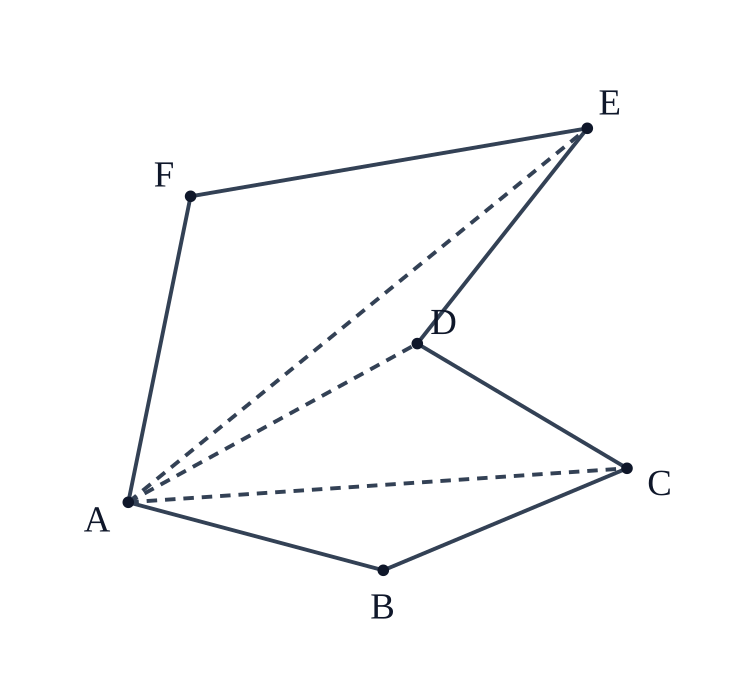 Claim: \(\displaystyle S(n)=(n-2)\cdot180^\circ \). Induction on \(\displaystyle n \), with \(\displaystyle S(3)=180^\circ \). Every \(\displaystyle n \)-gon, \(\displaystyle n\ge4 \), has a diagonal inside it (leftmost vertex \(\displaystyle V \), neighbours \(\displaystyle U,W \): if \(\displaystyle \triangle UVW \) holds no other vertex use \(\displaystyle UW \), else join \(\displaystyle V \) to the vertex of \(\displaystyle \triangle UVW \) farthest from \(\displaystyle UW \)). It splits the \(\displaystyle n \)-gon into a \(\displaystyle p \)-gon and a \(\displaystyle q \)-gon with \(\displaystyle p,q<n \):\[p+q=n+2\quad(\text{the diagonal's two ends lie in both pieces}) \]\[S(n)=S(p)+S(q)=(p-2)180^\circ+(q-2)180^\circ=(p+q-4)\,180^\circ=(n-2)\,180^\circ \]Answer: \(\displaystyle 540^\circ,\ 720^\circ,\ 900^\circ,\ 1080^\circ \) for \(\displaystyle n=5,6,7,8 \); in general \(\displaystyle (n-2)\times180^\circ \).
Claim: \(\displaystyle S(n)=(n-2)\cdot180^\circ \). Induction on \(\displaystyle n \), with \(\displaystyle S(3)=180^\circ \). Every \(\displaystyle n \)-gon, \(\displaystyle n\ge4 \), has a diagonal inside it (leftmost vertex \(\displaystyle V \), neighbours \(\displaystyle U,W \): if \(\displaystyle \triangle UVW \) holds no other vertex use \(\displaystyle UW \), else join \(\displaystyle V \) to the vertex of \(\displaystyle \triangle UVW \) farthest from \(\displaystyle UW \)). It splits the \(\displaystyle n \)-gon into a \(\displaystyle p \)-gon and a \(\displaystyle q \)-gon with \(\displaystyle p,q<n \):\[p+q=n+2\quad(\text{the diagonal's two ends lie in both pieces}) \]\[S(n)=S(p)+S(q)=(p-2)180^\circ+(q-2)180^\circ=(p+q-4)\,180^\circ=(n-2)\,180^\circ \]Answer: \(\displaystyle 540^\circ,\ 720^\circ,\ 900^\circ,\ 1080^\circ \) for \(\displaystyle n=5,6,7,8 \); in general \(\displaystyle (n-2)\times180^\circ \).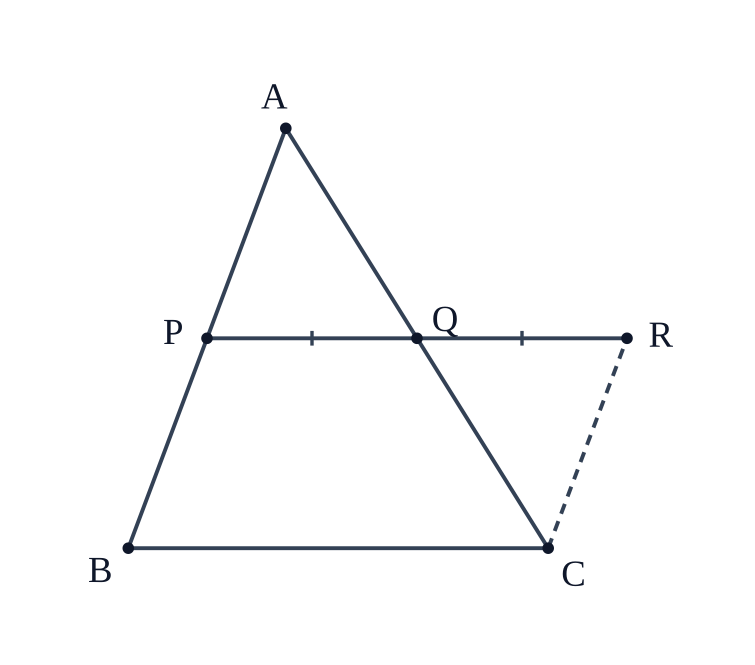 \[PR=2PQ=BC,\ \ PR\parallel BC\ \Rightarrow\ BCRP\text{ is a parallelogram}\quad(\text{Theorem 5}) \]\[CR\parallel BP,\qquad CR=BP \]\[\angle AQP=\angle CQR\ (\text{vertically opposite}),\quad \angle APQ=\angle CRQ\ (AP\parallel RC),\quad PQ=RQ \]\[\triangle APQ\cong\triangle CRQ\ (\text{ASA})\ \Rightarrow\ AQ=CQ,\qquad AP=CR=BP \](ii) Keeping the first sentence: if \(\displaystyle PQ\parallel BC \), then \(\displaystyle Q \) is the midpoint of \(\displaystyle AC \). This is Theorem 7.\[\text{Midpoint Theorem: (P MID)}\wedge\text{(Q MID)}\Rightarrow\text{(PRLL)}\wedge\text{(HALF)} \]\[\text{Theorem 7: (P MID)}\wedge\text{(PRLL)}\Rightarrow\text{(Q MID)}\wedge\text{(HALF)} \](iii) Two of the four conditions as assumptions give $\displaystyle 6$ statements; \(\displaystyle B\leftrightarrow C \) swaps P and Q.\[\begin{array}{l|l|l} \text{Assume} & \text{Conclude} & \text{Status} \\ \hline \text{P MID, Q MID} & \text{PRLL, HALF} & \text{Midpoint Theorem} \\ \text{PRLL, HALF} & \text{P MID, Q MID} & \text{part (i)} \\ \text{P MID, PRLL} & \text{Q MID, HALF} & \text{Theorem 7} \\ \text{Q MID, PRLL} & \text{P MID, HALF} & \text{Theorem 7, } B\leftrightarrow C \\ \text{Q MID, HALF} & \text{P MID, PRLL} & \text{last row, } B\leftrightarrow C \\ \text{P MID, HALF} & \text{Q MID, PRLL} & \text{to examine} \end{array} \]If \(\displaystyle P \) is the midpoint of \(\displaystyle AB \) and \(\displaystyle PQ=\tfrac{BC}{2} \), must \(\displaystyle Q \) be the midpoint of \(\displaystyle AC \) with \(\displaystyle PQ\parallel BC \)? No.\[A(0,0),\ B(6,4),\ C(10,0),\ P(3,2),\ Q(1,0):\qquad PQ=\sqrt8=\tfrac{BC}{2} \]\[\text{midpoint of }AC=(5,0)\ne Q,\qquad \text{slope }PQ=1\ne-1=\text{slope }BC \]The circle about \(\displaystyle P \) of radius \(\displaystyle \tfrac{BC}{2} \) meets \(\displaystyle AC \) twice.Answer: (i) true; (ii) Theorem $\displaystyle 7$: (P MID) and (PRLL) give (Q MID) and (HALF); (iii) no, the example above.
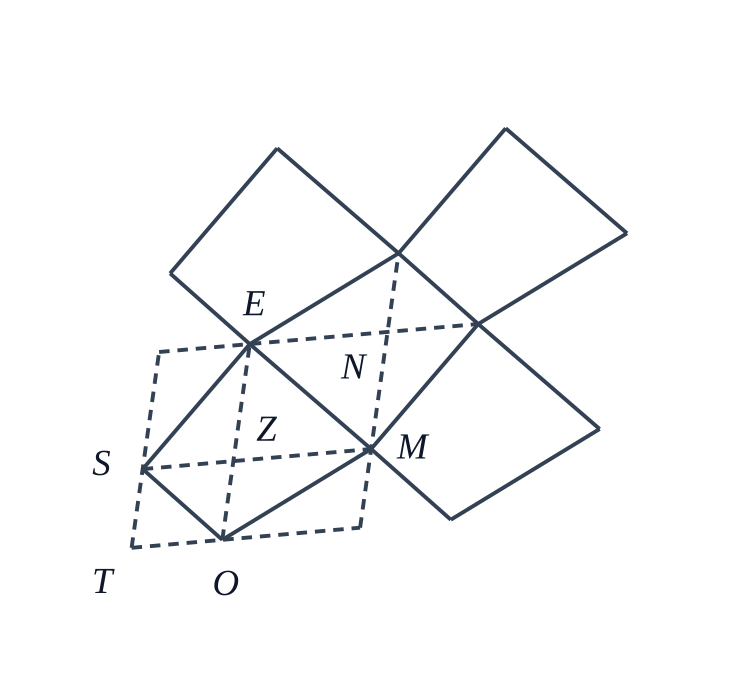 \[ST\parallel ZO,\ OT\parallel ZS\ \Rightarrow\ SZOT\text{ is a parallelogram}\ \Rightarrow\ SO,\ ZT\text{ bisect each other} \]The half-turn about the midpoint of \(\displaystyle SO \) sends \(\displaystyle \triangle ZSO \) to the corner triangle \(\displaystyle TOS \); likewise at the other corners. At \(\displaystyle N \), where four cells meet, the corner triangles are \(\displaystyle \triangle ZSO,ZOM,ZME,ZES \), each turned through \(\displaystyle 180^\circ \):\[\text{blank at }N\ (\text{the four corner triangles})=SOME\text{ turned through }180^\circ\text{ about the midpoint of }ZN \]Every corner triangle lies in exactly one blank: no gap, no overlap.\[\begin{array}{l|l|l} \text{Method} & \text{Places} & \text{Same pattern because} \\ \hline 3 & \text{slides by }EO,\ SM & \text{these are the cells} \\ 2 & \text{copies on every second Varignon cell} & \text{two steps of }\tfrac{SM}{2},\tfrac{OE}{2}\text{ are slides by }SM,\ OE \\ 1 & \text{half-turn about a side's midpoint} & \text{swaps a slid copy and the blank across it} \end{array} \]Answer: slid copies and blanks tile the plane.
 What fraction of the square is shaded?
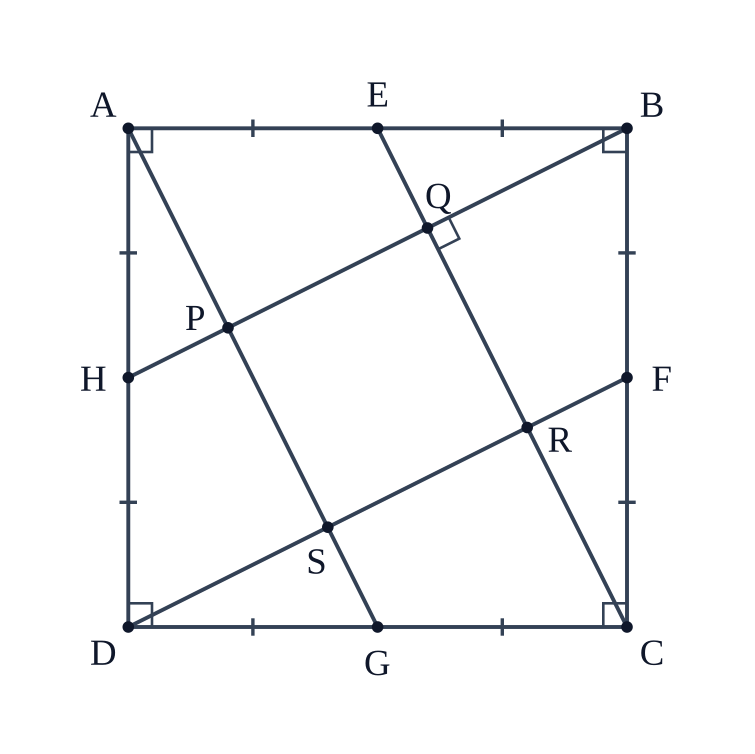 \[AE\parallel GC,\ AE=GC\ \Rightarrow\ AECG\text{ is a parallelogram},\ \ AG\parallel EC\quad(\text{Theorem 5}) \]\[DH\parallel FB,\ DH=FB\ \Rightarrow\ DHBF\text{ is a parallelogram},\ \ DF\parallel HB \]\[\triangle ABH\cong\triangle BCE\ (\text{SAS})\ \Rightarrow\ \angle ABH=\angle BCE\ \Rightarrow\ \angle QBC+\angle QCB=90^\circ\ \Rightarrow\ \angle BQC=90^\circ \]\[\triangle BAP:\ E\text{ midpoint of }AB,\ EQ\parallel AP\ \Rightarrow\ BQ=QP\quad(\text{Theorem 7}) \]\[\triangle BQC:\ F\text{ midpoint of }BC,\ FR\parallel BQ\ \Rightarrow\ QC=2\,QR\quad(\text{Theorem 7}) \]\(\displaystyle PQRS \) is a parallelogram with a right angle at \(\displaystyle Q \); a quarter turn about the centre maps the four lines onto each other, so \(\displaystyle PQ=QR=s \).\[BQ=PQ=s,\qquad QC=2QR=2s \]\[BC^2=BQ^2+QC^2=s^2+4s^2=5s^2 \]\[\frac{\operatorname{area}(PQRS)}{\operatorname{area}(ABCD)}=\frac{s^2}{5s^2}=\frac15 \]Answer: \(\displaystyle \dfrac15 \) of the square is shaded.