Exercise 1
Let ABCD be a quadrilateral.
(i)
List all sides of ABCD adjacent to side AB . List all sides opposite to AB.
(ii)
List all angles of ABCD adjacent to . List all angles opposite to .
(iii)
Define a pair of opposite sides and a pair of opposite angles without using the names of the vertices.
Not cross-checked
This solution has not been cross-checked against the answer printed in NCERT.
(i) Adjacent sides share an endpoint with AB; the remaining side shares none.\[\text{adjacent to } AB:\quad BC \ (\text{at } B),\quad DA \ (\text{at } A) \]\[\text{opposite to } AB:\quad CD \](ii) The vertices joined to A by a side are B and D; C is not.\[\text{adjacent to } \angle A:\quad \angle B,\ \angle D \]\[\text{opposite to } \angle A:\quad \angle C \](iii) Opposite sides: two sides with no common endpoint. Opposite angles: two internal angles with no common side, so their vertices are the ends of a diagonal.Answer: (i) adjacent \(\displaystyle BC, DA\); opposite \(\displaystyle CD\). (ii) adjacent \(\displaystyle \angle B, \angle D\); opposite \(\displaystyle \angle C\). (iii) opposite sides share no endpoint; opposite angles share no side.
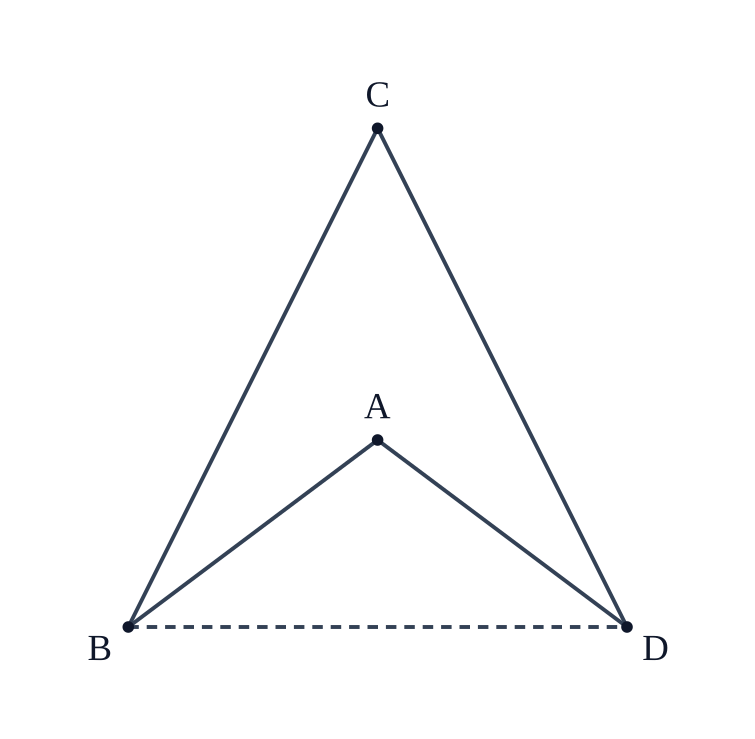 In the figure A is inside \(\displaystyle \triangle BCD\), so the internal angle at A is reflex. The four internal angles still total a full turn.\[\angle A + \angle B + \angle C + \angle D = 360^\circ \]Answer: The internal angle at A is \(\displaystyle \angle BAD\), except when A lies inside \(\displaystyle \triangle BCD\) (C the opposite vertex); then it is \(\displaystyle 360^\circ - \angle BAD\).
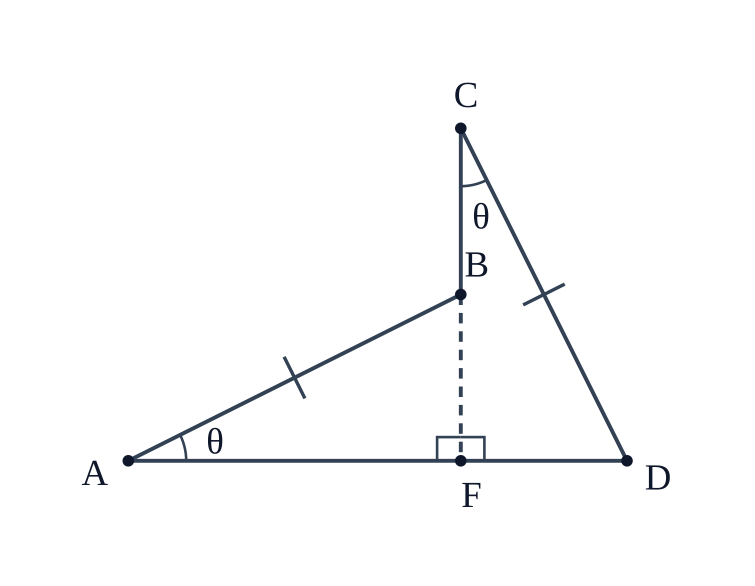 \[A(0,0),\ B(2,1),\ C(2,2),\ D(3,0),\ F(2,0) \]\[\tfrac16(0,0) + \tfrac12(2,2) + \tfrac13(3,0) = (2,1) = B \]\[AF = CF = 2, \quad FB = FD = 1 \]\[\angle AFB = \angle CFD = 90^\circ \]\[\triangle AFB \cong \triangle CFD \quad \text{(SAS)} \]\[AB = CD, \quad \angle BAF = \angle DCF \quad \text{(c.p.c.t.)} \]\[\angle BAF = \angle A \quad (F \text{ on } AD) \]\[\angle DCF = \angle C \quad (B \text{ on } CF) \]Answer: \(\displaystyle AB \parallel DC\): no, ABCD is convex. \(\displaystyle AB = CD\): yes, it can be non-convex. \(\displaystyle \angle A = \angle C\): yes, it can be non-convex.
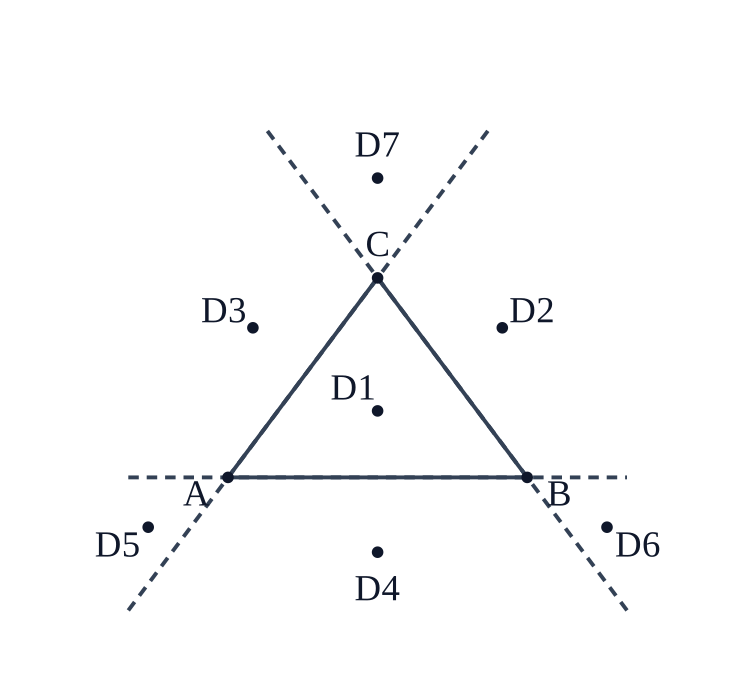 \[\begin{array}{|c|l|l|} \hline D_i & \text{region of } D & ABCD \\ \hline D_1 & \text{inside } \triangle ABC & \text{non-convex} \\ \hline D_2 & \text{across } BC & \text{self-intersecting} \\ \hline D_3 & \text{across } CA & \text{convex} \\ \hline D_4 & \text{across } AB & \text{self-intersecting} \\ \hline D_5 & \text{beyond } A & \text{non-convex} \\ \hline D_6 & \text{beyond } B & \text{non-convex} \\ \hline D_7 & \text{beyond } C & \text{non-convex} \\ \hline \end{array} \]Across BC the sides DA, BC cross; across AB the sides CD, AB cross; across CA the diagonals AC, BD cross. Inside the triangle D is a dent; beyond a vertex, that vertex is a dent.Answer: Convex only for D across CA. Self-intersecting for D across AB or across BC. Non-convex for D inside \(\displaystyle \triangle ABC\) or beyond A, B or C.
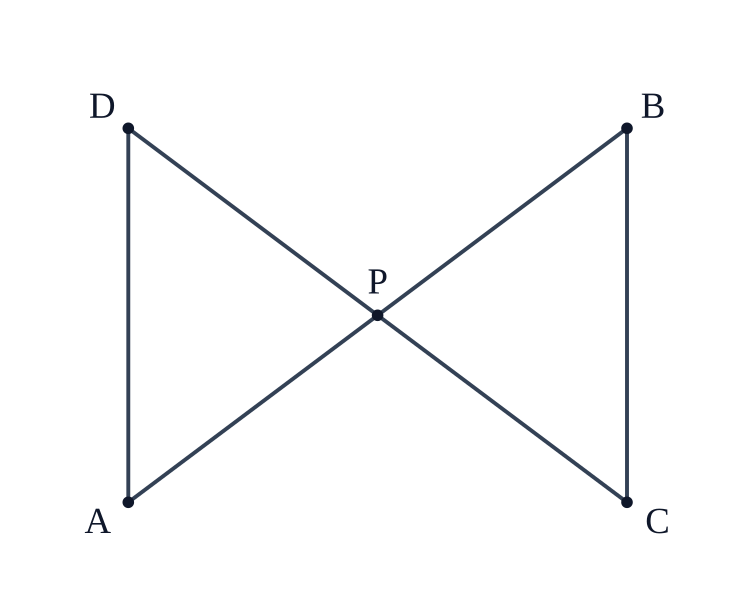 \[P \in AB \text{ and } P \in CD \quad \text{(sides cross)} \]\[AB,\ CD \text{ in one plane} \quad \text{(meet at } P) \]\[A, B, C, D \text{ coplanar} \quad \text{(on those lines)} \]The same argument works for BC and DA.Answer: No; a self-intersecting quadrilateral is always planar.