Exercise 1
True or false?
(i)
A parallelogram with a right angle is a rectangle.
(ii)
A rhombus with perpendicular diagonals is a square.
(iii)
If the diagonals of a parallelogram are equal, then it is a rectangle.
Not cross-checked
This solution has not been cross-checked against the answer printed in NCERT.
(i) True. Let \(\displaystyle \angle A = 90^\circ\) in parallelogram \(\displaystyle ABCD\).
\[\angle A + \angle B = 180^\circ \quad (AD \parallel BC) \]
\[\angle B = 90^\circ \]
\[\angle C = \angle A = 90^\circ, \quad \angle D = \angle B = 90^\circ \quad \text{(opposite angles)} \]
All four angles are right angles, so \(\displaystyle ABCD\) is a rectangle.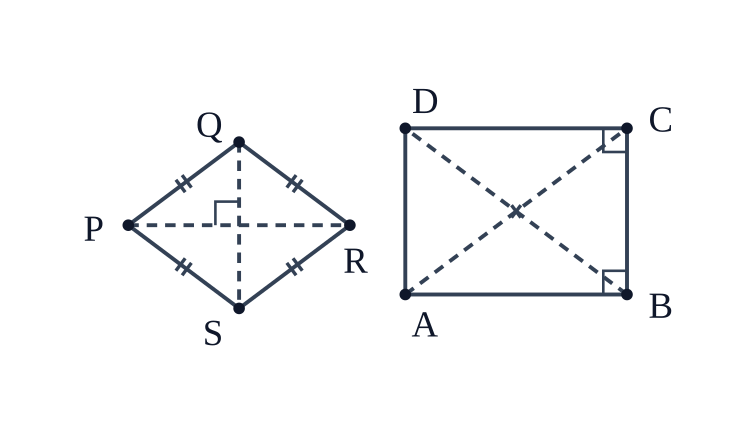 (ii) False. Every rhombus already has perpendicular diagonals. Counterexample: rhombus \(\displaystyle PQRS\) with diagonals \(\displaystyle PR = 8\), \(\displaystyle QS = 6\) (figure, left); the half-diagonals are $\displaystyle 4$ and 3.
\[PQ = \sqrt{4^2 + 3^2} = 5 = QR = RS = SP \]
\[QS^2 = 36 \neq 50 = PQ^2 + PS^2 \;\Rightarrow\; \angle P \neq 90^\circ \]
So it is not a square.(iii) True. Let \(\displaystyle ABCD\) be a parallelogram with \(\displaystyle AC = BD\) (figure, right). Compare \(\displaystyle \triangle ABC\) and \(\displaystyle \triangle DCB\).
\[AB = DC \quad \text{(opposite sides)} \]
\[BC = CB \quad \text{(common)} \]
\[AC = DB \quad \text{(given)} \]
\[\triangle ABC \cong \triangle DCB \quad \text{(SSS)} \;\Rightarrow\; \angle ABC = \angle DCB \]
\[\angle ABC + \angle DCB = 180^\circ \quad (AB \parallel DC) \]
\[\angle ABC = \angle DCB = 90^\circ \]
A parallelogram with a right angle is a rectangle, by (i).Answer: (i) True; (ii) False; (iii) True.
(ii) False. Every rhombus already has perpendicular diagonals. Counterexample: rhombus \(\displaystyle PQRS\) with diagonals \(\displaystyle PR = 8\), \(\displaystyle QS = 6\) (figure, left); the half-diagonals are $\displaystyle 4$ and 3.
\[PQ = \sqrt{4^2 + 3^2} = 5 = QR = RS = SP \]
\[QS^2 = 36 \neq 50 = PQ^2 + PS^2 \;\Rightarrow\; \angle P \neq 90^\circ \]
So it is not a square.(iii) True. Let \(\displaystyle ABCD\) be a parallelogram with \(\displaystyle AC = BD\) (figure, right). Compare \(\displaystyle \triangle ABC\) and \(\displaystyle \triangle DCB\).
\[AB = DC \quad \text{(opposite sides)} \]
\[BC = CB \quad \text{(common)} \]
\[AC = DB \quad \text{(given)} \]
\[\triangle ABC \cong \triangle DCB \quad \text{(SSS)} \;\Rightarrow\; \angle ABC = \angle DCB \]
\[\angle ABC + \angle DCB = 180^\circ \quad (AB \parallel DC) \]
\[\angle ABC = \angle DCB = 90^\circ \]
A parallelogram with a right angle is a rectangle, by (i).Answer: (i) True; (ii) False; (iii) True.
(ii) False. Every rhombus already has perpendicular diagonals. Counterexample: rhombus \(\displaystyle PQRS\) with diagonals \(\displaystyle PR = 8\), \(\displaystyle QS = 6\) (figure, left); the half-diagonals are $\displaystyle 4$ and 3.
\[PQ = \sqrt{4^2 + 3^2} = 5 = QR = RS = SP \]
\[QS^2 = 36 \neq 50 = PQ^2 + PS^2 \;\Rightarrow\; \angle P \neq 90^\circ \]
So it is not a square.(iii) True. Let \(\displaystyle ABCD\) be a parallelogram with \(\displaystyle AC = BD\) (figure, right). Compare \(\displaystyle \triangle ABC\) and \(\displaystyle \triangle DCB\).
\[AB = DC \quad \text{(opposite sides)} \]
\[BC = CB \quad \text{(common)} \]
\[AC = DB \quad \text{(given)} \]
\[\triangle ABC \cong \triangle DCB \quad \text{(SSS)} \;\Rightarrow\; \angle ABC = \angle DCB \]
\[\angle ABC + \angle DCB = 180^\circ \quad (AB \parallel DC) \]
\[\angle ABC = \angle DCB = 90^\circ \]
A parallelogram with a right angle is a rectangle, by (i).Answer: (i) True; (ii) False; (iii) True.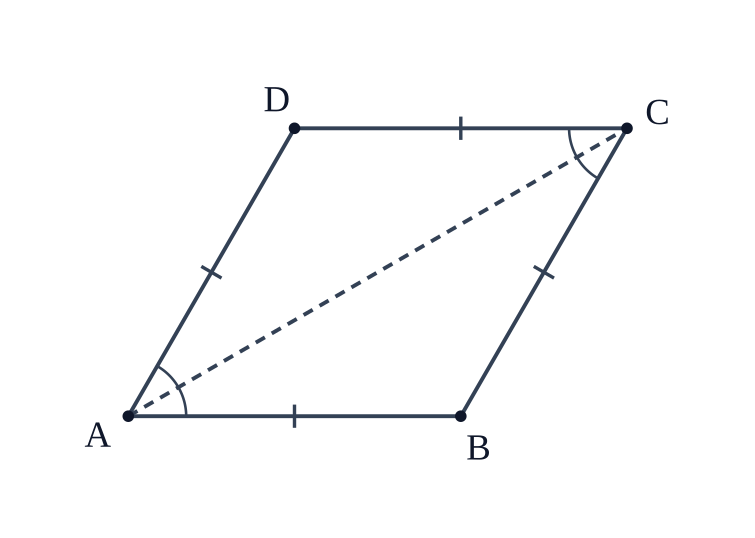 \[\angle BAC = \angle DAC \quad \text{(given)} \]
\[AB \parallel DC \;\Rightarrow\; \angle DCA = \angle BAC \quad \text{(alternate angles)} \]
\[AD \parallel BC \;\Rightarrow\; \angle BCA = \angle DAC \quad \text{(alternate angles)} \]
\[\angle DCA = \angle BAC = \angle DAC = \angle BCA \]
So \(\displaystyle AC\) bisects \(\displaystyle \angle C\).In \(\displaystyle \triangle ABC\):
\[\angle BAC = \angle BCA \;\Rightarrow\; AB = BC \quad \text{(sides opposite equal angles)} \]
\[AB = CD, \quad BC = AD \quad \text{(opposite sides of a parallelogram)} \]
\[AB = BC = CD = DA \]
All four sides are equal, so \(\displaystyle ABCD\) is a rhombus.Answer: \(\displaystyle AC\) bisects \(\displaystyle \angle C\), and \(\displaystyle AB = BC = CD = DA\), so \(\displaystyle ABCD\) is a rhombus.
\[\angle BAC = \angle DAC \quad \text{(given)} \]
\[AB \parallel DC \;\Rightarrow\; \angle DCA = \angle BAC \quad \text{(alternate angles)} \]
\[AD \parallel BC \;\Rightarrow\; \angle BCA = \angle DAC \quad \text{(alternate angles)} \]
\[\angle DCA = \angle BAC = \angle DAC = \angle BCA \]
So \(\displaystyle AC\) bisects \(\displaystyle \angle C\).In \(\displaystyle \triangle ABC\):
\[\angle BAC = \angle BCA \;\Rightarrow\; AB = BC \quad \text{(sides opposite equal angles)} \]
\[AB = CD, \quad BC = AD \quad \text{(opposite sides of a parallelogram)} \]
\[AB = BC = CD = DA \]
All four sides are equal, so \(\displaystyle ABCD\) is a rhombus.Answer: \(\displaystyle AC\) bisects \(\displaystyle \angle C\), and \(\displaystyle AB = BC = CD = DA\), so \(\displaystyle ABCD\) is a rhombus.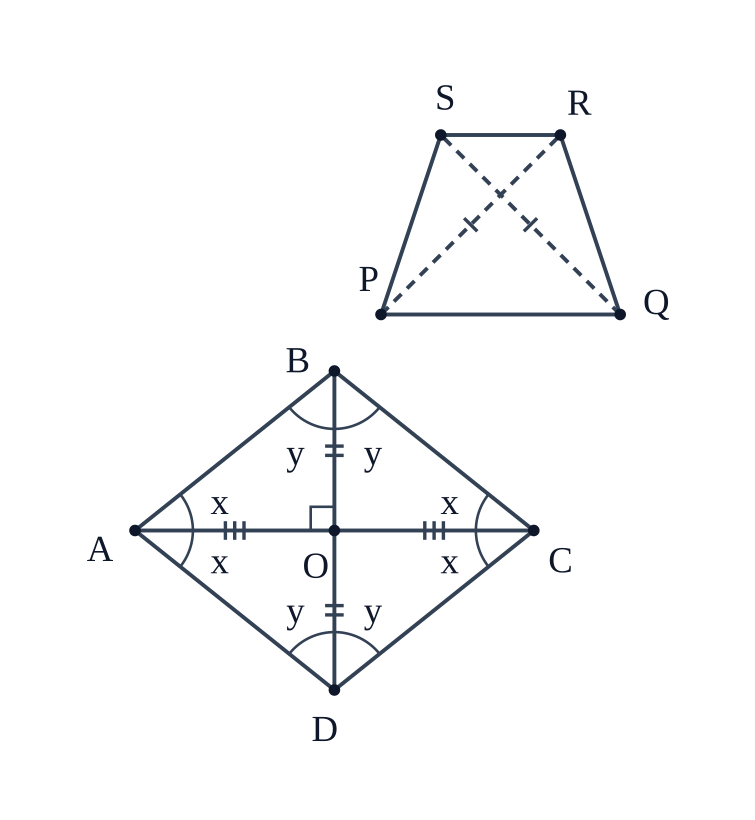 (i) Converse: if the diagonals bisect the angles, the quadrilateral is a rhombus. Yes. Use \(\displaystyle AC\), which bisects \(\displaystyle \angle A\) and \(\displaystyle \angle C\), and \(\displaystyle BD\), which bisects \(\displaystyle \angle B\) and \(\displaystyle \angle D\).
\[\angle BAC = \angle DAC, \quad AC = AC, \quad \angle BCA = \angle DCA \;\Rightarrow\; \triangle ABC \cong \triangle ADC \quad \text{(ASA)} \]
\[AB = AD, \quad CB = CD \]
\[\angle ABD = \angle CBD, \quad BD = BD, \quad \angle ADB = \angle CDB \;\Rightarrow\; \triangle BAD \cong \triangle BCD \quad \text{(ASA)} \]
\[BA = BC, \quad DA = DC \]
\[AB = BC = CD = DA \]
All four sides are equal: a rhombus.(ii) Converse: if the diagonals bisect each other at right angles, the quadrilateral is a rhombus. Yes. Let the diagonals meet at \(\displaystyle O\), so \(\displaystyle OA = OC\), \(\displaystyle OB = OD\) and every angle at \(\displaystyle O\) is \(\displaystyle 90^\circ\).
\[AB^2 = OA^2 + OB^2 \]
\[BC^2 = OB^2 + OC^2 = OB^2 + OA^2 \]
\[CD^2 = OC^2 + OD^2 = OA^2 + OB^2 \]
\[DA^2 = OD^2 + OA^2 = OB^2 + OA^2 \]
\[AB = BC = CD = DA \]
A rhombus.(iii) Converse: equal diagonals make a rectangle. No. Counterexample: isosceles trapezium \(\displaystyle PQRS\) (figure, above) with
\[P(0,0), \quad Q(4,0), \quad R(3,3), \quad S(1,3) \]
\[PR = QS = \sqrt{3^2 + 3^2} = 3\sqrt{2} \]
\[PQ = 4 \neq 2 = SR \]
Opposite sides unequal, so it is not a parallelogram, hence not a rectangle.
Extra condition: \(\displaystyle ABCD\) is a parallelogram (Q1 (iii)).Answer: (i) Yes; (ii) Yes; (iii) No, but adding that \(\displaystyle ABCD\) is a parallelogram makes it Yes.
(i) Converse: if the diagonals bisect the angles, the quadrilateral is a rhombus. Yes. Use \(\displaystyle AC\), which bisects \(\displaystyle \angle A\) and \(\displaystyle \angle C\), and \(\displaystyle BD\), which bisects \(\displaystyle \angle B\) and \(\displaystyle \angle D\).
\[\angle BAC = \angle DAC, \quad AC = AC, \quad \angle BCA = \angle DCA \;\Rightarrow\; \triangle ABC \cong \triangle ADC \quad \text{(ASA)} \]
\[AB = AD, \quad CB = CD \]
\[\angle ABD = \angle CBD, \quad BD = BD, \quad \angle ADB = \angle CDB \;\Rightarrow\; \triangle BAD \cong \triangle BCD \quad \text{(ASA)} \]
\[BA = BC, \quad DA = DC \]
\[AB = BC = CD = DA \]
All four sides are equal: a rhombus.(ii) Converse: if the diagonals bisect each other at right angles, the quadrilateral is a rhombus. Yes. Let the diagonals meet at \(\displaystyle O\), so \(\displaystyle OA = OC\), \(\displaystyle OB = OD\) and every angle at \(\displaystyle O\) is \(\displaystyle 90^\circ\).
\[AB^2 = OA^2 + OB^2 \]
\[BC^2 = OB^2 + OC^2 = OB^2 + OA^2 \]
\[CD^2 = OC^2 + OD^2 = OA^2 + OB^2 \]
\[DA^2 = OD^2 + OA^2 = OB^2 + OA^2 \]
\[AB = BC = CD = DA \]
A rhombus.(iii) Converse: equal diagonals make a rectangle. No. Counterexample: isosceles trapezium \(\displaystyle PQRS\) (figure, above) with
\[P(0,0), \quad Q(4,0), \quad R(3,3), \quad S(1,3) \]
\[PR = QS = \sqrt{3^2 + 3^2} = 3\sqrt{2} \]
\[PQ = 4 \neq 2 = SR \]
Opposite sides unequal, so it is not a parallelogram, hence not a rectangle.
Extra condition: \(\displaystyle ABCD\) is a parallelogram (Q1 (iii)).Answer: (i) Yes; (ii) Yes; (iii) No, but adding that \(\displaystyle ABCD\) is a parallelogram makes it Yes. Let ABCD be a parallelogram with