Exercise 11
 Suppose P is a point on side AB of and the line through P parallel to BC meets AC in point Q. For parts (i) to (iii), assume , and see Fig. 12.39. (i) If find QC . (Hint: See the dotted line) (ii) If find QC . (Hint: See the dotted lines) (iii) If find QC . (Hint: Divide both PB and AP suitably.) *(iv) Show that if is a rational number, then . In Grade , you will prove this equality without assuming is rational. That will require a new idea.
Not cross-checked
This solution has not been cross-checked against the answer printed in NCERT.
(i) Cut \(\displaystyle PB\) into two parts of length $\displaystyle 1$, so \(\displaystyle AB\) has $\displaystyle 3$ equal parts. Parallels to \(\displaystyle BC\) through the cut points cut \(\displaystyle AC\) into $\displaystyle 3$ equal parts, each equal to \(\displaystyle AQ\).\[\text{equal parts on } AB \;\Rightarrow\; \text{equal parts on } AC \quad \text{(Theorem 7, Exercise 7)} \]\[QC = 2\,AQ = 2\sqrt5 \](ii) Cut \(\displaystyle AP\) into $\displaystyle 3$ parts of length \(\displaystyle \tfrac13\): \(\displaystyle AB = \tfrac43\) has $\displaystyle 4$ equal parts, so \(\displaystyle AC\) has $\displaystyle 4$, and \(\displaystyle AQ\) is $\displaystyle 3$ of them.\[3u = \sqrt5 \;\Rightarrow\; u = \frac{\sqrt5}{3}, \qquad QC = u = \frac{\sqrt5}{3} \](iii) Use parts of length \(\displaystyle \tfrac13\): \(\displaystyle AP\) is $\displaystyle 3$ parts and \(\displaystyle PB\) is $\displaystyle 2$, so \(\displaystyle AC\) has $\displaystyle 5$ equal parts and \(\displaystyle AQ\) is $\displaystyle 3$ of them.\[3u = \sqrt5, \qquad QC = 2u = \frac{2\sqrt5}{3} \]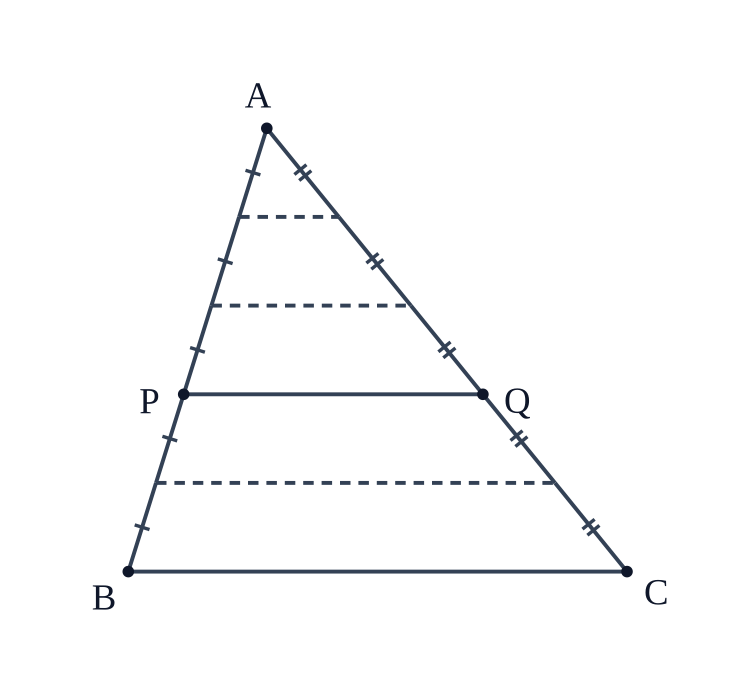 (iv) Let \(\displaystyle \frac{AP}{PB} = \frac mn\). Cut \(\displaystyle AP\) into \(\displaystyle m\) and \(\displaystyle PB\) into \(\displaystyle n\) equal parts of one common length. Parallels through the \(\displaystyle m + n\) cut points cut \(\displaystyle AC\) into \(\displaystyle m + n\) equal parts \(\displaystyle v\); \(\displaystyle Q\) is the \(\displaystyle m\)th cut.\[AQ = mv, \quad QC = nv \;\Rightarrow\; \frac{AQ}{QC} = \frac mn = \frac{AP}{PB} \]Answer: (i) \(\displaystyle 2\sqrt5\); (ii) \(\displaystyle \dfrac{\sqrt5}{3}\); (iii) \(\displaystyle \dfrac{2\sqrt5}{3}\); (iv) \(\displaystyle \dfrac{AP}{PB} = \dfrac{AQ}{QC}\).
(iv) Let \(\displaystyle \frac{AP}{PB} = \frac mn\). Cut \(\displaystyle AP\) into \(\displaystyle m\) and \(\displaystyle PB\) into \(\displaystyle n\) equal parts of one common length. Parallels through the \(\displaystyle m + n\) cut points cut \(\displaystyle AC\) into \(\displaystyle m + n\) equal parts \(\displaystyle v\); \(\displaystyle Q\) is the \(\displaystyle m\)th cut.\[AQ = mv, \quad QC = nv \;\Rightarrow\; \frac{AQ}{QC} = \frac mn = \frac{AP}{PB} \]Answer: (i) \(\displaystyle 2\sqrt5\); (ii) \(\displaystyle \dfrac{\sqrt5}{3}\); (iii) \(\displaystyle \dfrac{2\sqrt5}{3}\); (iv) \(\displaystyle \dfrac{AP}{PB} = \dfrac{AQ}{QC}\).
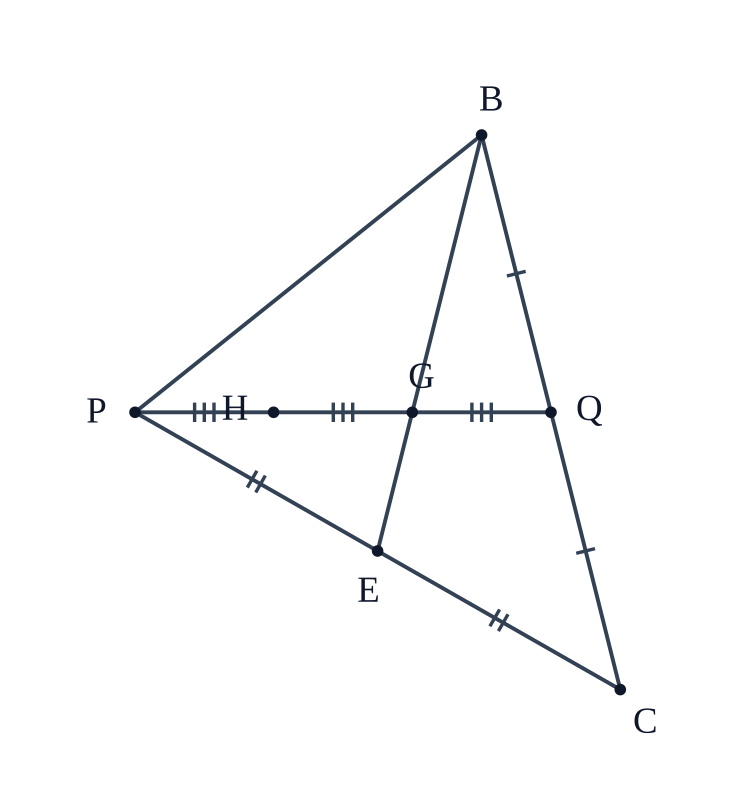 Answer: (i) \(\displaystyle AX = XY = YC\). (ii) Parallelogram \(\displaystyle PBQD\) with (i); equal steps on a ray with parallels; centroid \(\displaystyle G\) and midpoint \(\displaystyle H\) of \(\displaystyle PG\).
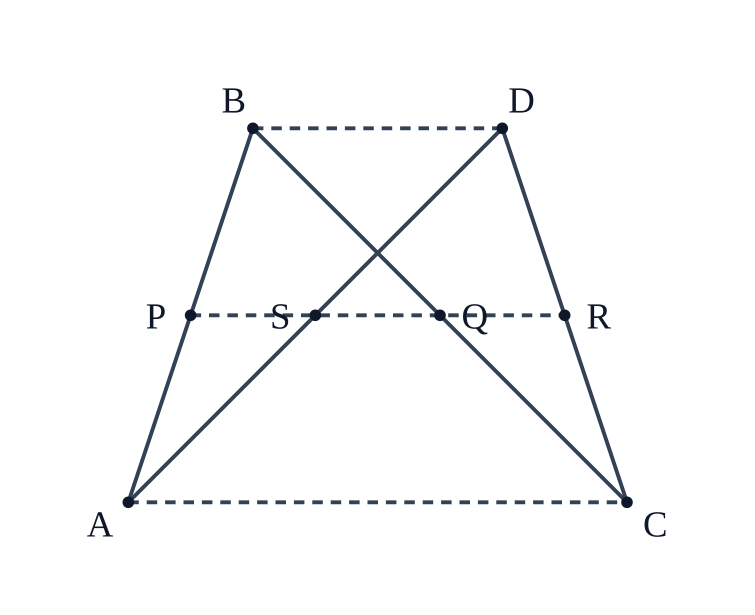 With \(\displaystyle A, C\) on one line and \(\displaystyle B, D\) on a parallel line, two opposite sides always cross: \(\displaystyle ABCD\) is self-intersecting.(iii) Yes. Each triangle is planar even if \(\displaystyle ABCD\) is not, so \(\displaystyle PQ \parallel AC \parallel SR\) and \(\displaystyle QR \parallel BD \parallel PS\) still hold. Lines parallel to a third are parallel in space, and parallel lines are coplanar: \(\displaystyle PQRS\) is a planar parallelogram.Answer: (i) Only the Midpoint Theorem in four triangles is used, never convexity. (ii) When \(\displaystyle AC \parallel BD\). (iii) Yes.
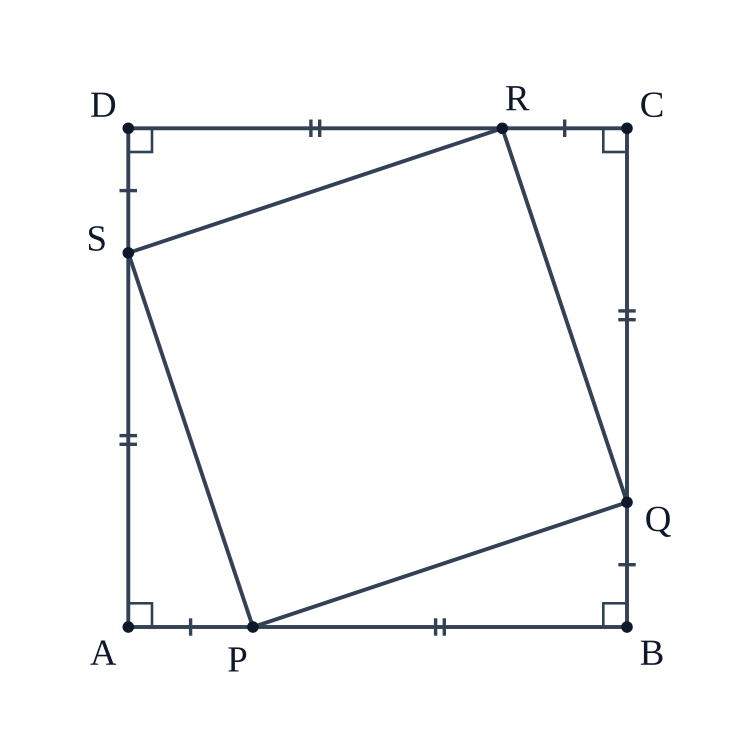 \[\triangle APS \cong \triangle BQP \cong \triangle CRQ \cong \triangle DSR \quad \text{(SAS, right angles)} \]\[PQ = QR = RS = SP \;\Rightarrow\; PQRS \text{ is a rhombus, hence a parallelogram} \]Yet \(\displaystyle AP = 1 \neq PB = 3\), so \(\displaystyle P\) is not a midpoint. The same happens for any \(\displaystyle AP = BQ = CR = DS \neq 2\).Answer: No. In a square, points \(\displaystyle \tfrac14\) of the way along each side from \(\displaystyle A, B, C, D\) form a parallelogram (a square) but are not midpoints.
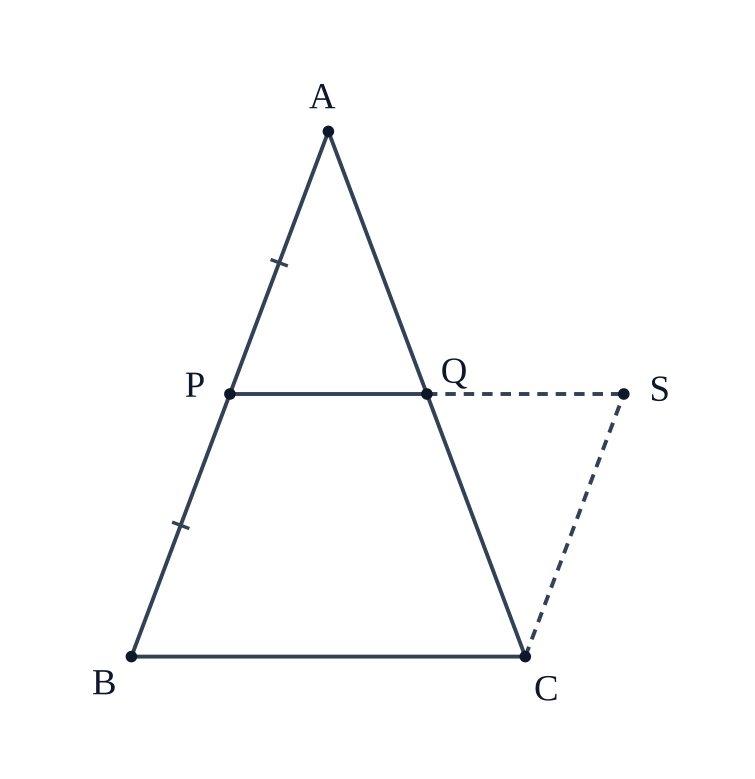 \[PS \parallel BC, \quad PS = BC \;\Rightarrow\; PBCS \text{ is a parallelogram} \quad \text{(Theorem 5)} \]\[CS \parallel BP, \quad CS = BP = AP \]\[\angle APQ = \angle CSQ \ \text{(alternate, } AB \parallel CS\text{)}, \quad \angle AQP = \angle CQS \ \text{(vertically opposite)}, \quad AP = CS \]\[\triangle APQ \cong \triangle CSQ \quad \text{(AAS)} \;\Rightarrow\; AQ = QC, \quad PQ = QS = \tfrac12 BC \]Answer: (i) Extend \(\displaystyle PQ\) by \(\displaystyle QS = PQ\). (ii) Extend \(\displaystyle PQ\) to \(\displaystyle S\) with \(\displaystyle PS = BC\); then \(\displaystyle AQ = QC\).

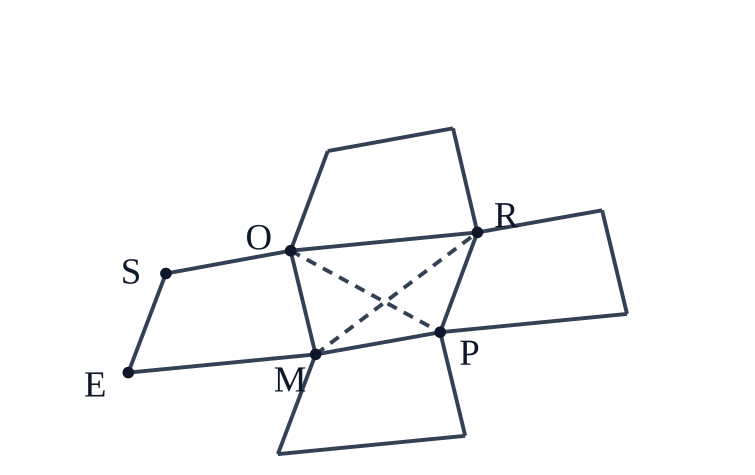 \[\rho(X)=O+M-X:\qquad \rho(S)=P,\quad \rho(E)=R,\quad \rho(O)=M,\quad \rho(M)=O \]So the gap is \(\displaystyle SOME \) turned through \(\displaystyle 180^\circ \) about the midpoint of \(\displaystyle OM \): congruent to \(\displaystyle SOME \).\[\text{around }O:\quad \underbrace{\angle O}_{Q}+\underbrace{\angle E}_{Q+\vec u}+\underbrace{\angle M}_{\text{gap }OMPR}+\underbrace{\angle S}_{\text{other gap}}=360^\circ \]so nothing overlaps.Answer: (i) the slide by \(\displaystyle \overrightarrow{EO} \) carries \(\displaystyle SOME \) onto \(\displaystyle S'O'M'E' \); (ii) the gaps are \(\displaystyle SOME \) turned through \(\displaystyle 180^\circ \).
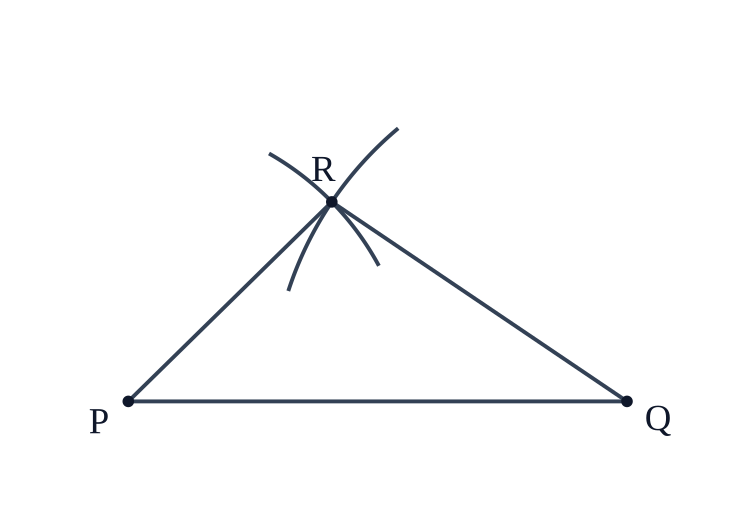 \[a\le b\le c:\quad a+b>c\ \Rightarrow\ a+c>b,\ \ b+c>a \]\[(4,5,7):\ 4+5=9>7\ \text{(triangle)};\qquad (2,3,5):\ 2+3=5\ \text{(arcs only touch: no triangle)} \](ii) By the rule in (iii), the longest side must be less than the sum of the other three.\[x=100:\ 100<2+5+11=18\ \text{false: no} \]\[x=10:\ 11<2+5+10=17\ \text{true: yes} \]\[x=1:\ 11<2+5+1=8\ \text{false: no} \]\[x\le11:\ 11<7+x\Rightarrow x>4;\qquad x>11:\ x<18\qquad\Rightarrow\qquad 4<x<18 \](iii) Necessary: a straight segment is the shortest path. Sufficient: take a diagonal \(\displaystyle x \) in the range below; triangles \(\displaystyle (a,b,x) \) and \(\displaystyle (c,d,x) \) exist by (i); glue them on opposite sides of \(\displaystyle x \).\[d=AD<AB+BC+CD=a+b+c\qquad(d\text{ longest; strict, as no three vertices are collinear}) \]\[\max(|a-b|,\ d-c)<x<\min(a+b,\ c+d)\ \text{ is non-empty: } d-c<a+b,\ \ |a-b|<d<c+d \]\[\max(a,b,c,d)<\tfrac12(a+b+c+d) \]Answer: (i) a triangle exists iff \(\displaystyle a+b>c \); (ii) $\displaystyle 100$: no, $\displaystyle 10$: yes, $\displaystyle 1$: no, and \(\displaystyle 4<x<18 \); (iii) the longest side must be less than the sum of the other three.
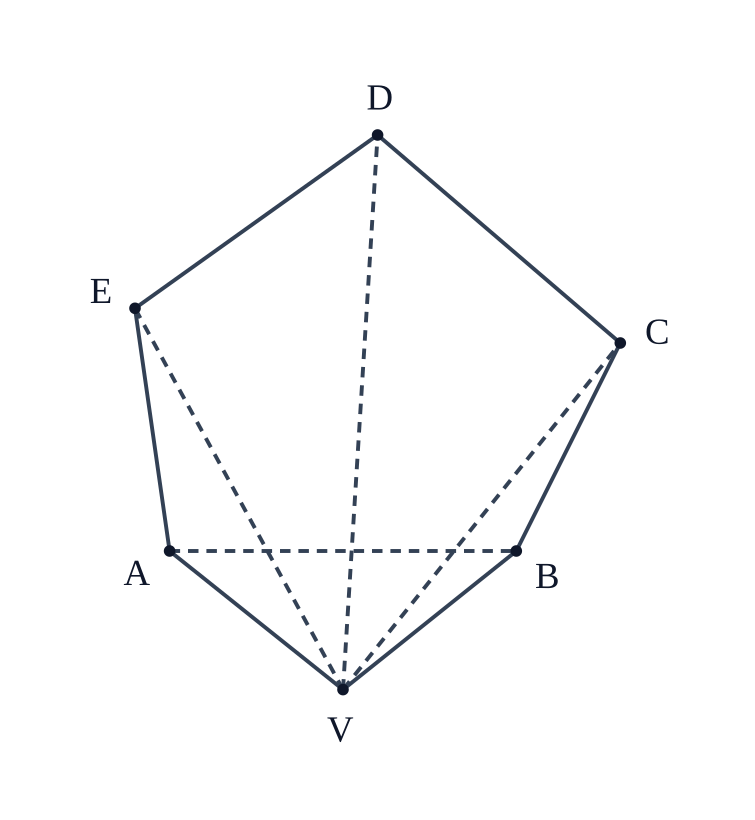 \[D(n+1)=D(n)+(n-1) \]\[\frac{n(n-3)}{2}+(n-1)=\frac{n^2-n-2}{2}=\frac{(n+1)(n-2)}{2}=\frac{(n+1)\big((n+1)-3\big)}{2} \]With \(\displaystyle D(3)=0 \), the formula holds for every \(\displaystyle n \).Answer: \(\displaystyle D(5)=5,\ D(6)=9,\ D(7)=14,\ D(8)=20 \); \(\displaystyle D(n)=\dfrac{n(n-3)}{2} \), and \(\displaystyle n-1 \) diagonals are added going from \(\displaystyle n \) to \(\displaystyle n+1 \) sides.