Exercise 1
Using a fact about parallelograms, show how to tile the plane using any given triangle. (Hint: Can you use the parallelogram tiling in the introduction?)
Not cross-checked
This solution has not been cross-checked against the answer printed in NCERT.
Half-turn a copy of \(\displaystyle \triangle ABC\) about the midpoint \(\displaystyle M\) of \(\displaystyle BC\): \(\displaystyle A\to D\), \(\displaystyle B\to C\), \(\displaystyle C\to B\).\[MB = MC, \quad MA = MD \]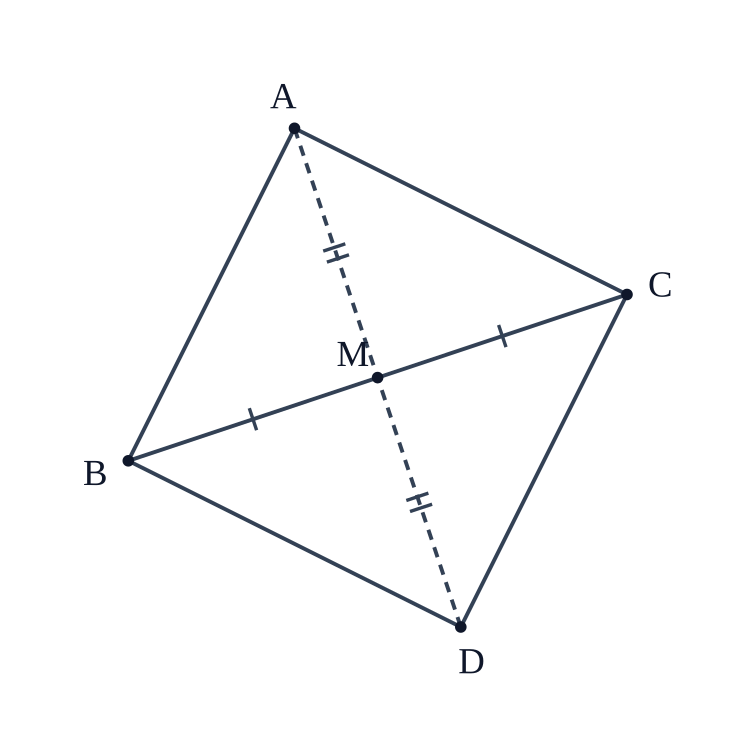 The diagonals \(\displaystyle BC\) and \(\displaystyle AD\) of \(\displaystyle ABDC\) bisect each other, so \(\displaystyle ABDC\) is a parallelogram (Theorem $\displaystyle 4$). Its opposite sides are equal:\[AB = DC, \quad AC = DB, \quad BC = CB \]
\[\triangle ABC \cong \triangle DCB \quad \text{(SSS)} \]Copies of one parallelogram tile the plane (Fig. 12.1B). Cut each copy along its diagonal \(\displaystyle BC\): every parallelogram gives two triangles congruent to \(\displaystyle \triangle ABC\).Answer: Two copies of the triangle make the parallelogram \(\displaystyle ABDC\), and parallelograms tile the plane, so the triangle tiles it too.
The diagonals \(\displaystyle BC\) and \(\displaystyle AD\) of \(\displaystyle ABDC\) bisect each other, so \(\displaystyle ABDC\) is a parallelogram (Theorem $\displaystyle 4$). Its opposite sides are equal:\[AB = DC, \quad AC = DB, \quad BC = CB \]
\[\triangle ABC \cong \triangle DCB \quad \text{(SSS)} \]Copies of one parallelogram tile the plane (Fig. 12.1B). Cut each copy along its diagonal \(\displaystyle BC\): every parallelogram gives two triangles congruent to \(\displaystyle \triangle ABC\).Answer: Two copies of the triangle make the parallelogram \(\displaystyle ABDC\), and parallelograms tile the plane, so the triangle tiles it too.
The diagonals \(\displaystyle BC\) and \(\displaystyle AD\) of \(\displaystyle ABDC\) bisect each other, so \(\displaystyle ABDC\) is a parallelogram (Theorem $\displaystyle 4$). Its opposite sides are equal:\[AB = DC, \quad AC = DB, \quad BC = CB \]
\[\triangle ABC \cong \triangle DCB \quad \text{(SSS)} \]Copies of one parallelogram tile the plane (Fig. 12.1B). Cut each copy along its diagonal \(\displaystyle BC\): every parallelogram gives two triangles congruent to \(\displaystyle \triangle ABC\).Answer: Two copies of the triangle make the parallelogram \(\displaystyle ABDC\), and parallelograms tile the plane, so the triangle tiles it too. Mark the midpoint of the line drawn on the paper (see Fig.
 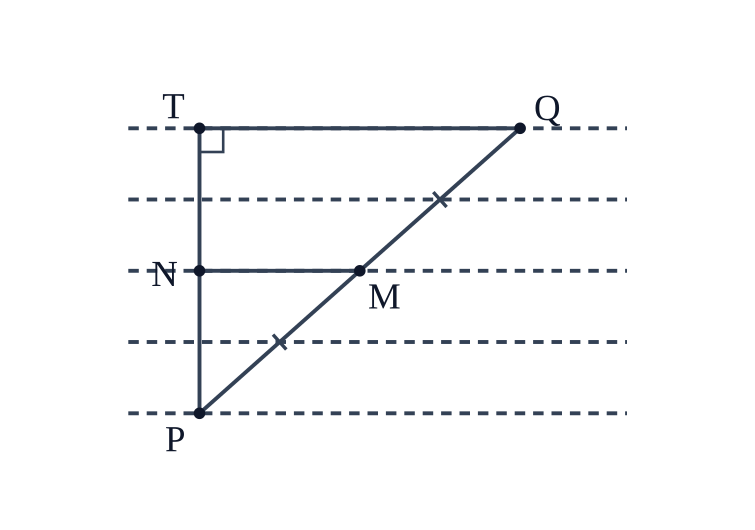 \[PT = 4 \text{ spaces}, \quad PN = 2 \text{ spaces} \;\Rightarrow\; PN = NT \]
\[NM \parallel TQ \quad \text{(both lie along ruled lines)} \]
\[N \text{ midpoint of } PT,\ NM \parallel TQ \;\Rightarrow\; M \text{ midpoint of } PQ \quad \text{(Theorem 7, } \triangle PTQ) \]Answer: The midpoint of the line is where it crosses the 4th ruled line from the top.
\[PT = 4 \text{ spaces}, \quad PN = 2 \text{ spaces} \;\Rightarrow\; PN = NT \]
\[NM \parallel TQ \quad \text{(both lie along ruled lines)} \]
\[N \text{ midpoint of } PT,\ NM \parallel TQ \;\Rightarrow\; M \text{ midpoint of } PQ \quad \text{(Theorem 7, } \triangle PTQ) \]Answer: The midpoint of the line is where it crosses the 4th ruled line from the top.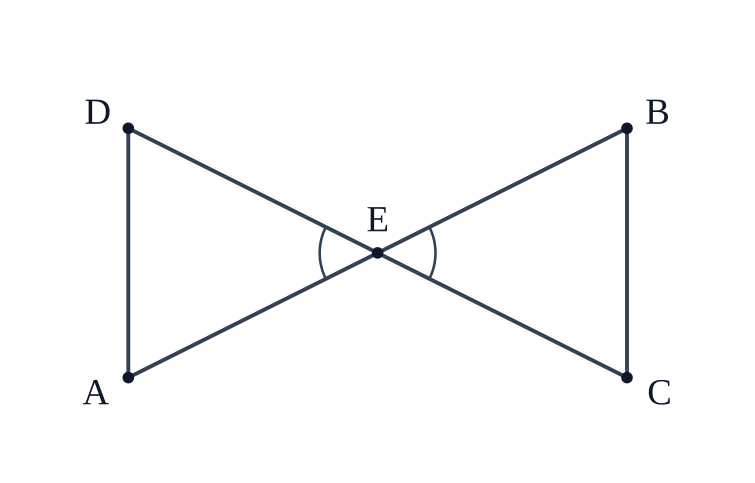 \[\angle A + \angle D = 180^\circ - \angle AED \quad \text{(angle sum, } \triangle EAD) \]
\[\angle B + \angle C = 180^\circ - \angle BEC \quad \text{(angle sum, } \triangle EBC) \]
\[\angle AED = \angle BEC \quad \text{(vertically opposite angles)} \]
\[\angle A + \angle B + \angle C + \angle D = 360^\circ - 2\angle AED < 360^\circ \]Yes, \(\displaystyle 2^\circ\) is possible: we need \(\displaystyle \angle AED = 179^\circ\). Draw two lines crossing at \(\displaystyle E\) at this angle; put \(\displaystyle A, B\) on one and \(\displaystyle C, D\) on the other, each at distance $\displaystyle 1$ from \(\displaystyle E\), on opposite sides of \(\displaystyle E\).\[\angle A = \angle D = \tfrac12\,(180^\circ - 179^\circ) = 0.5^\circ, \quad \angle B = \angle C = 0.5^\circ \]
\[\angle A + \angle B + \angle C + \angle D = 2^\circ \]Answer: The sum is \(\displaystyle 360^\circ - 2\angle AED < 360^\circ\); it equals \(\displaystyle 2^\circ\) when \(\displaystyle \angle AED = 179^\circ\).
\[\angle A + \angle D = 180^\circ - \angle AED \quad \text{(angle sum, } \triangle EAD) \]
\[\angle B + \angle C = 180^\circ - \angle BEC \quad \text{(angle sum, } \triangle EBC) \]
\[\angle AED = \angle BEC \quad \text{(vertically opposite angles)} \]
\[\angle A + \angle B + \angle C + \angle D = 360^\circ - 2\angle AED < 360^\circ \]Yes, \(\displaystyle 2^\circ\) is possible: we need \(\displaystyle \angle AED = 179^\circ\). Draw two lines crossing at \(\displaystyle E\) at this angle; put \(\displaystyle A, B\) on one and \(\displaystyle C, D\) on the other, each at distance $\displaystyle 1$ from \(\displaystyle E\), on opposite sides of \(\displaystyle E\).\[\angle A = \angle D = \tfrac12\,(180^\circ - 179^\circ) = 0.5^\circ, \quad \angle B = \angle C = 0.5^\circ \]
\[\angle A + \angle B + \angle C + \angle D = 2^\circ \]Answer: The sum is \(\displaystyle 360^\circ - 2\angle AED < 360^\circ\); it equals \(\displaystyle 2^\circ\) when \(\displaystyle \angle AED = 179^\circ\). In a parallelogram ABCD, two points P and Q are taken on diagonal
 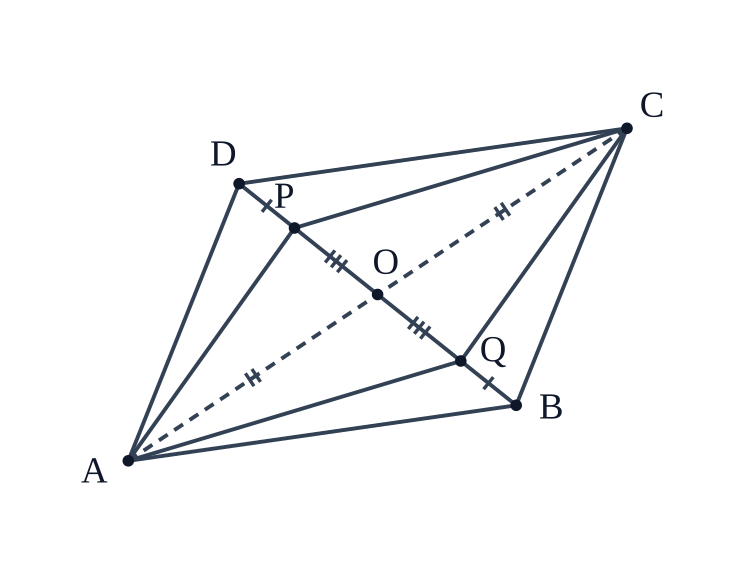 \[OA = OC, \quad OB = OD \quad \text{(diagonals of a parallelogram bisect each other)} \]
\[OP = OD - DP = OB - BQ = OQ \quad (DP = BQ) \]So the diagonals \(\displaystyle AC\) and \(\displaystyle PQ\) of \(\displaystyle APCQ\) bisect each other at \(\displaystyle O\); by Theorem $\displaystyle 4$, \(\displaystyle APCQ\) is a parallelogram.Answer: \(\displaystyle APCQ\) is a parallelogram, since its diagonals \(\displaystyle AC\) and \(\displaystyle PQ\) bisect each other at \(\displaystyle O\).
\[OA = OC, \quad OB = OD \quad \text{(diagonals of a parallelogram bisect each other)} \]
\[OP = OD - DP = OB - BQ = OQ \quad (DP = BQ) \]So the diagonals \(\displaystyle AC\) and \(\displaystyle PQ\) of \(\displaystyle APCQ\) bisect each other at \(\displaystyle O\); by Theorem $\displaystyle 4$, \(\displaystyle APCQ\) is a parallelogram.Answer: \(\displaystyle APCQ\) is a parallelogram, since its diagonals \(\displaystyle AC\) and \(\displaystyle PQ\) bisect each other at \(\displaystyle O\). A right-triangle shaped cutout of a paper is folded such that point A touches point B (Fig.
 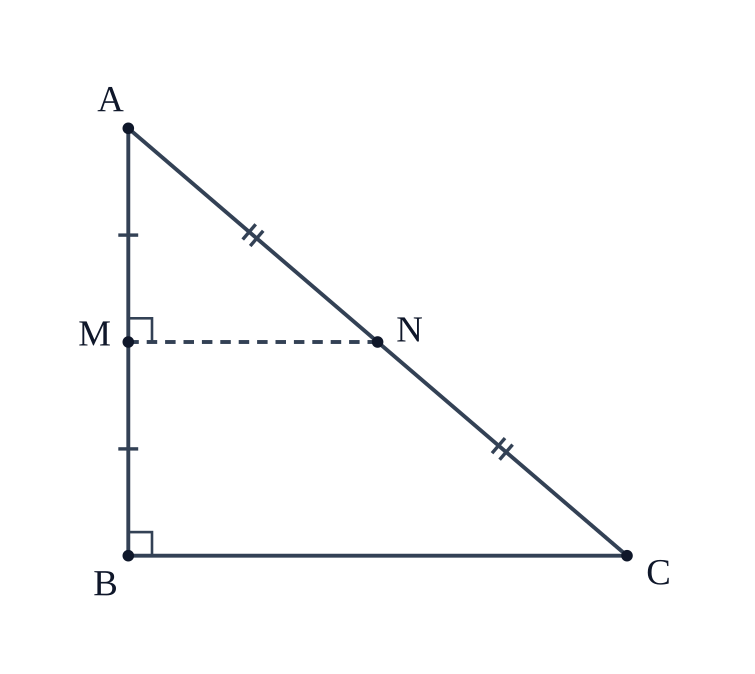 \[AM = BM, \quad \angle AMN = \angle BMN \]
\[\angle AMN + \angle BMN = 180^\circ \;\Rightarrow\; \angle AMN = 90^\circ = \angle ABC \]
\[MN \parallel BC \quad \text{(corresponding angles)} \]
\[M \text{ midpoint of } AB,\ MN \parallel BC \;\Rightarrow\; N \text{ midpoint of } AC \quad \text{(Theorem 7)} \]Answer: The crease meets \(\displaystyle AB\) at its midpoint \(\displaystyle M\) and, being parallel to \(\displaystyle BC\), meets \(\displaystyle AC\) at its midpoint \(\displaystyle N\).
\[AM = BM, \quad \angle AMN = \angle BMN \]
\[\angle AMN + \angle BMN = 180^\circ \;\Rightarrow\; \angle AMN = 90^\circ = \angle ABC \]
\[MN \parallel BC \quad \text{(corresponding angles)} \]
\[M \text{ midpoint of } AB,\ MN \parallel BC \;\Rightarrow\; N \text{ midpoint of } AC \quad \text{(Theorem 7)} \]Answer: The crease meets \(\displaystyle AB\) at its midpoint \(\displaystyle M\) and, being parallel to \(\displaystyle BC\), meets \(\displaystyle AC\) at its midpoint \(\displaystyle N\).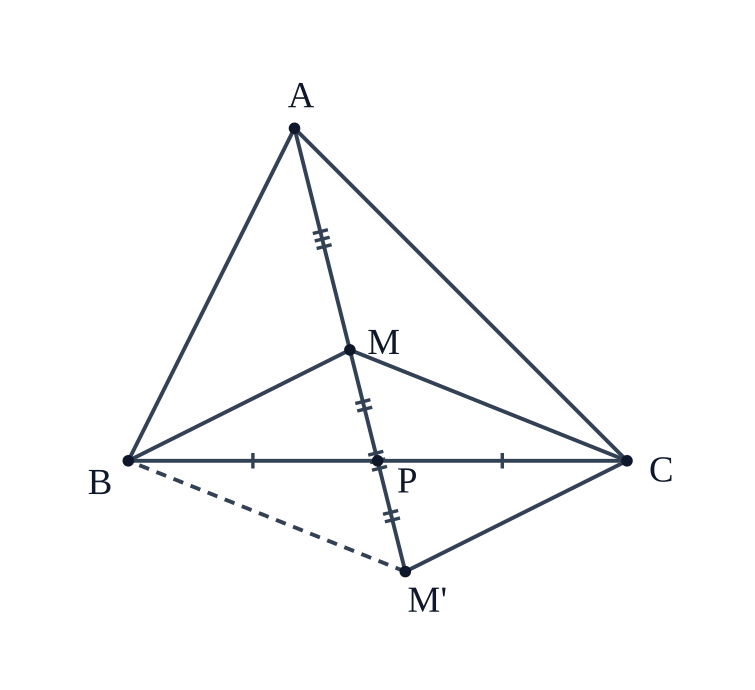 \[MM' = 2MP = AM \quad \text{(Centroid Theorem)}, \qquad M'C = MB, \qquad MC = MC \]Its sides are \(\displaystyle MA, MB, MC\), that is \(\displaystyle \tfrac23\) of \(\displaystyle AP, BQ, CR\). The pieces at \(\displaystyle Q\) and \(\displaystyle R\) give triangles with the same three sides, so all three are congruent (SSS).(ii) Apply (i) to \(\displaystyle T = \triangle MCM'\): the new triangles have sides \(\displaystyle \tfrac23\) of the medians of \(\displaystyle T\). Here \(\displaystyle P\) is the midpoint of \(\displaystyle MM'\) and of \(\displaystyle BC\), and \(\displaystyle M\) is the midpoint of \(\displaystyle AM'\).\[\text{median from } C:\quad CP = \tfrac12 BC \]
\[\text{median from } M:\quad MN = \tfrac12 AC \quad (N \text{ mid } CM';\ \text{Midpoint Theorem in } \triangle AM'C) \]
\[ML' = \tfrac12 AB \quad (L' \text{ mid } BM';\ \text{Midpoint Theorem in } \triangle ABM') \]
\[\text{median from } M':\quad M'L = ML' = \tfrac12 AB \quad (L \text{ mid } MC;\ \text{half-turn about } P) \]
\[\tfrac23 \cdot \tfrac12\,(BC,\ AC,\ AB) = \tfrac{BC}{3},\ \tfrac{AC}{3},\ \tfrac{AB}{3} \](iii) Cut along the median \(\displaystyle AP\), then along the median \(\displaystyle PE\) of \(\displaystyle \triangle APB\) (\(\displaystyle E\) the midpoint of \(\displaystyle AB\)). Turn \(\displaystyle \triangle PEB\) half a turn about \(\displaystyle E\): \(\displaystyle B\to A\), \(\displaystyle P\to P'\). Then \(\displaystyle \triangle AEP\) and \(\displaystyle \triangle AEP'\) form \(\displaystyle \triangle PAP'\).\[PA = AP, \quad AP' = PB = PC, \quad P'P = 2PE = CA \quad (PE = \tfrac12 CA,\ \text{Midpoint Theorem}) \]
\[\triangle PAP' \cong \triangle APC \quad \text{(SSS)} \]Answer: (i) sides \(\displaystyle MA, MB, MC\); (ii) \(\displaystyle \tfrac{AB}{3}, \tfrac{BC}{3}, \tfrac{AC}{3}\); (iii) \(\displaystyle \triangle APC \cong \triangle PAP'\).
\[MM' = 2MP = AM \quad \text{(Centroid Theorem)}, \qquad M'C = MB, \qquad MC = MC \]Its sides are \(\displaystyle MA, MB, MC\), that is \(\displaystyle \tfrac23\) of \(\displaystyle AP, BQ, CR\). The pieces at \(\displaystyle Q\) and \(\displaystyle R\) give triangles with the same three sides, so all three are congruent (SSS).(ii) Apply (i) to \(\displaystyle T = \triangle MCM'\): the new triangles have sides \(\displaystyle \tfrac23\) of the medians of \(\displaystyle T\). Here \(\displaystyle P\) is the midpoint of \(\displaystyle MM'\) and of \(\displaystyle BC\), and \(\displaystyle M\) is the midpoint of \(\displaystyle AM'\).\[\text{median from } C:\quad CP = \tfrac12 BC \]
\[\text{median from } M:\quad MN = \tfrac12 AC \quad (N \text{ mid } CM';\ \text{Midpoint Theorem in } \triangle AM'C) \]
\[ML' = \tfrac12 AB \quad (L' \text{ mid } BM';\ \text{Midpoint Theorem in } \triangle ABM') \]
\[\text{median from } M':\quad M'L = ML' = \tfrac12 AB \quad (L \text{ mid } MC;\ \text{half-turn about } P) \]
\[\tfrac23 \cdot \tfrac12\,(BC,\ AC,\ AB) = \tfrac{BC}{3},\ \tfrac{AC}{3},\ \tfrac{AB}{3} \](iii) Cut along the median \(\displaystyle AP\), then along the median \(\displaystyle PE\) of \(\displaystyle \triangle APB\) (\(\displaystyle E\) the midpoint of \(\displaystyle AB\)). Turn \(\displaystyle \triangle PEB\) half a turn about \(\displaystyle E\): \(\displaystyle B\to A\), \(\displaystyle P\to P'\). Then \(\displaystyle \triangle AEP\) and \(\displaystyle \triangle AEP'\) form \(\displaystyle \triangle PAP'\).\[PA = AP, \quad AP' = PB = PC, \quad P'P = 2PE = CA \quad (PE = \tfrac12 CA,\ \text{Midpoint Theorem}) \]
\[\triangle PAP' \cong \triangle APC \quad \text{(SSS)} \]Answer: (i) sides \(\displaystyle MA, MB, MC\); (ii) \(\displaystyle \tfrac{AB}{3}, \tfrac{BC}{3}, \tfrac{AC}{3}\); (iii) \(\displaystyle \triangle APC \cong \triangle PAP'\).
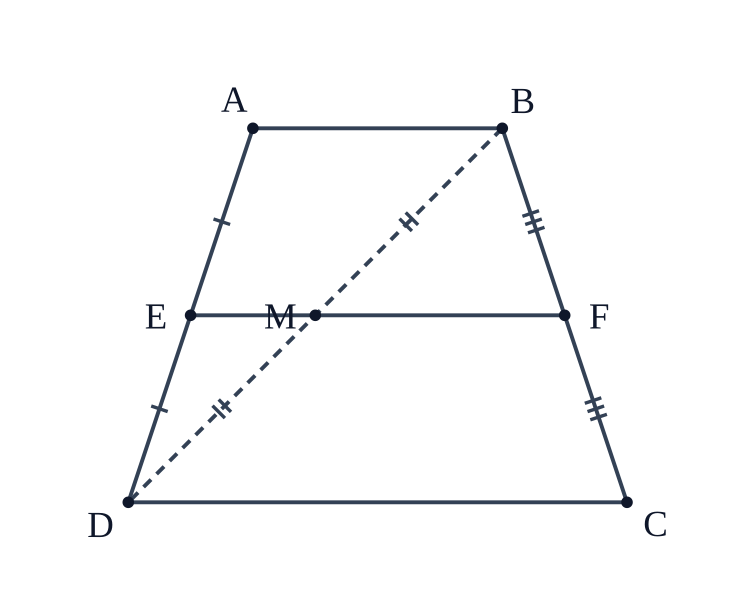 \[\triangle BDC:\ M \text{ midpoint of } BD,\ MF \parallel DC \;\Rightarrow\; F \text{ midpoint of } BC, \quad MF = \tfrac12 DC \quad \text{(Theorem 7)} \]
\[EF = EM + MF = \tfrac12 AB + \tfrac12 CD = \tfrac{AB + CD}{2} \](ii) Direct way: \(\displaystyle M\) is the midpoint of \(\displaystyle BD\), \(\displaystyle F\) the midpoint of \(\displaystyle BC\).\[\triangle ABD:\ E, M \text{ midpoints} \;\Rightarrow\; EM \parallel AB \quad \text{(Midpoint Theorem)} \]
\[\triangle BDC:\ M, F \text{ midpoints} \;\Rightarrow\; MF \parallel DC \quad \text{(Midpoint Theorem)} \]
\[AB \parallel DC \;\Rightarrow\; EM \parallel MF \]Both lines pass through \(\displaystyle M\), so they coincide: \(\displaystyle E, M, F\) are collinear and \(\displaystyle EF \parallel AB\). Second way: the parallel to \(\displaystyle AB\) through \(\displaystyle E\) meets \(\displaystyle BC\) at its midpoint by (i), which is \(\displaystyle F\), so it is \(\displaystyle EF\). The second is simpler.Answer: (i) \(\displaystyle F\) is the midpoint of \(\displaystyle BC\), \(\displaystyle EF = \tfrac{AB + CD}{2}\); (ii) \(\displaystyle EF \parallel AB\).
\[\triangle BDC:\ M \text{ midpoint of } BD,\ MF \parallel DC \;\Rightarrow\; F \text{ midpoint of } BC, \quad MF = \tfrac12 DC \quad \text{(Theorem 7)} \]
\[EF = EM + MF = \tfrac12 AB + \tfrac12 CD = \tfrac{AB + CD}{2} \](ii) Direct way: \(\displaystyle M\) is the midpoint of \(\displaystyle BD\), \(\displaystyle F\) the midpoint of \(\displaystyle BC\).\[\triangle ABD:\ E, M \text{ midpoints} \;\Rightarrow\; EM \parallel AB \quad \text{(Midpoint Theorem)} \]
\[\triangle BDC:\ M, F \text{ midpoints} \;\Rightarrow\; MF \parallel DC \quad \text{(Midpoint Theorem)} \]
\[AB \parallel DC \;\Rightarrow\; EM \parallel MF \]Both lines pass through \(\displaystyle M\), so they coincide: \(\displaystyle E, M, F\) are collinear and \(\displaystyle EF \parallel AB\). Second way: the parallel to \(\displaystyle AB\) through \(\displaystyle E\) meets \(\displaystyle BC\) at its midpoint by (i), which is \(\displaystyle F\), so it is \(\displaystyle EF\). The second is simpler.Answer: (i) \(\displaystyle F\) is the midpoint of \(\displaystyle BC\), \(\displaystyle EF = \tfrac{AB + CD}{2}\); (ii) \(\displaystyle EF \parallel AB\). The diagonals AC and BD of a parallelogram ABCD intersect at O. A line through O meets AB and CD at points P and Q respectively. Show that O is the midpoint of PQ. (Multiple proofs are possible. Which is the simplest?)
 ABCD is a trapezium with parallel sides AD =
 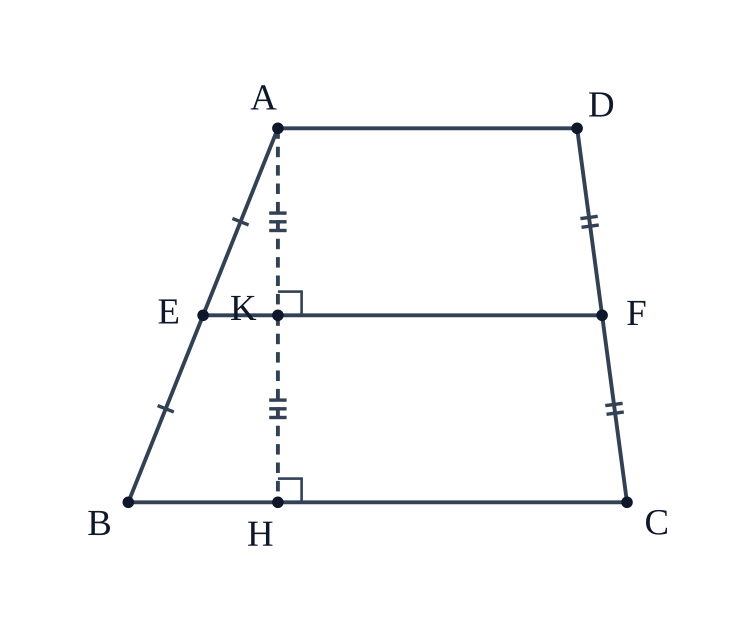 \[AK = KH = \frac{h}{2} \]\[\text{ar}(AEFD) = \frac{AD + EF}{2} \cdot AK = \frac{3 + 4}{2} \cdot \frac{h}{2} = \frac{7h}{4} \]\[\text{ar}(EBCF) = \frac{EF + BC}{2} \cdot KH = \frac{4 + 5}{2} \cdot \frac{h}{2} = \frac{9h}{4} \]\[\text{ar}(AEFD) : \text{ar}(EBCF) = 7 : 9 \]Answer: \(\displaystyle 7 : 9\)