Exercise 3.3
Why are the epithelial tissues that line an animal’s internal organs usually only one or a few cells thick? (i) To store food efficiently. (ii) To provide maximum strength. (iii) To allow quick exchange of materials across them. (iv) To reduce friction.
Check this one against your book
NCERT’s printed answer for this exercise does not match its own question. This working follows the question as printed.
To allow quick exchange of materials across them — option (iii).
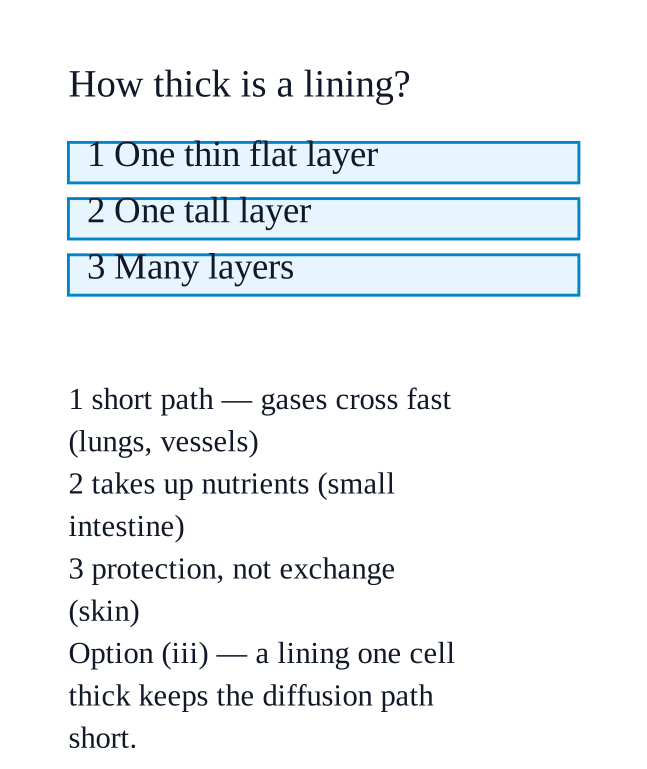
Table $\displaystyle 3.2$ pairs each epithelial structure with the function it serves, and its first row is exactly this case: function "Exchange: Helps in rapid diffusion of liquids and gases"; structure "Single layer of thin, flat cells"; location "Lining of the tissue in the blood vessels and lungs". A single thin layer keeps the diffusion path short, which is what makes the exchange rapid.
The last row of the same table makes the same pairing for the gut: function "Absorption: Efficient uptake of nutrients, water, etc."; structure "Single layer of tall, pillar-like cells"; location "Lining of small intestine". Again a single layer wherever the tissue's job is moving material across itself.
Section $\displaystyle 3.3.1$ gives the general statement: epithelial tissue "lines the internal organs, such as the mouth, lungs, blood vessels and intestine" and "helps in the absorption, secretion and movement of substances."
Why not (ii) To provide maximum strength: Table $\displaystyle 3.2$ answers that with a different row. Where the body needs protection "from mechanical injury, friction and entry of microbes", the epithelium is "Many layers of cells; the outer cells are flat and tightly packed", located in "Skin, mouth and oesophagus". In this chapter strength comes from many layers — the opposite of the one-or-few-cell thickness the question asks about.
Why not (iv) To reduce friction: friction appears in that same many-layered protection row, not in either of the thin, single-layer rows.
Why not (i) To store food efficiently: storage is not among the five functions Table $\displaystyle 3.2$ lists for epithelium — they are exchange, protection, secretion, sensory functions and absorption.
The book's printed Answer Key gives (ii) To provide maximum strength, which does not agree with Table 3.2. In that table maximum strength belongs to the "Many layers of cells" protective epithelium of skin, mouth and oesophagus, while the one-cell-thick lining of blood vessels and lungs is set against "rapid diffusion of liquids and gases". The chapter's own table therefore settles it the other way: the answer is (iii), and the key entry should be treated as an error.