Exercise 3.2
Ground tissue system: This forms the main body of a plant between the dermal and conducting tissues. It includes parenchyma, collenchyma and sclerenchyma.
Not cross-checked
NCERT prints no numerical answer for this exercise, so this working has not been cross-checked against the book.
A thick cuticle helps a desert plant because the waxy layer of cutin is water-proof and cuts down water loss; it harms an underwater plant because that same layer seals off the exchange of gases, water and minerals across its surface.
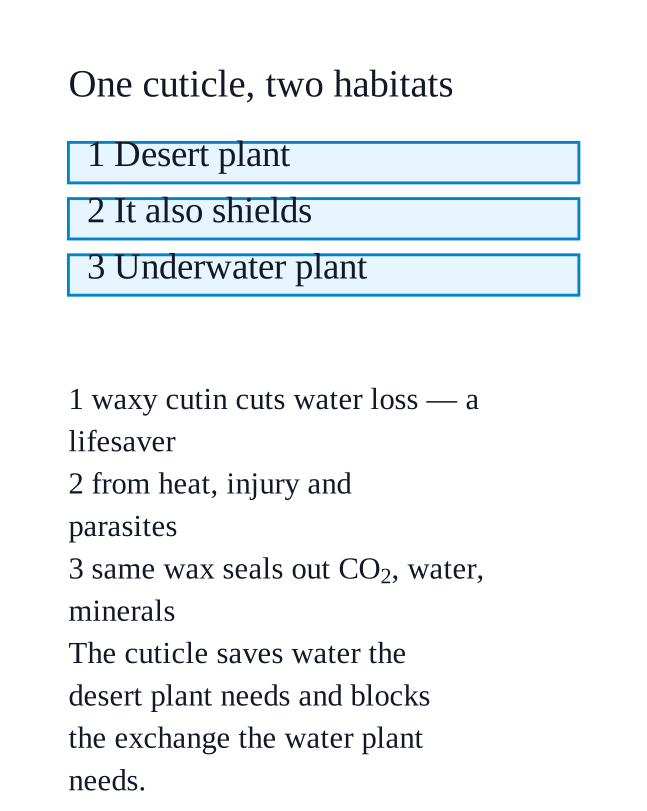
In a desert, water is the scarcest resource. The chapter states that in plants living in very dry habitats the epidermis may be covered by a thick layer of cuticle to reduce water loss by transpiration through the stomata.
The cuticle also shields the desert plant from mechanical injury, from invasion by parasites, and from the extreme heat and light of its habitat — all of which the epidermis is there to resist.
Underwater, the plant is surrounded by water on every side, so there is nothing to conserve — a thick cuticle solves a problem the plant does not have.
Worse, an aquatic plant takes in dissolved \(\displaystyle CO_2 \), \(\displaystyle O_2 \), water and minerals over its whole body surface; a thick waxy seal blocks that uptake and starves it of the gases needed for photosynthesis and respiration.
A thick opaque layer also cuts the light reaching the photosynthesising cells beneath the epidermis.
So the same structure is an adaptation in one habitat and a handicap in the other — structure is useful only in relation to the surroundings it must work in.