Exercise 3.1
Meristematic tissues divide repeatedly. What property of their cells allows them to do this? (i) They have thick walls for protection. (ii) They contain large vacuoles that store nutrients. (iii) They have thin walls, dense cytoplasm and large prominent nucleus. (iv) They are functionally differentiated cells.
Not cross-checked
NCERT prints no numerical answer for this exercise, so this working has not been cross-checked against the book.
NCERT’s answer
(iii)
(iii) They have thin walls, dense cytoplasm and large prominent nucleus.
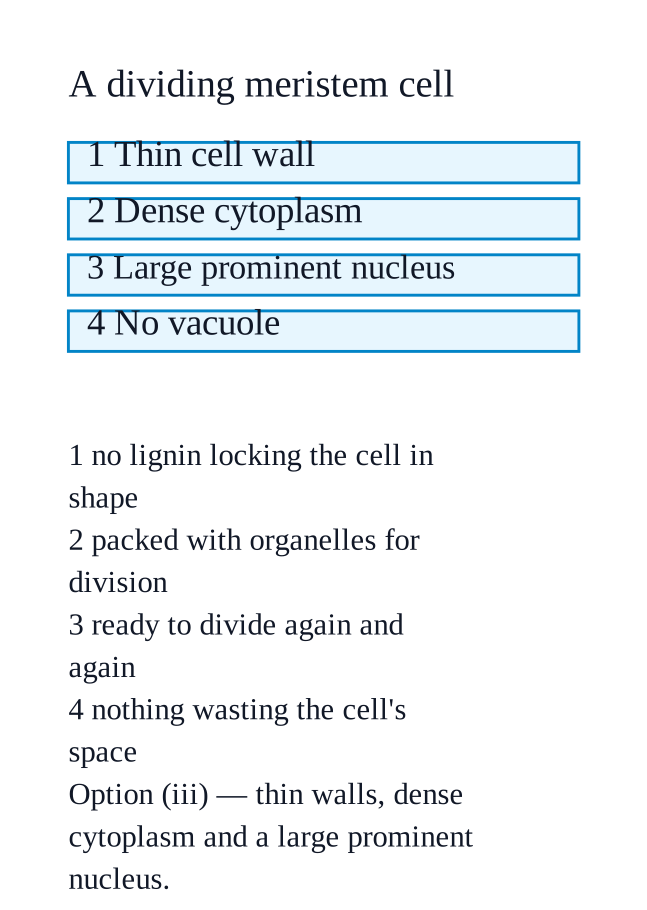
The chapter describes meristematic cells as small, with thin cell walls, a large and prominent nucleus, and dense cytoplasm containing many organelles — precisely the equipment for repeated division.
The cells are also tightly packed with little or no intercellular space, and these features together are what allow continuous and rapid cell division.
(i) is wrong — thick walls belong to sclerenchyma, whose cells are lignified and mostly dead, and dead cells do not divide.
(ii) is wrong — vacuoles are generally absent in meristematic cells; a large vacuole would leave too little cytoplasm and too few organelles for division.
(iv) is wrong — differentiation is what happens when a meristematic cell loses the ability to divide and turns into a permanent tissue; a differentiated cell is the opposite of a dividing one.