SolveItClass 9 · NCERT

NCERT Solutions · Class 9 Science Tissues in Action

25 questions · 25 still being checked

Revise, Reflect, Refine 3.6–3.15 (part 16 of 16)

  1. Exercise 3.6

    In each of the following cases (A, B, C and D), choose the correct option as given below: (i) Both (A) and (R) are true, and (R) is the correct explanation of (A). (ii) Both (A) and (R) are true, but (R) is not the correct explanation of (A). (iii) (A) is true, but (R) is false. (iv) (A) is false, but (R) is true. A. Assertion: Epithelium is well-suited for gas exchange in the lungs. Reason: It consists of multiple layers of tall cells that slow down diffusion. B. Assertion: Cardiac muscle can contract continuously without fatigue. Reason: Cardiac muscle cells have a high number of mitochondria and an abundant blood supply.

    Not cross-checked

    NCERT prints no numerical answer for this exercise, so this working has not been cross-checked against the book.

    NCERT’s answer
    A (iii) B (i) C (iv) D (iii)
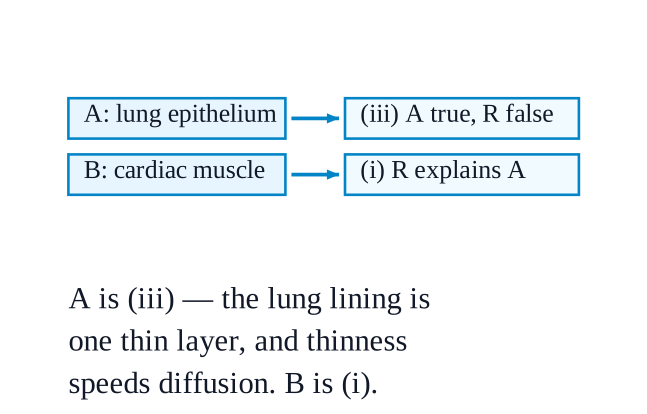
    A — (iii): (A) is true, but (R) is false.
    NCERT_Solution_Class9_Science_Ch3_RRR_Q3-6
    Assertion true: Table $\displaystyle 3.2$ places a single layer of thin, flat cells in the lining of the lungs precisely because it helps rapid diffusion of liquids and gases.
    Reason false on two counts: that lining is one cell thick, not multiple layers of tall cells; and its thinness speeds diffusion rather than slowing it. Multiple layers of tall cells describe the protective and absorptive epithelia instead.
    B — (i): both true, and (R) is the correct explanation of (A).
    Assertion true: the chapter says cardiac muscles work tirelessly and rhythmically, enabling the heart to beat throughout life without fatigue.
    Reason true and genuinely explanatory: many mitochondria mean a steady supply of energy, and an abundant blood supply keeps delivering the oxygen and nutrients needed to make it — so the muscle never runs an energy debt, which is exactly why it does not tire.
    C — (iv): (A) is false, but (R) is true.
    Assertion false: tendons connect muscle to bone; it is ligaments that connect bone to bone, and Table $\displaystyle 3.4$ sets the two out side by side.
    Reason true, and it is the chapter's own sentence: when a muscle contracts, the tendon transmits this force to the bone, resulting in movement at a joint. Note that the reason quietly states the correct fact that the assertion gets wrong.
    D — (iii): (A) is true, but (R) is false.
    Assertion true: §$\displaystyle 3.5.2$ says a hinge joint bends and straightens in one direction only, like a door hinge — the elbow and the knee.
    Reason false: bone ends shaped to allow sliding in all directions would give a ball and socket joint. The hinge shape is what restricts movement to one plane, so the reason describes the opposite of what a hinge does.
  2. Exercise 3.7

    Plot a graph between the age of a tree (in years) on the x-axis and the diameter of the tree (in cm) along with the number of annual rings formed over time on the y-axis, using the data given in the Table 3.7. increase in the diameter of stem and number of annual rings S. No. 1. 2. 3. 4. 5. 6. (i) Analyse the graph in terms of the diameter of the stem over time and share the interpretation. (ii) What is the relation between the diameter of the teak tree to the annual rings formed? (iii) Which specialised tissue is responsible for the girth of the stem and where is it located?

    Not cross-checked

    NCERT prints no numerical answer for this exercise, so this working has not been cross-checked against the book.

    The graph to draw. One graph carrying two plotted lines against the same axes.
    x-axis: Age of the teak tree (years), scaled \(\displaystyle 0 \) to \(\displaystyle 40 \) in steps of \(\displaystyle 5 \).
    y-axis: Diameter (cm) and Number of annual rings, scaled \(\displaystyle 0 \) to \(\displaystyle 40 \) in steps of \(\displaystyle 5 \) — both quantities happen to share the same range, so one scale serves both.
    Line $\displaystyle 1$ — DBH (cm): plot \(\displaystyle (5,4),\ (10,8),\ (20,24),\ (25,28),\ (30,32),\ (40,40) \) and join the points.
    Line $\displaystyle 2$ — Number of annual rings: plot \(\displaystyle (5,5),\ (10,10),\ (20,20),\ (25,25),\ (30,30),\ (40,40) \) and join the points. This comes out as a perfectly straight line through the origin at \(\displaystyle 45^\circ \).
    Mark each plotted point clearly, use a different symbol or line style for the two lines, and add a key naming them.
    (i) Interpretation of the diameter curve
    The diameter increases steadily throughout — the teak tree never stops thickening, because its lateral meristem keeps dividing year after year.
    Average rate over the whole record: \(\displaystyle \dfrac{40 - 4}{40 - 5} = \dfrac{36}{35} \approx 1.03 \) cm per year.
    The rate is not uniform, interval by interval:
    \(\displaystyle 5 \to 10 \) yr: \(\displaystyle \dfrac{8-4}{5} = 0.8 \) cm/yr
    \(\displaystyle 10 \to 20 \) yr: \(\displaystyle \dfrac{24-8}{10} = 1.6 \) cm/yr
    \(\displaystyle 20 \to 25 \) yr: \(\displaystyle \dfrac{28-24}{5} = 0.8 \) cm/yr
    \(\displaystyle 25 \to 30 \) yr: \(\displaystyle \dfrac{32-28}{5} = 0.8 \) cm/yr
    \(\displaystyle 30 \to 40 \) yr: \(\displaystyle \dfrac{40-32}{10} = 0.8 \) cm/yr
    So the curve is steepest between years \(\displaystyle 10 \) and \(\displaystyle 20 \), where girth grows at twice the rate of every other stretch, and settles back to a steady \(\displaystyle 0.8 \) cm/yr after that.
    This matches the chapter's account of annual rings: some are wide and some narrow, reflecting favourable or unfavourable growth conditions in that year. The years \(\displaystyle 10\!-\!20 \) were the favourable ones for this tree.
    (ii) Relation between diameter and annual rings
    The number of annual rings equals the age in years exactly — \(\displaystyle 5, 10, 20, 25, 30, 40 \) rings at \(\displaystyle 5, 10, 20, 25, 30, 40 \) years — so one ring is laid down each year, and counting rings gives the tree's age.
    Diameter and ring count rise together: the more rings, the greater the diameter. Each ring is one year's fresh layer of cells added to the girth.
    The relation is close to proportional but not exactly so, because rings differ in width: \(\displaystyle \dfrac{4}{5} = 0.8 \) cm per ring at age \(\displaystyle 5 \), \(\displaystyle \dfrac{24}{20} = 1.2 \) cm per ring at age \(\displaystyle 20 \), and \(\displaystyle \dfrac{40}{40} = 1.0 \) cm per ring at age \(\displaystyle 40 \).
    Practical use: from a cut trunk, ring count gives the age and ring widths give the climate record of the years the tree grew through.
    (iii) The tissue responsible for girth
    The lateral meristem.
    It is a meristematic tissue of actively dividing cells arranged in a ring along the circumference of the stem — visible in the T.S. of the sunflower stem in Fig. $\displaystyle 3.7$, lying between the phloem outside and the xylem inside.
    It divides and produces new cells both inside and outside in concentric layers, and that is what increases the diameter of the stem.
    NCERT_Solution_Class9_Science_Ch3_RRR_Q3-7
  3. Exercise 3.8

    In a forest, it was observed that one of the trees was severely debarked by an elephant to meet its food requirements, as the bark is a rich source of nutrients (Fig. 3.22\displaystyle 3.22). Based on your learning, answer the following: (i) Which function(s) of the tree is/are hampered by debarking? (ii) Which plant tissue would be affected by further damage to the tree trunk even after debarking? (iii) Which function of the tree would be hampered if the tissues beneath the bark were severely damaged? (iv) What assumptions are you making to answer the questions above? How would the answer change if your assumptions are also changed?NCERT_Question_Class9_Science_Ch3_RRR_Q3-8

    Not cross-checked

    NCERT prints no numerical answer for this exercise, so this working has not been cross-checked against the book.

    (i) Functions hampered by debarking
    Protection and food transport are the two that fail first.
    The bark is made of cork cells — dead, compactly arranged, and containing a substance that makes them impermeable to water and gases. Strip it and the trunk loses its shield against water loss, mechanical injury, harmful microorganisms and extreme environmental conditions.
    Immediately beneath the bark lies the phloem. If it is torn away with the bark, food made in the leaves can no longer be carried down to the stem and the roots, and the roots begin to starve because they cannot photosynthesise for themselves.
    The exposed wound is an open door for parasites and pathogens — the chapter notes that the cuticle and outer covering exist partly to prevent invasion by parasites.
    (ii) Tissue affected by further damage to the trunk
    Working inwards from the surface, the order in Fig. $\displaystyle 3.7$ is epidermis/cork → ground tissue → phloemlateral meristemxylem.
    So the phloem is hit next, and then the lateral meristem (cambium) just inside it. Deeper damage reaches the xylem.
    (iii) Function hampered if the tissues beneath the bark are severely damaged
    Loss of phloem → transport of food from leaves to stem and roots stops completely; the roots starve.
    Loss of lateral meristem → the tree can no longer grow in girth, cannot lay down new phloem, new xylem or new cork, and so cannot heal the wound or add another annual ring.
    Loss of xylem → transport of water and minerals from roots to leaves stops, and the tree also loses the mechanical strength xylem provides. The leaves wilt, photosynthesis fails, and the tree dies.
    (iv) Assumptions, and how the answers would change
    Assumed that the tree is a dicot with secondary growth, so it has bark, a cambium ring and annual rings at all.
    Assumed that "bark" here means the dead cork layer together with the phloem just under it — that is, the elephant took conducting tissue and not merely the dead covering.
    Assumed that the damage runs all the way round the trunk, not just across a patch.
    Assumed the cambium underneath is still alive.
    If only the dead cork was scraped off and phloem plus cambium survive, the tree loses protection alone. The cork cambium can divide and make fresh cork, and the tree recovers with a scar.
    If the damage is a patch rather than a complete ring, food can still travel down through the intact phloem on the undamaged side, and the tree survives.
    If it is a complete ring and the phloem is gone all round, the roots are permanently cut off from food. They starve and die, and the whole tree follows — even though the xylem is intact and the leaves stay green for a while, because water can still go up while food cannot come down.
  4. Exercise 3.9

    Aamrapali observed that a young mango sapling’s stem bends flexibly during monsoon winds and does not break. Which tissue is responsible for this flexibility? Predict and provide your explanation of the impact if the existing tissue was replaced by sclerenchyma.

    Not cross-checked

    NCERT prints no numerical answer for this exercise, so this working has not been cross-checked against the book.

    Collenchyma is the tissue responsible for the flexibility of the mango sapling's stem.
    NCERT_Solution_Class9_Science_Ch3_RRR_Q3-9
    Its cells are living, with their corners unevenly thickened by pectin — a chemical the chapter compares to rubber for the flexibility it gives.
    That combination supports the stem without making it rigid, which is precisely what the chapter credits collenchyma with: it allows parts of the plant like stems and tendrils to bend without breaking.
    In a monsoon gust the stem gives way, lets the wind pass, and springs back.
    If sclerenchyma replaced it, the stem would become stiff and brittle and would snap.
    Sclerenchyma cells have thick walls due to deposition of lignin, making them hard and strong and forming the woody structure — and most of these cells are dead.
    Hard is not the same as tough: a rigid rod cannot absorb the energy of a gust the way a flexible one can, so the force would go into breaking the stem instead of bending it.
    Being dead and lignified, sclerenchyma also cannot stretch or elongate, so a young growing stem would lose the ability to extend and to recover its shape after being bent.
    The chapter's own contrast makes the point in two familiar objects: coconut husk fibre (sclerenchyma) is hard and brittle, while a coriander leaf stalk (collenchyma) is soft and flexible. A sapling built like coconut husk would not survive a monsoon.
  5. Exercise 3.10

    Sohan designed an experiment for the regeneration of sugarcane, where he used cuttings to grow sugarcane. He used two types of cuttings, type ‘A’ and type ‘B’ (Fig. 3.23\displaystyle 3.23). After a few weeks, type ‘B’ cuttings sprouted and developed into sugarcane plants, whereas the type ‘A’ cuttings did not sprout. (i) Why were the type ‘B’ cuttings able to grow as sugarcane but type ‘A’ could not? (ii) What difference was present in type ‘B’ compared to type ‘A’? (iii) What observation or measurement was made to determine whether this change had an effect? (iv) What parameters should be kept the same for both types of cuttings to ensure a fair comparison?NCERT_Question_Class9_Science_Ch3_RRR_Q3-10

    Not cross-checked

    NCERT prints no numerical answer for this exercise, so this working has not been cross-checked against the book.

    (i) Why type B grew and type A did not
    Type B contained a node; type A did not.
    A node is the point on the stem where branches or leaves arise, and it carries a bud together with intercalary meristem, which the chapter locates at the base of the internode or just above the node.
    Meristematic cells divide continuously, so the bud at the node can sprout into a new shoot, after which the cutting puts out roots and grows into a whole sugarcane plant.
    Type A was cut from the internode — the part of the stem between two nodes. Its cells are permanent tissue: through differentiation they have lost the ability to divide, and a tissue that cannot divide cannot produce a new shoot.
    This is the same principle as the hedge that grows bushy after trimming and the grass that grows back after mowing — the intercalary meristem at the nodes is what regenerates the plant.
    (ii) The difference present in type B
    The presence of at least one node, with its bud and its intercalary meristematic tissue.
    Type A had only internode tissue, entirely permanent and non-dividing.
    (iii) Observations and measurements made
    Whether each cutting sprouted at all — a simple yes/no for every cutting.
    The number of cuttings that sprouted out of the total in each group, e.g. \(\displaystyle \dfrac{8}{10} \) of type B against \(\displaystyle \dfrac{0}{10} \) of type A.
    The number of days taken to sprout.
    The number of shoots produced per cutting.
    The length of each new shoot in cm, measured at fixed intervals over the few weeks.
    Whether roots formed, and how many.
    (iv) Parameters to keep the same for a fair comparison
    Everything except the one factor being tested — the presence of a node.
    Same sugarcane variety, and cuttings taken from the same parent plant of the same age.
    Same length and thickness of every cutting.
    Equal numbers of cuttings in group A and group B.
    Same soil or growing medium, same pot size, and the same depth and orientation of planting.
    Same watering schedule, light, temperature and humidity for both groups.
    Same period of observation, with both groups checked on the same days.
  6. Exercise 3.11

    During the discussion in class, Rohan gives a statement that, “A tissue is a group of similar cells performing similar functions”. But Rajiv counter argues that, “this is true in case of simple tissues but little different in case of complex tissues”. Provide your explanation in view of the discussion in class.

    Not cross-checked

    NCERT prints no numerical answer for this exercise, so this working has not been cross-checked against the book.

    Both are partly right, and Rajiv's correction is the one that matters: Rohan's definition fits simple tissues but breaks down for complex tissues.
    NCERT_Solution_Class9_Science_Ch3_RRR_Q3-11
    Rohan is quoting the chapter's general definition correctly — a tissue is a group of cells, similar in structure, that work together to perform a specific function.
    It holds for simple permanent tissues. Parenchyma, collenchyma and sclerenchyma are each made of only one type of cell, which is exactly what "simple" means in the chapter.
    It holds for meristematic tissue too, and for animal tissues like muscle and epithelium.
    It fails for complex permanent tissues, which the chapter defines as being made up of more than one type of cell working together.
    Xylem contains tracheids, vessels, xylem parenchyma and xylem fibres — dead and living cells, tubular and fibrous, side by side. Tracheids and vessels are thick-walled tubes; the parenchyma is the only living component; the fibres are sclerenchymatous. Structurally they are not alike at all, yet all of them serve one job: conducting water and minerals, and giving strength.
    Phloem contains sieve tubes, companion cells, phloem parenchyma and phloem fibres. Sieve tubes carry the food, companion cells regulate loading and unloading of sugars, parenchyma stores food, resin, tannins and latex, and fibres give strength. Four different cell types, one shared purpose.
    So the accurate statement is: a tissue is a group of cells — similar or dissimilar in structure — that work together to perform a specific function.
    It is the shared function, not identical structure, that makes a group of cells a tissue. Rohan has described the usual case; Rajiv has spotted the exception that forces the better definition.
  7. Exercise 3.12

    Coconut husk fibres are used for mats which are tough and fibrous. Which tissue has structural features suitable for providing this strength? Explain why living parenchyma couldn’t serve the same purpose.

    Not cross-checked

    NCERT prints no numerical answer for this exercise, so this working has not been cross-checked against the book.

    Sclerenchyma gives coir mats their strength.
    NCERT_Solution_Class9_Science_Ch3_RRR_Q3-12
    Its cells have thick walls due to deposition of lignin, which makes them hard and strong and forms the woody structure of the plant.
    The chapter names this exact use: sclerenchyma is found in stems, leaf veins, and the hard coverings of seeds and nuts, such as coconut husk and walnut shell.
    Most sclerenchyma cells are dead, which is an advantage here — the fibre keeps its shape and strength after the husk is cut, beaten and dried, with nothing left inside that needs water or food.
    The cells are long, narrow and tightly packed with no intercellular space, so they resist pulling and tearing along their length — which is what a mat is subjected to every day.
    Living parenchyma could not do this job.
    Parenchyma cells are thin-walled and unlignified, so they carry no reinforcement and crush or tear under any real load.
    They are loosely packed with intercellular spaces, which makes the tissue soft and easily torn apart.
    They are living and full of water and stored food — dried out for a mat they would shrink and collapse; kept moist they would rot.
    Parenchyma's actual work is storage, photosynthesis in green parts, and forming air spaces that let aquatic plants float. None of that requires or produces mechanical toughness.
    The general rule the chapter is teaching: lignified dead walls give strength, thin living walls give metabolic activity — no tissue gets both.
  8. Exercise 3.13

    Vibha claims to her friend Neha that, “Meristematic cells are located only at the root and shoot apices”. What do you think about this statement? What question can Neha ask Vibha to help her understand further if the statement is incorrect?

    Not cross-checked

    NCERT prints no numerical answer for this exercise, so this working has not been cross-checked against the book.

    Vibha's statement is incorrect — she has described the apical meristem only, and the chapter names three kinds of meristematic tissue.
    NCERT_Solution_Class9_Science_Ch3_RRR_Q3-13
    Apical meristem — at the root and shoot tips; increases the plant's length. This is the part Vibha has right, and it is what the onion experiment in Activity $\displaystyle 3.1$ demonstrates.
    Lateral meristem — actively dividing cells arranged in a ring along the circumference of the stem; they divide inwards and outwards in concentric layers and increase the girth. Nowhere near a tip.
    Intercalary meristem — at the base of the internode or just above the node; it is why grasses regrow after mowing or grazing and why a trimmed hedge turns bushy.
    The chapter adds a fourth site in "Ready to Go Beyond": as a stem ages, some cells below the epidermis regain the ability to divide, act as lateral meristematic cells and form the cork cambium, which makes the bark.
    Questions Neha can ask to help Vibha see the gap:
    "If the dividing cells were only at the tips, how does a tree trunk get thicker every year and lay down annual rings?"
    "A lawn is mowed, so the shoot tips have been cut off — why does the grass grow back?"
    "Why does a hedge become bushier after trimming instead of simply stopping?"
    "In Activity $\displaystyle 3.1$ we cut the root tips of Jar B and those roots stopped growing in length — but did that tell us anything about growth in girth?"
    "Which meristem makes the bark of an old tree, and is it anywhere near a tip?"
    Each of these points at a growth that Vibha's statement cannot explain, which is a better way of correcting her than simply naming the missing meristems.
  9. Exercise 3.14

    A plant cell and an animal cell are of the same size. (i) Which cell will have a larger vacuole? Give reasons. (ii) What assumptions are you making to answer the question above?

    Not cross-checked

    NCERT prints no numerical answer for this exercise, so this working has not been cross-checked against the book.

    (i) Which cell will have the larger vacuoleNCERT_Solution_Class9_Science_Ch3_RRR_Q3-14
    The plant cell.
    A mature plant cell keeps one large central vacuole that occupies most of the cell's volume and stores cell sap, water and food.
    Filled with water, the vacuole presses outwards and keeps the cell turgid — this is how a non-woody plant part stays firm and upright — and the rigid cell wall can withstand that pressure without the cell bursting.
    An animal cell has no cell wall, only a flexible membrane. A large water-filled vacuole would push it out of shape or burst it, so animal cells have small vacuoles or none at all.
    There is a functional reason as well: a plant cannot move to fetch food or walk away from its wastes, so it needs a large internal store; an animal ingests food and removes wastes continuously and does not.
    (ii) Assumptions being made
    That both cells are mature, differentiated cells. Chapter $\displaystyle 3$ states that vacuoles are generally absent in meristematic cells — so if the plant cell were a dividing meristematic cell, it would have little or no vacuole and the answer could flip.
    That the plant cell is a living cell such as parenchyma, not a dead sclerenchyma cell or an empty xylem vessel, which have no cell contents to speak of.
    That both cells are normally hydrated; a wilted plant cell has a shrunken vacuole.
    That "same size" means the same total cell volume, so the question is really about how that volume is divided between vacuole and cytoplasm.
    That the animal cell is an ordinary body cell and not a specialised secretory or fat-storing cell.
  10. Exercise 3.15

    A textbook states, “Each plant tissue performs only one specific function”. What questions would you ask to critically examine the correctness of this statement? What examples of tissues would you take to find out the answers to these questions?

    Not cross-checked

    NCERT prints no numerical answer for this exercise, so this working has not been cross-checked against the book.

    The statement is incorrect: most plant tissues perform several functions, and many single functions need more than one tissue.
    NCERT_Solution_Class9_Science_Ch3_RRR_Q3-15
    Questions worth asking to test it:
    "Can a single named tissue be shown doing two clearly different jobs?"
    "Does the chapter's own description of any one tissue already list more than one function?"
    "Does the same tissue do the same job in every organ — root, stem, leaf — and in every habitat?"
    "Can any one function be completed by one tissue acting alone, or does it need partners?"
    "Can a tissue's function change over the plant's life, or is it fixed once and for all?"
    Tissues to test the questions on:
    Parenchyma — mainly stores food, but also performs photosynthesis in the green parts of the plant, and in aquatic plants forms the air spaces that help them float. One tissue, three functions.
    Xylem — transports water and minerals from the roots upward and provides strength to the plant; the chapter states both in the same paragraph.
    Epidermis — protects against mechanical injury, water loss, harmful microorganisms and extreme conditions; its stomata carry out gaseous exchange, transpiration and elimination of wastes; its root hairs increase surface area for absorbing water and minerals. Protection, exchange, transport and absorption from one tissue.
    Phloem — sieve tubes conduct food, phloem parenchyma stores food, resin, tannins and latex, and phloem fibres provide strength.
    Sclerenchyma — gives mechanical strength in stems and leaf veins and forms the hard protective coverings of seeds and nuts.
    Testing the other direction — lifting water to the top of a tall tree needs the xylem (the pipe), the root epidermis with its root hairs (absorption) and the leaf epidermis with its stomata (the transpiration pull). Three tissues, one function.
    A tissue that changed its role — in F. C. Steward's experiment the phloem cells of carrot dedifferentiated, divided and redifferentiated into a whole plant, so even a specialised conducting cell is not locked to one function for ever.
    Conclusion: tissues are specialised, which is not the same as single-purpose. The chapter's own definition is that a tissue performs "a specific function" — specific means characteristic, not solitary.