Exercise 3.2
If a plant is unable to transport food from leaves to roots which tissue is malfunctioning? (i) Xylem (ii) Phloem (iii) Epidermis (iv) Sclerenchyma
Check this one against your book
NCERT’s printed answer for this exercise does not match its own question. This working follows the question as printed.
Phloem — option (ii).
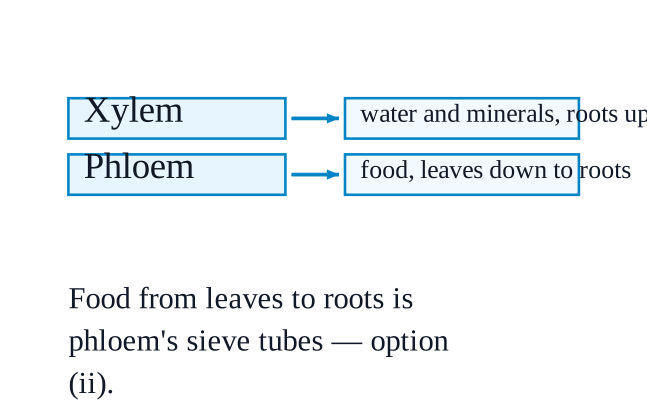
The chapter separates the two conducting tissues by cargo in its opening pages: "xylem transports water and minerals, while phloem transports food." Food travelling from leaves down to roots is therefore a phloem job.
Section $\displaystyle 3.2.4$(iii), Conducting tissues, names the cells that do it. Phloem "consists of sieve tubes, companion cells, phloem parenchyma and phloem fibres", and "Sieve tubes transport food from leaves to other parts of the plant." The roots are among those "other parts", so a plant that cannot move food from leaves to roots has sieve tubes of the phloem that are not working.
Why not (i) Xylem: the same section says xylem "transports water and minerals from the roots to other parts of the plant" — the wrong cargo, and the opposite direction to the one in the question.
Why not (iii) Epidermis: the chapter files the epidermis under "(i) Protective tissue". It is "the outermost layer of the plant body", "a tightly packed, single layer of flat and rectangular cells" that "protects all parts of the plants". The jobs listed for it there are protection by the cuticle, absorption through root hair, and gaseous exchange and transpiration through stomata — never food transport. It is not one of the conducting tissues at all.
Why not (iv) Sclerenchyma: it is listed as a simple permanent (supporting) tissue with "thick walls… due to deposition of lignin", of which "Most of these cells are dead". It supplies hardness and strength — coconut husk, walnut shell — not conduction.
At a Glance states it once more: "Complex permanent tissues include xylem and phloem that transport water and food respectively to all parts of the plant."
The book's printed Answer Key gives (iii) Epidermis, which does not agree with Section $\displaystyle 3.2.4$ or with the At a Glance summary. Both of those passages assign food transport from the leaves to the phloem's sieve tubes, and both classify the epidermis as a protective tissue with no conducting role, so the chapter's own text settles it the other way: the answer is (ii) Phloem, and the key entry should be treated as an error.