SolveItClass 9 · NCERT

NCERT Solutions · Class 9 Science Tissues in Action

25 questions · 25 still being checked

Questions 3.1–3.5 (part 2 of 4)

  1. Exercise 3.1

    The red colour of blood is due to haemoglobin, an iron-rich protein in the Red Blood Cells (RBCs). RBCs live for about 4\displaystyle 4 months and are replaced regularly.

    Not cross-checked

    NCERT prints no numerical answer for this exercise, so this working has not been cross-checked against the book.

    Blood is red because of haemoglobin, an iron-rich protein carried inside the Red Blood Cells (RBCs).

    NCERT_Solution_Class9_Science_Ch3_Qs_Q3-1
    RBCs live for about $\displaystyle 4$ months and are then replaced regularly by newly made ones, so the supply is continuously renewed.
    This is why red blood oozes out of even a small cut on the skin.
    Blood is a connective tissue — it connects the parts of the body by transporting nutrients, gases and hormones.
    Its matrix is watery: plasma makes up \(\displaystyle 55\% \) of the total volume, and the formed elements — RBCs, WBCs and platelets — the remaining \(\displaystyle 45\% \).
  2. Exercise 3.2

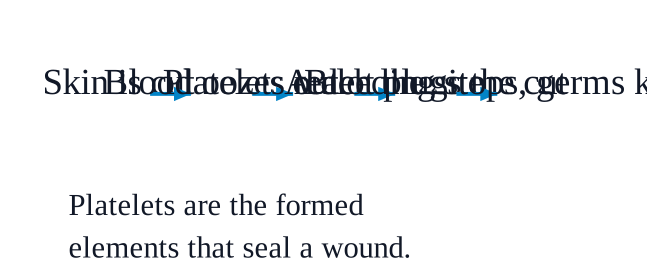
    Platelets help in blood clotting at the site of the injury.

    Not cross-checked

    NCERT prints no numerical answer for this exercise, so this working has not been cross-checked against the book.

    Blood clots because of platelets, which act at the site of the injury.
    NCERT_Solution_Class9_Science_Ch3_Qs_Q3-2
    Table $\displaystyle 3.3$ pairs the everyday experience — red blood oozing from a small cut — with the observation that a clot forms after some time, and the question "What causes blood to clot?"
    The clot plugs the cut so that bleeding stops and germs cannot get in through the wound.
    Platelets are one of the formed elements of blood, which together make up \(\displaystyle 45\% \) of its volume; the rest is plasma.
  3. Exercise 3.3

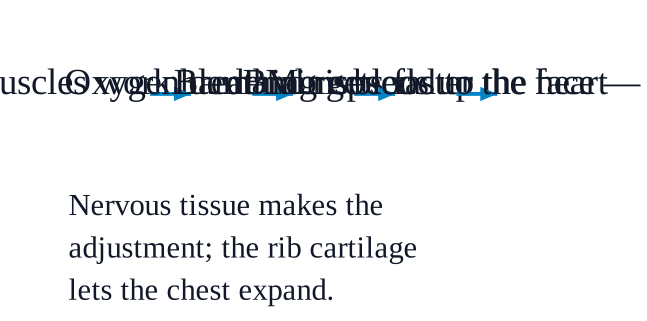
    During exercise or running, muscles need more oxygen, so breathing becomes faster and blood flow increases (face appears red).

    Not cross-checked

    NCERT prints no numerical answer for this exercise, so this working has not been cross-checked against the book.

    You breathe faster while running because the muscles need more oxygen, and your face turns red because the blood flow increases.
    NCERT_Solution_Class9_Science_Ch3_Qs_Q3-3
    Working muscles use up oxygen quickly, so the breathing rate rises to take in more air.
    The rib cage makes this possible: the ribs are joined to the spine at the back and to the sternum in front by flexible cartilage, letting the cage expand and contract so air moves in and out of the lungs.
    The nervous tissue is in charge of the adjustment — during exercise the brain signals the heart to beat faster to meet the body's increased oxygen demand.
    More blood flowing through the vessels close to the skin of the face is what makes it look red.
  4. Exercise 3.4

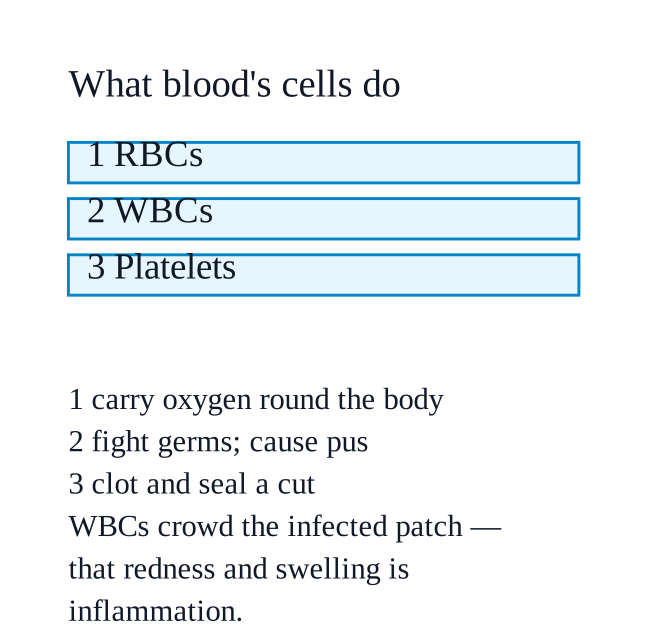
    White Blood Cells (WBCs) collect at infected areas, causing pus formation and inflammation (causing redness and swelling, and possible pus formation at the infected area). WBC Platelets RBCs

    Not cross-checked

    NCERT prints no numerical answer for this exercise, so this working has not been cross-checked against the book.

    An infected patch of skin turns red and swollen because White Blood Cells (WBCs) collect there.
    NCERT_Solution_Class9_Science_Ch3_Qs_Q3-4
    WBCs gather at the infected area to fight the germs; this gives inflammation — the redness and the slight swelling — and possibly pus.
    Fever may go with it, as the body responds to the infection.
    WBCs are one of the formed elements of blood, alongside RBCs and platelets, which together make up \(\displaystyle 45\% \) of blood volume.
    Note how the three formed elements divide the labour: RBCs carry oxygen, platelets seal wounds, WBCs fight infection — division of labour inside a single tissue.
  5. Exercise 3.5

    Compare your findings with those of your classmates and calculate the class average. Discuss why do bone and muscle mass differ between individuals, and how do they contribute to the overall body weight? 3.4.1\displaystyle 3.4.1 The musculoskeletal system in action Activity 3.5\displaystyle 3.5: Let us observe Move different parts of your body and observe what movement(s) it can make. Body Complete parts rotation Elbow No Shoulder Knee Neck Fingers Toes Wrist You may have noticed that some parts of our body can move easily in many directions, while others move only in a single direction. Why does this happen? The difference is due to the types of joints present. A joint is a junction between two or more bones. Joints allow movement but they cannot move the bones on their own. So, what actually causes the bones to move?

    Not cross-checked

    NCERT prints no numerical answer for this exercise, so this working has not been cross-checked against the book.

    Bones and muscles together make up roughly half of the body's weight — bone about \(\displaystyle 12\!-\!15\% \) for all adults, and muscle about \(\displaystyle 40\!-\!50\% \) in adult males and \(\displaystyle 30\!-\!40\% \) in adult females.
    NCERT_Solution_Class9_Science_Ch3_Qs_Q3-5
    Worked example for a student of \(\displaystyle 50 \) kg, taking bone \(\displaystyle = 13.5\% \) and muscle \(\displaystyle = 35\% \):
    bone mass \(\displaystyle = 50 \times \dfrac{13.5}{100} = 6.75 \) kg
    muscle mass \(\displaystyle = 50 \times \dfrac{35}{100} = 17.5 \) kg
    together \(\displaystyle = 6.75 + 17.5 = 24.25 \) kg, i.e. \(\displaystyle \dfrac{24.25}{50} \times 100 = 48.5\% \) of the total body weight
    Why they differ between individuals — the chapter names three reasons: age, gender and body composition; it adds that the percentages may also vary by ethnicity or body type.
    Level of physical activity and nutrition matter too: the chapter says correct posture, proper nutrition, regular exercise and yoga keep bones strong and muscles fit, so two people of the same weight can carry very different bone and muscle mass.
    How they contribute to body weight — the skeleton is the rigid framework and the muscles are the tissue that pulls on it, so between them they account for the single largest share of body weight; fat, organs and body fluids make up the rest.
    Expect the class average to sit near these figures, with the boys' muscle percentage higher than the girls' and the bone percentage similar for everyone.