SolveItClass 9 · NCERT

NCERT Solutions · Class 9 Science Tissues in Action

25 questions · 25 still being checked

Pause and Ponder 3.1–3.5 (part 1 of 4)

  1. Exercise 3.1

    You may have noticed that fibres of coconut husk are hard and brittle, whereas the leaf stalks of coriander are soft and flexible. Find out the reason. Xylem fibre Tracheid Xylem parenchyma Vessel Phloem parenchyma Sieve tube Sieve pore Companion cell (b) phloem Phloem Epidermal tissue Epidermal tissue Xylem

    Not cross-checked

    NCERT prints no numerical answer for this exercise, so this working has not been cross-checked against the book.

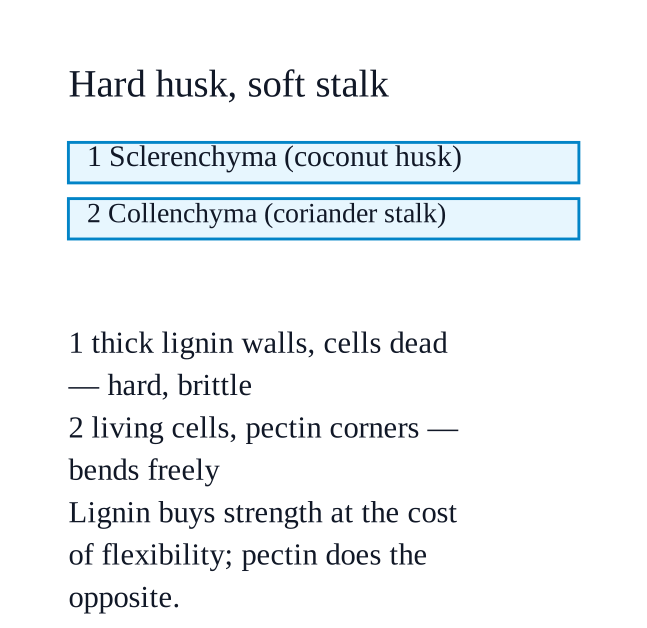
    Coconut husk fibres are made of sclerenchyma, while coriander leaf stalks are made of collenchyma (with parenchyma).
    NCERT_Solution_Class9_Science_Ch3_PP_Q3-1
    Sclerenchyma cells have thick walls due to deposition of lignin, which makes them hard and strong, and most of these cells are dead.
    A dead, lignified, rigid wall cannot give way, so the fibre resists bending and finally snaps — hard and brittle.
    The chapter places coconut husk here itself, alongside walnut shell, as a hard covering made of sclerenchyma.
    Collenchyma cells are living, with their corners unevenly thickened by pectin — a chemical the chapter compares to rubber for the flexibility it gives.
    That uneven, unlignified thickening supports the stalk yet still lets it bend without breaking, so the coriander stalk stays soft and flexible.
    Same job (support), two different materials: lignin buys strength at the cost of flexibility; pectin buys flexibility at the cost of strength.
  2. Exercise 3.2

    Ground tissue system: This forms the main body of a plant between the dermal and conducting tissues. It includes parenchyma, collenchyma and sclerenchyma.

    Not cross-checked

    NCERT prints no numerical answer for this exercise, so this working has not been cross-checked against the book.

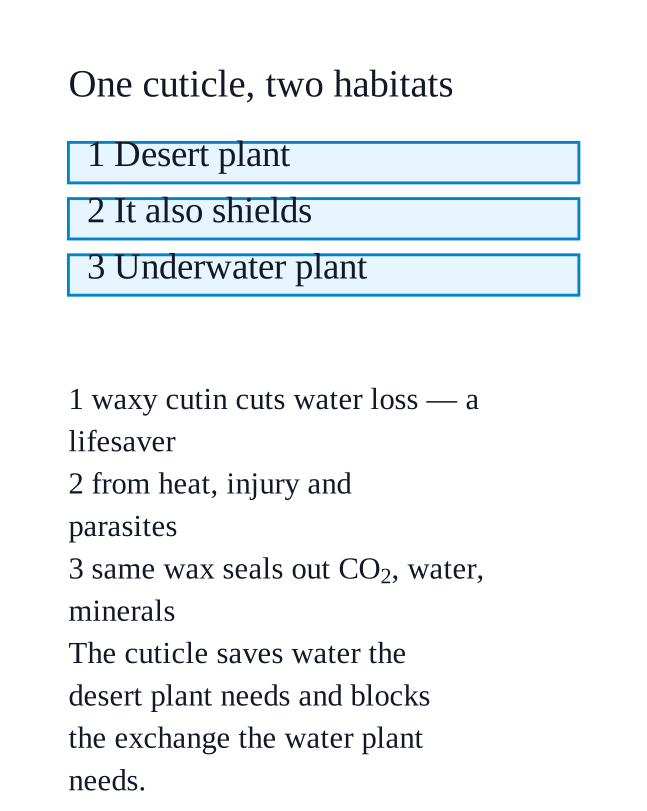
    A thick cuticle helps a desert plant because the waxy layer of cutin is water-proof and cuts down water loss; it harms an underwater plant because that same layer seals off the exchange of gases, water and minerals across its surface.
    NCERT_Solution_Class9_Science_Ch3_PP_Q3-2
    In a desert, water is the scarcest resource. The chapter states that in plants living in very dry habitats the epidermis may be covered by a thick layer of cuticle to reduce water loss by transpiration through the stomata.
    The cuticle also shields the desert plant from mechanical injury, from invasion by parasites, and from the extreme heat and light of its habitat — all of which the epidermis is there to resist.
    Underwater, the plant is surrounded by water on every side, so there is nothing to conserve — a thick cuticle solves a problem the plant does not have.
    Worse, an aquatic plant takes in dissolved \(\displaystyle CO_2 \), \(\displaystyle O_2 \), water and minerals over its whole body surface; a thick waxy seal blocks that uptake and starves it of the gases needed for photosynthesis and respiration.
    A thick opaque layer also cuts the light reaching the photosynthesising cells beneath the epidermis.
    So the same structure is an adaptation in one habitat and a handicap in the other — structure is useful only in relation to the surroundings it must work in.
  3. Exercise 3.3

    Vascular tissue system: This consists of conducting tissues — xylem and phloem.

    Not cross-checked

    NCERT prints no numerical answer for this exercise, so this working has not been cross-checked against the book.

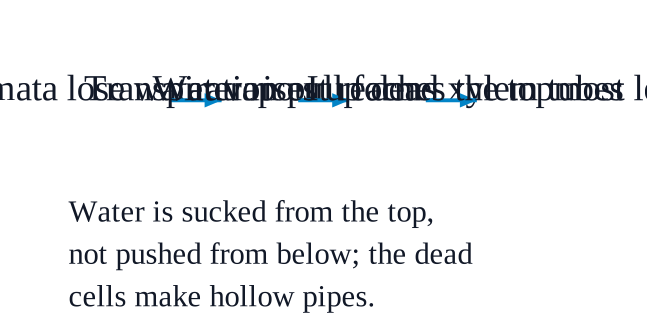
    Water rises because the dead cells of the xylem form open, unblocked pipes while the living cells of the leaf pull the water up by transpiration — the plant does not push water from below, it is sucked up from the top.
    NCERT_Solution_Class9_Science_Ch3_PP_Q3-3
    Tracheids and vessels are tubular and thick-walled and lose their living contents. Joined end to end, they make a continuous hollow tube running from root to leaf with no cytoplasm or nucleus in the way — being dead is exactly what makes them good pipes.
    Their thick, lignified walls stop the tube from collapsing while the water inside it is under tension, and the chapter notes that xylem also gives strength to the plant.
    At the top, the living epidermal cells of the leaf carry pores called stomata, through which water escapes as vapour. This evaporation is transpiration.
    The chapter states the link directly: transpiration helps in water transportation by creating a transpiration pull in the xylem.
    Every water molecule that leaves at the leaf drags the column behind it, so the loss of water at the top is what lifts fresh water at the bottom, against gravity, without any pump.
    At the other end, living root hairs — projections of the root epidermal cells — increase the surface area for absorbing water and minerals and keep the column supplied.
    So it is a partnership: dead cells supply the plumbing, living cells supply the force.
  4. Exercise 3.4

    What do you think will happen if there were no stomata in the epidermis of the stem or leaves? Now think, which tissue helps you move? Which tissue enables you to sense heat or cold? Which tissue allows oxygen to enter the blood? Which tissue holds the body together so that the skin does not fall off? Many such questions can be asked but the answers lie in the diversity of animal tissues, which are specially adapted to perform different functions. It is interesting to understand how the structure of an animal tissue suits its specific function. Let us explore different kinds of animal tissues. Each tissue performs a specific function. 3.3.1\displaystyle 3.3.1 Epithelial tissues — Structure and functions Epithelial tissue forms the outer covering of the body (skin) and also lines the internal organs, such as the mouth, lungs, blood vessels and intestine. It is composed of closely packed cells with very little space between them.

    Not cross-checked

    NCERT prints no numerical answer for this exercise, so this working has not been cross-checked against the book.

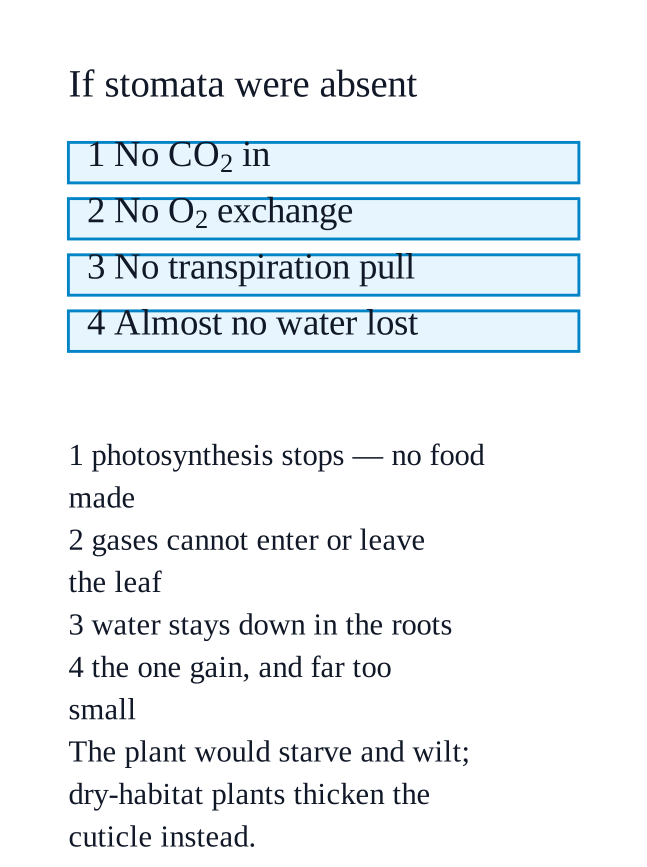
    The plant would starve and then wilt — with no stomata there is neither gaseous exchange nor transpiration.
    NCERT_Solution_Class9_Science_Ch3_PP_Q3-4
    No \(\displaystyle CO_2 \) could enter the leaf, so photosynthesis would stop and the plant could not synthesise its food.
    The \(\displaystyle O_2 \) produced in photosynthesis could not leave, and the \(\displaystyle O_2 \) needed for respiration could not enter through the leaf or stem surface.
    With no transpiration there would be no transpiration pull, so water and minerals absorbed by the roots could not be lifted through the xylem to the top of a tall plant.
    The chapter also credits transpiration with the elimination of wastes from the plant body — that route would be closed too.
    The one gain would be almost no water loss, which is why plants of dry habitats reduce their exposure with a thick cuticle rather than losing stomata altogether.
    On balance the loss far outweighs the gain: a plant sealed against water loss is also sealed against carbon dioxide, and it cannot feed itself.
  5. Exercise 3.5

    Look at the picture given below (Fig. 3.17\displaystyle 3.17). Carefully observe the various poses of classical and folk dances of India. Can you identify which joints are involved? Also, what type of movement each joint allows? 40\displaystyle 40 Exploration|Grade 9\displaystyle 9NCERT_Question_Class9_Science_Ch3_PP_Q3-5

    Not cross-checked

    NCERT prints no numerical answer for this exercise, so this working has not been cross-checked against the book.

    The dance poses between them use all four joint types the chapter names — ball and socket, hinge, pivot, and (unmoving) fixed.
    Shoulder — ball and socket joint. The rounded top of the upper arm bone sits in a shallow hollow of the shoulder bone, so the raised, spread and circling arms of almost every pose can move forward, backwards, sideways and in circles. This is the freest joint in the body and the reason arm positions carry so much of the expression.
    Hip — ball and socket joint. Gives the turned-out, sideways and circular leg movements of the classic half-sitting stance.
    Elbow — hinge joint. Bends and straightens the forearm in one direction only, like a door hinge — used whenever the arm is folded in or extended out.
    Knee — hinge joint. Bends and straightens in one plane for the deep bent-knee stance; the kneecap, a small bone, protects the joint while it is loaded.
    Ankle — hinge-type movement. Up-and-down movement of the foot for the flat-footed stamping of the footwork.
    Neck — pivot joint. The skull is connected to the backbone by a pivot joint, letting the head move side to side like a doorknob turning in its socket — the signature head movement of Indian classical dance.
    Wrist and fingers. Bending and partial rotation shape the hand gestures.
    Backbone. Not a single joint but a column of vertebrae with a cartilage disc between each pair, cushioning them and allowing the torso to bend and twist without injuring the spinal cord.
    Skull — fixed joints. Its flat bones stay locked together throughout, keeping the brain safe however vigorously the body moves.
    In every case the joint only permits the movement; the chapter is explicit that joints cannot move bones on their own — muscles contract and pull on the bones through tendons, and the movement appears at the joint.