SolveItClass 9 · NCERT

NCERT Solutions · Class 9 Science Tissues in Action

25 questions · 25 still being checked

Revise, Reflect, Refine 3.11–3.15 (part 4 of 4)

  1. Exercise 3.11

    During the discussion in class, Rohan gives a statement that, “A tissue is a group of similar cells performing similar functions”. But Rajiv counter argues that, “this is true in case of simple tissues but little different in case of complex tissues”. Provide your explanation in view of the discussion in class.

    Not cross-checked

    NCERT prints no numerical answer for this exercise, so this working has not been cross-checked against the book.

    Both are partly right, and Rajiv's correction is the one that matters: Rohan's definition fits simple tissues but breaks down for complex tissues.
    NCERT_Solution_Class9_Science_Ch3_RRR_Q3-11
    Rohan is quoting the chapter's general definition correctly — a tissue is a group of cells, similar in structure, that work together to perform a specific function.
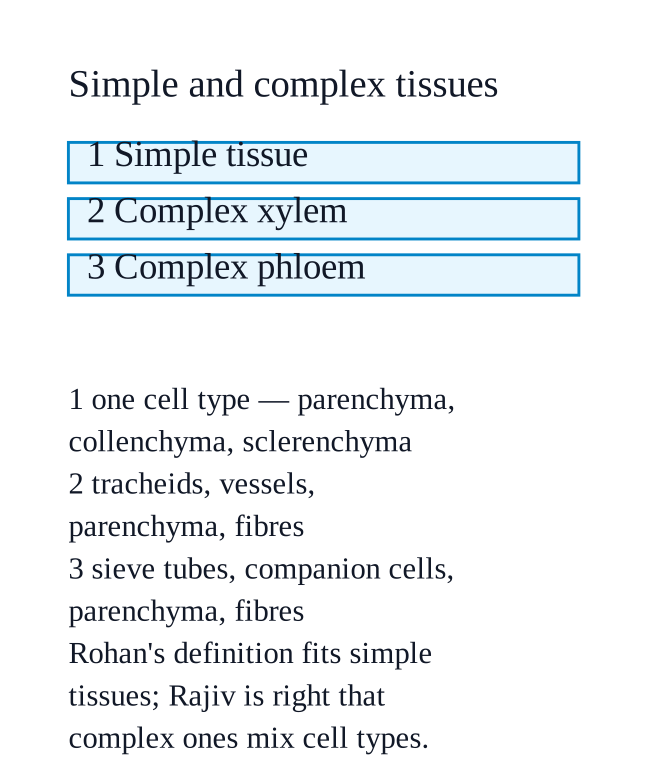
    It holds for simple permanent tissues. Parenchyma, collenchyma and sclerenchyma are each made of only one type of cell, which is exactly what "simple" means in the chapter.
    It holds for meristematic tissue too, and for animal tissues like muscle and epithelium.
    It fails for complex permanent tissues, which the chapter defines as being made up of more than one type of cell working together.
    Xylem contains tracheids, vessels, xylem parenchyma and xylem fibres — dead and living cells, tubular and fibrous, side by side. Tracheids and vessels are thick-walled tubes; the parenchyma is the only living component; the fibres are sclerenchymatous. Structurally they are not alike at all, yet all of them serve one job: conducting water and minerals, and giving strength.
    Phloem contains sieve tubes, companion cells, phloem parenchyma and phloem fibres. Sieve tubes carry the food, companion cells regulate loading and unloading of sugars, parenchyma stores food, resin, tannins and latex, and fibres give strength. Four different cell types, one shared purpose.
    So the accurate statement is: a tissue is a group of cells — similar or dissimilar in structure — that work together to perform a specific function.
    It is the shared function, not identical structure, that makes a group of cells a tissue. Rohan has described the usual case; Rajiv has spotted the exception that forces the better definition.
  2. Exercise 3.12

    Coconut husk fibres are used for mats which are tough and fibrous. Which tissue has structural features suitable for providing this strength? Explain why living parenchyma couldn’t serve the same purpose.

    Not cross-checked

    NCERT prints no numerical answer for this exercise, so this working has not been cross-checked against the book.

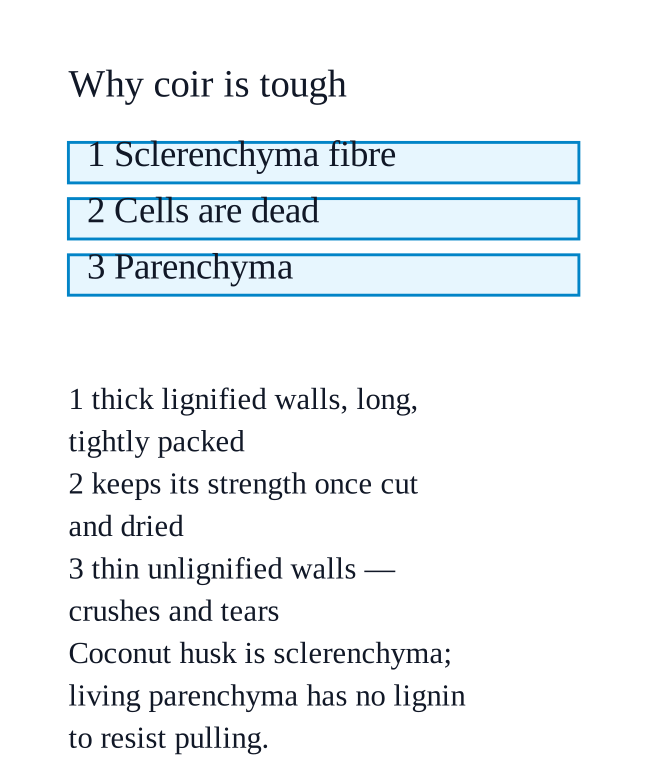
    Sclerenchyma gives coir mats their strength.
    NCERT_Solution_Class9_Science_Ch3_RRR_Q3-12
    Its cells have thick walls due to deposition of lignin, which makes them hard and strong and forms the woody structure of the plant.
    The chapter names this exact use: sclerenchyma is found in stems, leaf veins, and the hard coverings of seeds and nuts, such as coconut husk and walnut shell.
    Most sclerenchyma cells are dead, which is an advantage here — the fibre keeps its shape and strength after the husk is cut, beaten and dried, with nothing left inside that needs water or food.
    The cells are long, narrow and tightly packed with no intercellular space, so they resist pulling and tearing along their length — which is what a mat is subjected to every day.
    Living parenchyma could not do this job.
    Parenchyma cells are thin-walled and unlignified, so they carry no reinforcement and crush or tear under any real load.
    They are loosely packed with intercellular spaces, which makes the tissue soft and easily torn apart.
    They are living and full of water and stored food — dried out for a mat they would shrink and collapse; kept moist they would rot.
    Parenchyma's actual work is storage, photosynthesis in green parts, and forming air spaces that let aquatic plants float. None of that requires or produces mechanical toughness.
    The general rule the chapter is teaching: lignified dead walls give strength, thin living walls give metabolic activity — no tissue gets both.
  3. Exercise 3.13

    Vibha claims to her friend Neha that, “Meristematic cells are located only at the root and shoot apices”. What do you think about this statement? What question can Neha ask Vibha to help her understand further if the statement is incorrect?

    Not cross-checked

    NCERT prints no numerical answer for this exercise, so this working has not been cross-checked against the book.

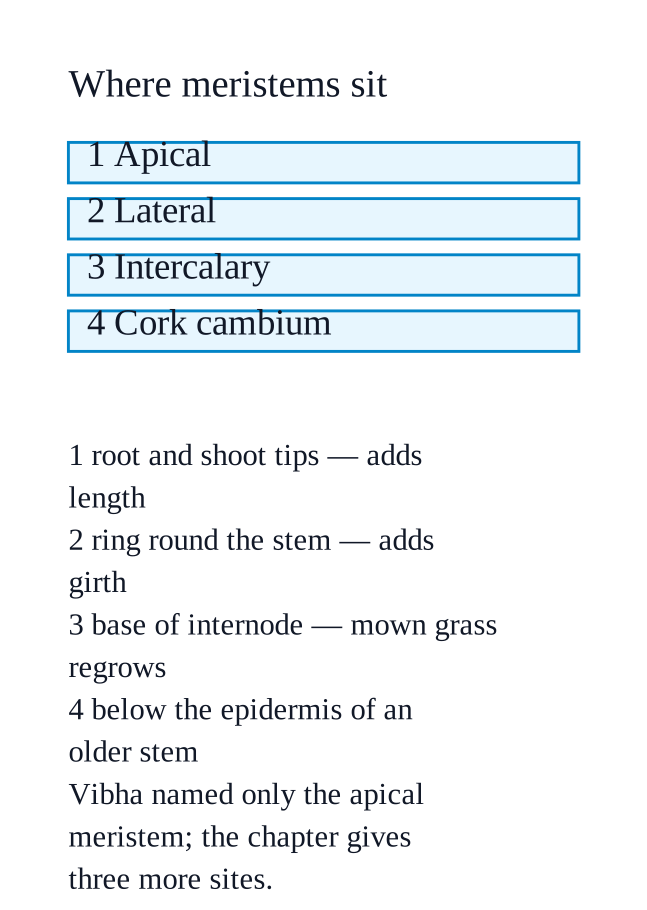
    Vibha's statement is incorrect — she has described the apical meristem only, and the chapter names three kinds of meristematic tissue.
    NCERT_Solution_Class9_Science_Ch3_RRR_Q3-13
    Apical meristem — at the root and shoot tips; increases the plant's length. This is the part Vibha has right, and it is what the onion experiment in Activity $\displaystyle 3.1$ demonstrates.
    Lateral meristem — actively dividing cells arranged in a ring along the circumference of the stem; they divide inwards and outwards in concentric layers and increase the girth. Nowhere near a tip.
    Intercalary meristem — at the base of the internode or just above the node; it is why grasses regrow after mowing or grazing and why a trimmed hedge turns bushy.
    The chapter adds a fourth site in "Ready to Go Beyond": as a stem ages, some cells below the epidermis regain the ability to divide, act as lateral meristematic cells and form the cork cambium, which makes the bark.
    Questions Neha can ask to help Vibha see the gap:
    "If the dividing cells were only at the tips, how does a tree trunk get thicker every year and lay down annual rings?"
    "A lawn is mowed, so the shoot tips have been cut off — why does the grass grow back?"
    "Why does a hedge become bushier after trimming instead of simply stopping?"
    "In Activity $\displaystyle 3.1$ we cut the root tips of Jar B and those roots stopped growing in length — but did that tell us anything about growth in girth?"
    "Which meristem makes the bark of an old tree, and is it anywhere near a tip?"
    Each of these points at a growth that Vibha's statement cannot explain, which is a better way of correcting her than simply naming the missing meristems.
  4. Exercise 3.14

    A plant cell and an animal cell are of the same size. (i) Which cell will have a larger vacuole? Give reasons. (ii) What assumptions are you making to answer the question above?

    Not cross-checked

    NCERT prints no numerical answer for this exercise, so this working has not been cross-checked against the book.

    (i) Which cell will have the larger vacuoleNCERT_Solution_Class9_Science_Ch3_RRR_Q3-14
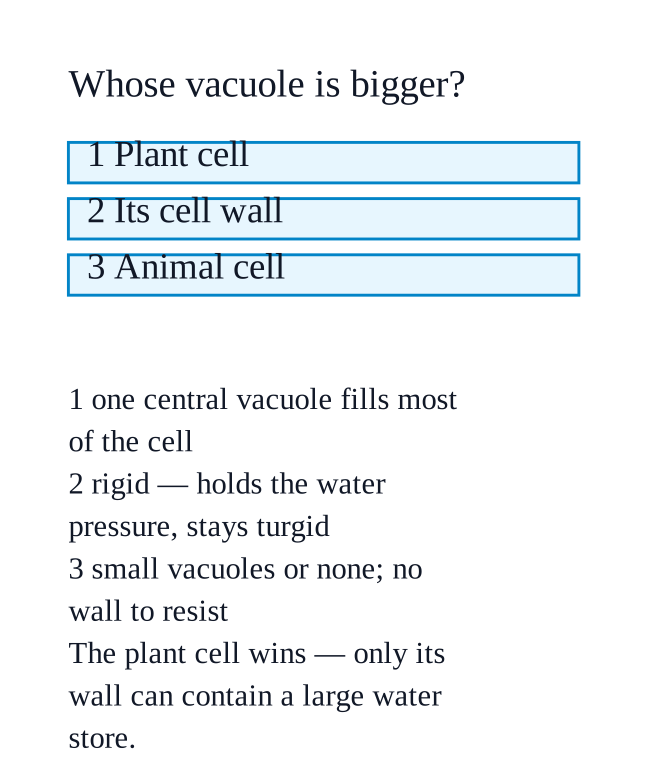
    The plant cell.
    A mature plant cell keeps one large central vacuole that occupies most of the cell's volume and stores cell sap, water and food.
    Filled with water, the vacuole presses outwards and keeps the cell turgid — this is how a non-woody plant part stays firm and upright — and the rigid cell wall can withstand that pressure without the cell bursting.
    An animal cell has no cell wall, only a flexible membrane. A large water-filled vacuole would push it out of shape or burst it, so animal cells have small vacuoles or none at all.
    There is a functional reason as well: a plant cannot move to fetch food or walk away from its wastes, so it needs a large internal store; an animal ingests food and removes wastes continuously and does not.
    (ii) Assumptions being made
    That both cells are mature, differentiated cells. Chapter $\displaystyle 3$ states that vacuoles are generally absent in meristematic cells — so if the plant cell were a dividing meristematic cell, it would have little or no vacuole and the answer could flip.
    That the plant cell is a living cell such as parenchyma, not a dead sclerenchyma cell or an empty xylem vessel, which have no cell contents to speak of.
    That both cells are normally hydrated; a wilted plant cell has a shrunken vacuole.
    That "same size" means the same total cell volume, so the question is really about how that volume is divided between vacuole and cytoplasm.
    That the animal cell is an ordinary body cell and not a specialised secretory or fat-storing cell.
  5. Exercise 3.15

    A textbook states, “Each plant tissue performs only one specific function”. What questions would you ask to critically examine the correctness of this statement? What examples of tissues would you take to find out the answers to these questions?

    Not cross-checked

    NCERT prints no numerical answer for this exercise, so this working has not been cross-checked against the book.

    The statement is incorrect: most plant tissues perform several functions, and many single functions need more than one tissue.
    NCERT_Solution_Class9_Science_Ch3_RRR_Q3-15
    Questions worth asking to test it:
    "Can a single named tissue be shown doing two clearly different jobs?"
    "Does the chapter's own description of any one tissue already list more than one function?"
    "Does the same tissue do the same job in every organ — root, stem, leaf — and in every habitat?"
    "Can any one function be completed by one tissue acting alone, or does it need partners?"
    "Can a tissue's function change over the plant's life, or is it fixed once and for all?"
    Tissues to test the questions on:
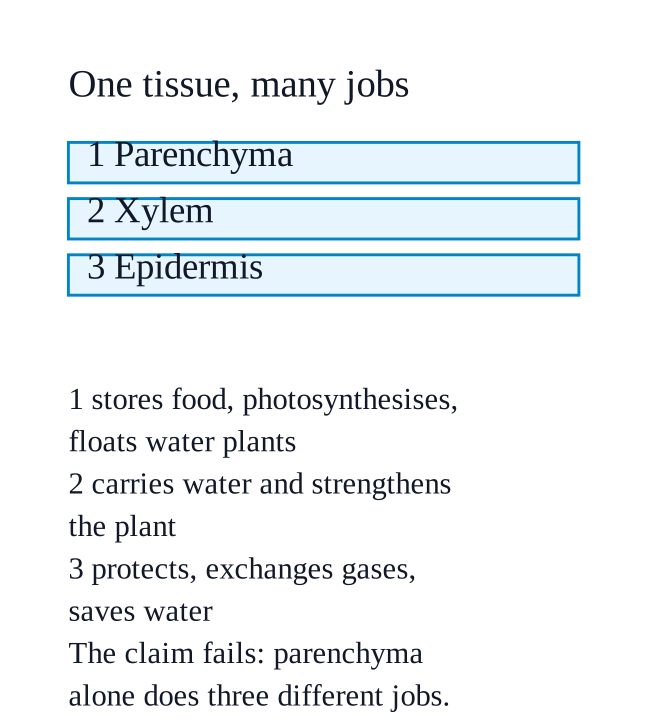
    Parenchyma — mainly stores food, but also performs photosynthesis in the green parts of the plant, and in aquatic plants forms the air spaces that help them float. One tissue, three functions.
    Xylem — transports water and minerals from the roots upward and provides strength to the plant; the chapter states both in the same paragraph.
    Epidermis — protects against mechanical injury, water loss, harmful microorganisms and extreme conditions; its stomata carry out gaseous exchange, transpiration and elimination of wastes; its root hairs increase surface area for absorbing water and minerals. Protection, exchange, transport and absorption from one tissue.
    Phloem — sieve tubes conduct food, phloem parenchyma stores food, resin, tannins and latex, and phloem fibres provide strength.
    Sclerenchyma — gives mechanical strength in stems and leaf veins and forms the hard protective coverings of seeds and nuts.
    Testing the other direction — lifting water to the top of a tall tree needs the xylem (the pipe), the root epidermis with its root hairs (absorption) and the leaf epidermis with its stomata (the transpiration pull). Three tissues, one function.
    A tissue that changed its role — in F. C. Steward's experiment the phloem cells of carrot dedifferentiated, divided and redifferentiated into a whole plant, so even a specialised conducting cell is not locked to one function for ever.
    Conclusion: tissues are specialised, which is not the same as single-purpose. The chapter's own definition is that a tissue performs "a specific function" — specific means characteristic, not solitary.