Exercise 3.4
What do you think will happen if there were no stomata in the epidermis of the stem or leaves? Now think, which tissue helps you move? Which tissue enables you to sense heat or cold? Which tissue allows oxygen to enter the blood? Which tissue holds the body together so that the skin does not fall off? Many such questions can be asked but the answers lie in the diversity of animal tissues, which are specially adapted to perform different functions. It is interesting to understand how the structure of an animal tissue suits its specific function. Let us explore different kinds of animal tissues. Each tissue performs a specific function. Epithelial tissues — Structure and functions Epithelial tissue forms the outer covering of the body (skin) and also lines the internal organs, such as the mouth, lungs, blood vessels and intestine. It is composed of closely packed cells with very little space between them.
Not cross-checked
NCERT prints no numerical answer for this exercise, so this working has not been cross-checked against the book.
The plant would starve and then wilt — with no stomata there is neither gaseous exchange nor transpiration.
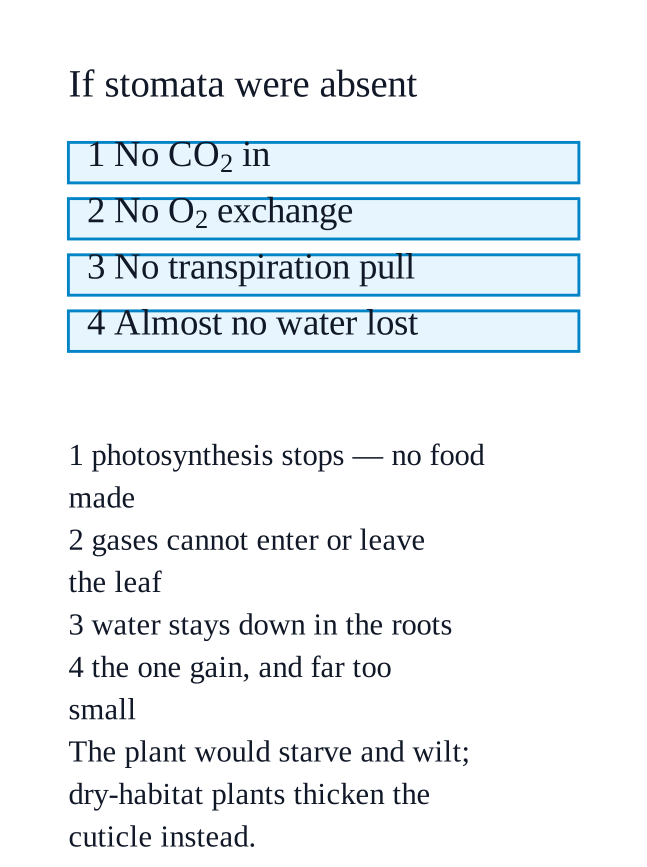
No \(\displaystyle CO_2 \) could enter the leaf, so photosynthesis would stop and the plant could not synthesise its food.
The \(\displaystyle O_2 \) produced in photosynthesis could not leave, and the \(\displaystyle O_2 \) needed for respiration could not enter through the leaf or stem surface.
With no transpiration there would be no transpiration pull, so water and minerals absorbed by the roots could not be lifted through the xylem to the top of a tall plant.
The chapter also credits transpiration with the elimination of wastes from the plant body — that route would be closed too.
The one gain would be almost no water loss, which is why plants of dry habitats reduce their exposure with a thick cuticle rather than losing stomata altogether.
On balance the loss far outweighs the gain: a plant sealed against water loss is also sealed against carbon dioxide, and it cannot feed itself.